
The Anatomy of a Strong Secondary-Connection Nexus Letter After the 2026 But-For Standard
This article focuses specifically on secondary-connection nexus letters under the 2026 Spicer framework. For a broader overview of what nexus letters are, how the VA weighs competing opinions, and when you need one, see our foundation guide: What Is a VA Nexus Letter?.
⚠️ KEW TAKEAWAY
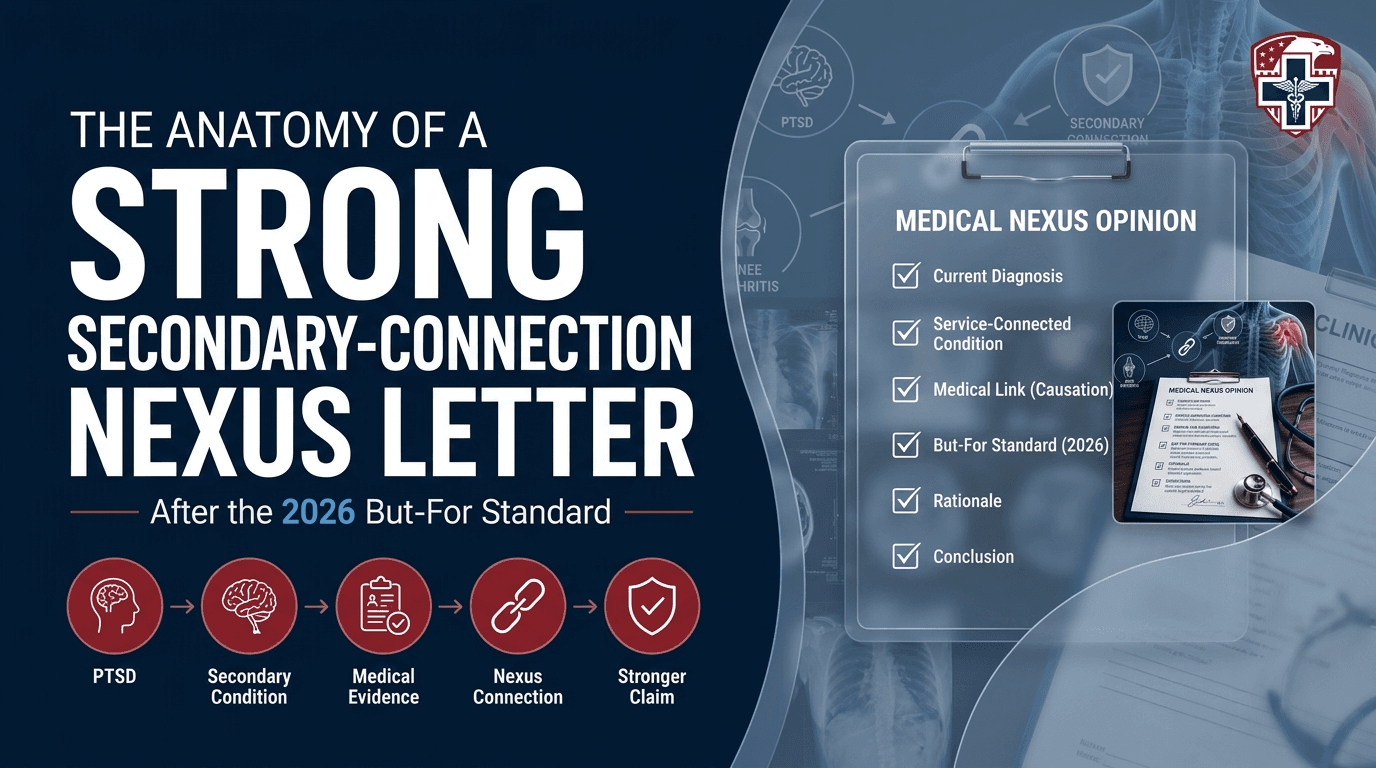
A strong secondary nexus letter after Spicer v. McDonough includes seven sections: provider qualifications, records reviewed, veteran-specific timeline, diagnosis, a nexus opinion addressing the pathway(s) the facts support, medical rationale with peer-reviewed citations, and proper signature. Your letter does not need to address all three pathways every time — only those the evidence supports.
A secondary nexus letter is a medical opinion connecting a claimed condition to an existing service-connected disability. For secondary claims — where you're arguing that one condition was caused or worsened by another — the nexus letter is often the single most important piece of evidence in the file.
The May 2026 M21-1 update, reflecting Spicer v. McDonough, 61 F.4th 1360 (Fed. Cir. 2023), changed the causation standard for secondary claims from "proximate cause" to "but-for cause." That shift means the structure, language, and reasoning in a secondary nexus letter must evolve. Here's what a strong one looks like — broken down section by section.
Why Secondary Nexus Letters Get Denied
No mechanism explained. The letter states a conclusion ("Condition B is related to Condition A") without explaining how or why. A conclusory statement without rationale is given little or no probative weight. The M21-1 instructs raters to evaluate adequacy based on whether the opinion includes a sufficient rationale.
Template language with no veteran-specific facts. The letter reads like it was written for any veteran, not this one. It doesn't reference the veteran's specific medical records, treatment history, or timeline. VA raters recognize boilerplate immediately.
Only addresses causation, ignores aggravation. Under El-Amin v. Shinseki, 26 Vet. App. 136 (2013), a medical opinion on secondary service connection is inadequate if it addresses only whether Condition A caused Condition B but fails to address whether Condition A aggravated Condition B. After Spicer, the opinion should also address treatment interference when the facts support it.
Uses the wrong standard. "More likely than not" implies greater than 50%. "Possible" implies less than 50%. The correct standard is "at least as likely as not" — a 50 percent or greater probability.
Uses proximate-cause reasoning. After Spicer, the proximate-cause standard is no longer lawful for secondary claims. A nexus letter framing the analysis as "direct and proximate cause" is applying a standard the Federal Circuit struck down.
The Seven Sections of a Strong Secondary Nexus Letter
SECTION 01
Provider Identification and Qualifications
Clearly identify who is writing the opinion — name, credentials (MD, DO, NP, PA), license type, and area of clinical expertise. VA raters consider qualifications when weighing probative value.
A letter from a psychologist addressing a cardiovascular claim, or from a chiropractor addressing a mental health condition, will face scrutiny about competence. Choosing the wrong specialty is one of the most common reasons well-documented nexus letters still get denied. For a full breakdown by specialty, see our guide: Who Should Write Your VA Nexus Letter? A Clinician's Specialty-by-Specialty Guide.
The provider should also state whether they reviewed the veteran's medical records, claims file, or other documentation. An opinion based on record review is generally given more weight than one based solely on interview — a principle reinforced in Prejean v. West, 13 Vet. App. 444 (2000).
Why it matters: An opinion from a qualified provider with matching specialty credentials, based on a thorough record review, is given the most probative weight.
SECTION 02
Records Reviewed and Evidence Considered
List the specific records: service treatment records (STRs), VA treatment records with date ranges, private medical records, C&P examination reports, imaging studies, medication lists, prior nexus letters. This demonstrates the clinician actually examined the file.
Why it matters: If the C-file contains a negative C&P opinion, the nexus letter should specifically reference and address it. Ignoring it leaves the negative opinion unrebutted.
SECTION 03
Medical History and Timeline
Narrate the relevant medical history in chronological order, specific to this veteran. When was the primary SC condition diagnosed? When did secondary symptoms begin? How has the condition progressed?
Be specific. "The veteran developed hypertension" is weak. "Medical records from March 2019 show blood pressure readings of 158/96 mmHg, a 22 mmHg systolic increase from baseline readings documented in 2016, coinciding with PTSD worsening and sertraline dose increase from 50mg to 150mg" is strong.
Why it matters: The timeline establishes temporal correlation. If the secondary condition developed or worsened after SC condition onset, that sequence supports the causal argument.
SECTION 04
Diagnosis of the Claimed Condition
Confirm the current diagnosis with ICD-10 code when applicable. For diagnoses based on clinical criteria (IBS uses Rome IV criteria), state the criteria and explain how the veteran meets them.
SECTION 05
The Nexus Opinion — Choosing the Right Pathway(s)
This is the core of the letter. After Spicer, there are three recognized pathways for secondary service connection. Your nexus letter does not need to address all three every time. The clinician should address whichever pathway or pathways the veteran's specific facts support.
Why it matters: Under El-Amin, addressing only causation while ignoring aggravation makes the opinion inadequate when the facts support both. But forcing a pathway the evidence doesn't support weakens the letter's credibility. Match the pathways to the facts.
SECTION 06
Medical Rationale With Literature Support
Explain the physiological mechanism in clear clinical language a non-medical rater can follow. Cite 3–5 peer-reviewed studies (PubMed/NCBI, JAMA, NEJM, Lancet, specialty journals) with author, journal, year, and finding description. Connect the mechanism to this veteran's specific facts. Rebut the likely counterargument.
Why it matters: A conclusory statement without rationale gets little probative weight. The mechanism, the literature, the veteran-specific facts, and the preemptive rebuttal are what give an opinion persuasive force.
SECTION 07
Signature and Attestation
Sign with full name, credentials, license number, state of licensure. Include a statement that the opinion was formed to at least a 50 percent degree of probability. Date the letter and state whether based on examination, record review, or both.
Choosing the Right Pathway for Your Claim
Important
Your nexus letter does not need to address all three pathways every time. The clinician should address whichever pathway or pathways the veteran's specific facts support. Some claims only need one. Some benefit from two. Forcing a pathway that doesn't fit the evidence weakens the letter's credibility.
Direct Secondary Causation
Use when: the SC condition created a new condition that didn't exist before
Veteran develops peripheral neuropathy caused by service-connected diabetes. The neuropathy is new diabetes caused it. Straightforward causation under § 3.310(a).
Secondary Aggravation
Use when: the secondary condition already existed, but the SC condition made it worse
Veteran had mild pre-existing hypertension before PTSD onset. After PTSD worsened, hypertension progressed to stage 2 requiring multiple medications. PTSD didn't create the hypertension — it aggravated it. The nexus letter needs a baseline and an explanation of the worsening mechanism.
Under the updated M21-1 and Ward v. Wilkie, 31 Vet. App. 233 (2019), permanent worsening is not required. When no baseline evidence exists, state that — under 38 C.F.R. §§ 3.22 and 4.22, no deduction is made. See: Do You Still Need a Baseline After Spicer?
Treatment Interference NEW UNDER SPICER
Use when: the SC condition blocked, delayed, or prevented treatment for the secondary condition
Veteran has service-connected coronary artery disease. He needs knee replacement surgery, but his cardiologist deems him too high-risk for anesthesia. The knee gets worse because surgery was unavailable. The heart condition didn't cause the arthritis — it prevented the fix. This is Spicer's actual fact pattern.
How the Pathways Interact in Practice
In many cases, one pathway is clearly the strongest and the only one worth arguing. PTSD causing GERD through SSRI medication effects is clean causation — you don't need to force aggravation or treatment interference if the facts don't support them.
In other cases, two pathways reinforce each other: PTSD both causes weight gain leading to OSA (causation chain) and prevents CPAP compliance (treatment interference). The clinician should address every pathway the facts support — but only those.
The one exception where addressing multiple pathways is strategically important: if the causation argument is strong but you anticipate the C&P examiner may disagree, including aggravation as an alternative theory gives the rater additional grounds to grant. Under El-Amin v. Shinseki, 26 Vet. App. 136 (2013), an opinion that addresses only causation and ignores aggravation may be found inadequate — so when the facts support both, addressing both protects you.
What VA Raters Actually Look At
Competence of the provider. Is this person qualified to opine on this specific condition?
Adequacy of the rationale. Does the opinion explain the "why"? Conclusory statements get little weight.
Consistency with the record. Does the opinion align with what's in the medical records?
Whether applicable theories are addressed. After El-Amin and Spicer, did the opinion address causation and aggravation and treatment interference where the facts support them?
Specificity. A letter about "PTSD and hypertension" in general is weaker than one about this veteran's PTSD, blood pressure history, and medication timeline.
Whether it addresses the C&P opinion. If a negative C&P opinion exists, does the nexus letter explain why it's inadequate?
The Five Mistakes That Kill a Secondary Nexus Letter
01 Wrong Probability Language
"It is possible" = less than 50% = denial. "At least as likely as not" is the correct standard.
02 No Baseline for Aggravation Claims
If arguing aggravation, establish what the condition looked like before worsening — or explain why a baseline can't be established. After Spicer, the baseline may not be legally required, but it remains strategically valuable. See: Do You Still Need a Baseline?
03 Ignoring the C&P Examiner's Opinion
If a negative opinion exists, address it directly — explain what it missed or where its reasoning is flawed. Silence leaves it unrebutted.
04 Citing Only Old or Irrelevant Studies
Recent studies (2015–2026) show the opinion reflects current science. Studies must directly support the specific mechanism, not just tangentially relate to the condition.
05 Forcing Pathways the Facts Don't Support
Address every pathway the evidence supports — but only those. A letter arguing treatment interference when no treatment was actually blocked damages credibility. Match the argument to the facts.
A Note on Who Should Write the Letter
Not every nexus letter provider understands the Spicer framework. Many are still writing opinions under the old proximate-cause standard. Some address only causation and ignore aggravation entirely.
A clinician writing a secondary nexus letter in 2026 should understand the but-for causation standard from Spicer, the El-Amin requirement to address applicable theories, the treatment-interference pathway, the baseline rules and what happens when no baseline exists (38 C.F.R. §§ 3.22, 4.22), the specific 38 CFR rating criteria for the claimed condition, and how to cite relevant peer-reviewed literature.
If the provider you're considering can't explain these elements, the letter they produce may not survive scrutiny. For more on choosing the right provider by specialty, see: Who Should Write Your VA Nexus Letter?
Need a Secondary Nexus Letter Under the Current Framework?
Military Disability Nexus provides clinician-written opinions built on peer-reviewed literature with the language and structure VA raters need. We address the pathways your evidence supports — causation, aggravation, treatment interference, or the combination that fits your claim.
Frequently Asked Questions
What makes a VA nexus letter strong?
Seven elements: qualified provider credentials, specific records reviewed, a veteran-specific medical timeline, a confirmed diagnosis, a nexus opinion addressing the pathways the facts support, a detailed medical rationale with peer-reviewed citations, and proper signature with attestation. After Spicer, the opinion must address the but-for causation standard.
Why do VA nexus letters get denied?
Common reasons: no mechanism explained (conclusory opinion), template language without veteran-specific facts, only addressing causation while ignoring aggravation (violating El-Amin), wrong probability language ("possible" instead of "at least as likely as not"), no peer-reviewed citations, outdated proximate-cause reasoning, and failing to address the C&P examiner's negative opinion.
Does every secondary nexus letter need all three pathways?
No. Address the pathways the facts support. Some claims only need causation. Some benefit from causation plus aggravation. Treatment interference only applies when the SC condition actually blocked or delayed treatment. Forcing a pathway the evidence doesn't support weakens the letter. When causation is strong but a negative C&P opinion is likely, adding aggravation as an alternative protects the claim under El-Amin.
What is the correct probability language?
"At least as likely as not" — meaning 50 percent or greater probability. Avoid "possible" (less than 50%, results in denial) and vague formulations like "could be related." The VA's DMA training explicitly labels hedging terms as unacceptable.
Who can write a VA nexus letter?
A physician (MD/DO), nurse practitioner (NP), or physician assistant (PA). The provider's specialty should match the condition. Specialist expertise adds probative weight. The letter carries more weight when based on record review plus examination. See: Who Should Write Your VA Nexus Letter?
Need help with your VA claim?
Get expert guidance and documentation from our licensed clinicians
Get Free ConsultationDr. Kishan Bhalani is a subject matter expert on VA disability claims documentation, with more than five years of focused work at the intersection of clinical m…
Dr. Kishan Bhalani is a subject matter expert on VA disability claims documentation, with more than five years of focused work at the intersection of clinical m…
Originally published May 29, 2026 • Last updated June 2, 2026
Related Insights
Spicer v. McDonough and the "But-For" Standard: What the May 2026 M21-1 Update Means for Your Secondary VA Claim
What Is a VA Nexus Letter? A Clinician's Anatomy of a Strong Medical Opinion
Who Should Write Your VA Nexus Letter? A Clinician's Specialty-by-Specialty Guide (2026)
About this article. This post is general educational and medical information published by the Military Disability Nexus clinical team. It is not legal advice, not individualized medical advice, and not a substitute for a personal evaluation by a licensed clinician or a consultation with an accredited representative. Reading it does not create a doctor-patient or attorney-client relationship. VA law and rating criteria change; some details may not reflect the most recent updates, and every claim is decided by the VA on its own facts – no outcome is promised or guaranteed. Military Disability Nexus is an independent medical-evidence provider and is not affiliated with, endorsed by, or acting on behalf of the U.S. Department of Veterans Affairs or any government agency. Free claims assistance is available from VA-accredited Veterans Service Organizations and county Veterans Service Officers; you can verify any representative's accreditation through the VA Office of General Counsel.