
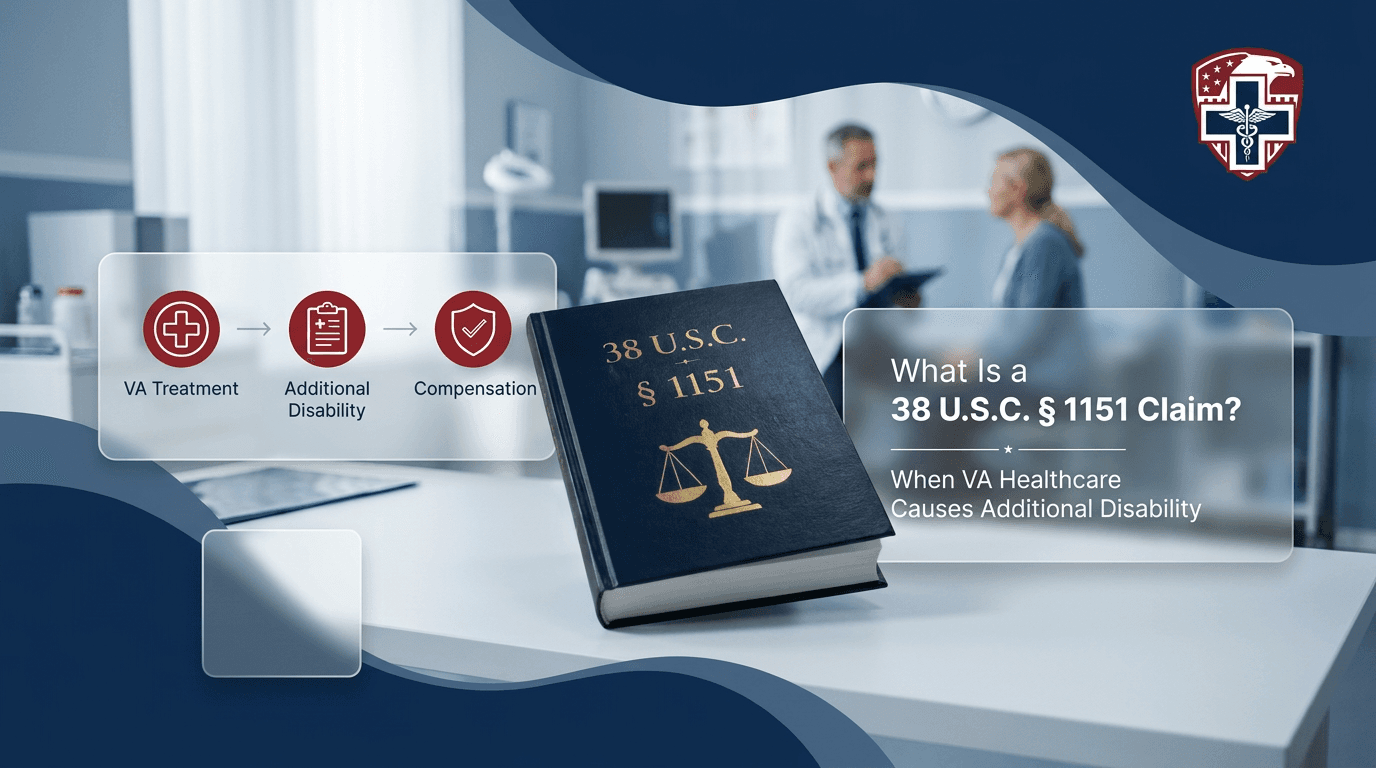
What Is a 38 U.S.C. § 1151 Claim? When VA Healthcare Causes Additional Disability
- 1.What Does § 1151 Cover?
- 2.What Qualifies as "Additional Disability" Under § 1151?
- 3.How Does an § 1151 Claim Differ from Standard Service Connection?
- 4.What Are the Two Ways to Prove Proximate Cause?
- 5.What Evidence Does a § 1151 Claim Require?
- 6.What Is the History Behind § 1151?
- 7.How Do You File an § 1151 Claim?
- 8.Frequently Asked Questions:
- 9.Concerned About an Injury From VA Care?
Key Takeaway:
A 38 U.S.C. § 1151 claim is a VA disability benefits claim that compensates veterans who suffered additional disability caused by VA hospital care, medical treatment, surgical treatment, or examination. Unlike standard service connection, it does not require a link to military service. The veteran must prove VA care caused the injury and that VA was at fault or the outcome was not reasonably foreseeable. If granted, benefits are paid as if the disability were service-connected..
What Does § 1151 Cover?
Section 1151 covers injuries caused by VA hospital care, medical or surgical treatment, VA examinations (including C&P exams), vocational rehabilitation under Chapter 31, and compensated work therapy programs. The injury must be an "additional disability" that did not exist before VA care or a measurable worsening of a pre-existing condition.
Section 1151 covers injuries caused by VA hospital care, medical or surgical treatment, VA examinations (including C&P exams), vocational rehabilitation under Chapter 31, and compensated work therapy programs. The injury must be an "additional disability" that did not exist before VA care or a measurable worsening of a pre-existing condition.
Most veterans interacting with the VA disability system are familiar with direct service connection — proving a condition began during or was caused by military service. Section 1151 addresses a different situation entirely: harm caused by the VA's own medical system after service.
Under 38 U.S.C. § 1151(a), compensation is awarded "as if such additional disability or death were service-connected" when VA care caused the disability and the injury was not the result of the veteran's willful misconduct. According to Dr. Kishan Bhalani, MD, MBA, who reviews § 1151 medical opinions at Military Disability Nexus: "The critical difference between a standard service-connection claim and an 1151 claim is the origin of the injury. In a standard claim, the injury traces to military service. In an 1151 claim, it traces to VA healthcare."
What Qualifies as "Additional Disability" Under § 1151?
Under 38 C.F.R. § 3.361(b), "additional disability" means a new condition that did not exist before VA care began, or a measurable worsening of a pre-existing condition. The VA compares the veteran's condition immediately before treatment to their condition after treatment, evaluating each body system separately.
The concept covers both entirely new injuries and aggravation of existing conditions. A veteran with mild, controlled hypertension who receives a VA-prescribed medication that causes severe, uncontrolled hypertension has an "additional disability" — the worsening from mild to severe.
Common Scenarios That Produce Additional Disability
Surgical injury: A nerve severed during VA knee replacement surgery causes permanent foot drop that did not exist before the procedure.
Medication error: An incorrect blood thinner dosage prescribed by a VA provider causes a hemorrhagic stroke.
Diagnostic delay: A VA emergency physician misreads imaging and discharges a veteran having a stroke. By the time the stroke is correctly identified days later, permanent cognitive deficits result that early intervention could have prevented.
Hospital-acquired infection: Inadequate sterile technique during catheter placement leads to a systemic infection and kidney damage.
9.2%OF Hospitalized patients experience an adverse event during admission, with 43.5% of those events deemed preventable, according to a systematic review of 74,485 patient recordS.
de Vries EN, Ramrattan MA, Smorenburg SM, et al. Qual Saf Health Care. 2008;17(3):216-223. doi:10.1136/qshc.2007.023622
How Does an § 1151 Claim Differ from Standard Service Connection?
A standard service-connection claim requires three elements: a current diagnosis, an in-service event, and a medical nexus linking them. An § 1151 claim replaces the in-service event with a VA treatment event and adds a fault-or-unforeseeability requirement. The injury does not need any connection to military service.
In a standard claim, the framework is anchored to the veteran's time in uniform. In an § 1151 claim, the framework is anchored to the VA's medical care. The four required elements are: (1) the veteran received VA care, (2) the care caused an additional disability, (3) the proximate cause was VA fault or an event not reasonably foreseeable, and (4) the injury was not caused by the veteran's willful misconduct.
If an § 1151 claim is granted, the disability is treated as if service-connected for payment purposes only. The veteran receives the same monthly compensation rate and may qualify for ancillary benefits including special monthly compensation, Chapter 21 housing grants, and Chapter 39 adaptive equipment.
What Are the Two Ways to Prove Proximate Cause?
The statute provides two alternative pathways: (1) VA fault — showing the VA failed to exercise the degree of care expected of a reasonable healthcare provider under 38 C.F.R. § 3.361(d)(1)(i), or failed to obtain informed consent under § 3.361(d)(1)(ii); or (2) an event not reasonably foreseeable under § 3.361(d)(2), meaning the adverse outcome was not an ordinary risk a competent provider would have anticipated.
The fault pathway uses an objective "reasonable provider" standard. It does not require malice or gross negligence — only evidence that the provider's conduct fell below what a competent practitioner would have done in the same clinical situation.
The informed consent pathway applies when the VA performed a procedure without adequately disclosing risks under 38 C.F.R. § 17.32. If a known risk materialized that the veteran was never warned about, and the veteran would not have consented had they been informed, this provides an independent basis for the claim.
The "not reasonably foreseeable" pathway applies when the VA acted without fault, but the outcome was not an ordinary risk of the treatment. The event need not be completely unimaginable — but it must be one a reasonable provider would not have considered an expected consequence.
What Evidence Does a § 1151 Claim Require?
A successful § 1151 claim requires: pre-treatment medical records establishing baseline, VA treatment records documenting the care at issue, post-treatment records showing the new or worsened condition, a medical nexus opinion explaining causation and fault, lay statements describing the change in condition, and informed consent documentation from the VA facility.
The evidentiary standard is preponderance of the evidence, and the benefit-of-the-doubt rule under 38 U.S.C. § 5107(b) applies. The most critical piece of evidence is typically the medical nexus opinion. This opinion must explain the causal mechanism — not just that the problem followed the treatment, but why the treatment caused the outcome.
Causation vs Correlation:
One of the most common reasons § 1151 claims fail is the absence of a credible medical opinion linking VA care to the additional disability. A temporal relationship (the problem started after the treatment) is not the same as a causal relationship. The opinion must explain the pathophysiological chain.
The VA will obtain its own medical advisory opinion when processing an § 1151 claim. Veterans should anticipate that this opinion may conclude the standard of care was met. Submitting an independent medical opinion from a qualified clinician is often the decisive factor in overcoming a denial.
What Is the History Behind § 1151?
In Brown v. Gardner, 513 U.S. 115 (1994), the Supreme Court struck down the VA's regulation requiring fault, ruling the statute's plain text did not contain that requirement at the time. Congress then amended § 1151 effective October 1, 1997, to explicitly add the fault-or-unforeseeability standard that exists today. Claims filed on or after that date must satisfy the current standard.
How Do You File an § 1151 Claim?
Veterans file using VA Form 21-526EZ (Application for Disability Compensation) and include a statement identifying the VA care that caused the injury. There is no statute of limitations, but the effective date of benefits is tied to the date the VA receives the claim under 38 C.F.R. § 3.400(i). Filing promptly preserves retroactive compensation.
Frequently Asked Questions:
Can I file an § 1151 claim if I already have service-connected disabilities?
Yes. An § 1151 claim is independent of existing service-connected conditions. If granted, the disability is added to your combined rating. The payments stack with no offset.
Is there a deadline to file an § 1151 claim?
There is no statute of limitations. However, the effective date of benefits is tied to the date the VA receives the claim under 38 C.F.R. § 3.400(i). Delaying your filing costs retroactive compensation.
What is the difference between an § 1151 claim and a medical malpractice lawsuit?
An § 1151 claim awards monthly VA disability compensation. A malpractice lawsuit under the FTCA is filed in federal court and can recover lump-sum damages including pain and suffering. Both can be pursued, but offset rules under § 1151(b) prevent double recovery.
Do I need a medical expert opinion for an § 1151 claim?
In most cases, yes. The VA obtains its own advisory opinion. An independent medical opinion explaining causation and the standard-of-care breach is often the decisive factor in overcoming a denial.
Concerned About an Injury From VA Care?
A clinician-authored medical opinion can document additional disability, establish causation, and address the standard of care. A Claim Readiness Review identifies what evidence your § 1151 case needs.
Need help with your VA claim?
Get expert guidance and documentation from our licensed clinicians
Get Free ConsultationDr. Kishan Bhalani is a subject matter expert on VA disability claims documentation, with more than five years of focused work at the intersection of clinical m…
Dr. Kishan Bhalani is a subject matter expert on VA disability claims documentation, with more than five years of focused work at the intersection of clinical m…
Originally published May 6, 2026 • Last updated May 6, 2026
Related Insights
1151 Claim Statute of Limitations: Is There a Deadline to File?
VA Form 21-526EZ Is Shrinking to 5 Pages: What Changes, and What Doesn't
TBI Secondary Conditions Under 38 CFR 3.310(d): What the Rule Actually Says
About this article. This post is general educational and medical information published by the Military Disability Nexus clinical team. It is not legal advice, not individualized medical advice, and not a substitute for a personal evaluation by a licensed clinician or a consultation with an accredited representative. Reading it does not create a doctor-patient or attorney-client relationship. VA law and rating criteria change; some details may not reflect the most recent updates, and every claim is decided by the VA on its own facts – no outcome is promised or guaranteed. Military Disability Nexus is an independent medical-evidence provider and is not affiliated with, endorsed by, or acting on behalf of the U.S. Department of Veterans Affairs or any government agency. Free claims assistance is available from VA-accredited Veterans Service Organizations and county Veterans Service Officers; you can verify any representative's accreditation through the VA Office of General Counsel.