
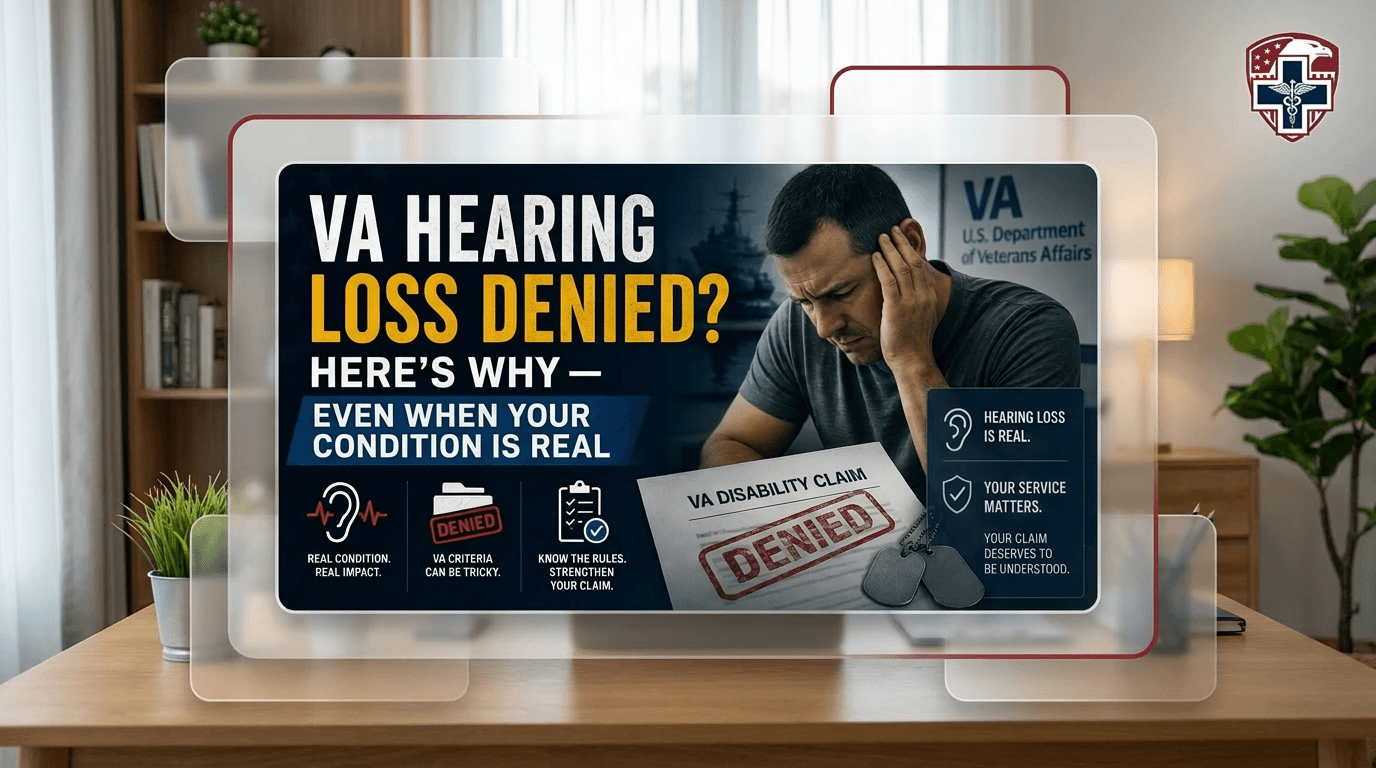
VA Hearing Loss Denied? Here's Why - Even When Your Condition Is Real
- 1.Why the VA Denies Hearing Loss Claims
- 2.What the VA Actually Requires: 38 CFR §3.385 in Plain English
- 3.What Is the Maryland CNC Test — And Why It Matters
- 4.Tinnitus vs. Hearing Loss: Why One Gets Approved and the Other Doesn't
- 5.Common Mistakes Veterans Make During C&P Exams
- 6.Why a Nexus Letter Alone Cannot Fix This
- 7.Post-Service Noise Exposure: The Factor That Sinks Claims
- 8.Real - World Scenario: When a Claim Goes Wrong
- 9.What You Should Do Next
- 10.Frequently Asked Questions
KEY TAKEAWAYS
The VA uses a strict legal standard (38 CFR §3.385) that many veterans don't know about until after they're denied.
Your hearing loss must hit specific audiometric thresholds or speech recognition scores — not just "bad hearing."
The Maryland CNC test is the only speech discrimination test the VA accepts — and many veterans don't even realize it was administered.
Tinnitus and hearing loss are rated differently, which is why tinnitus is often approved while hearing loss is denied.
A nexus letter cannot override audiometric results that don't meet 38 CFR §3.385 criteria.
C&P exam mistakes - including bad testing environments and inconsistent effort — are more common than most veterans think.
You spent years on the flight line, in the engine room, or near artillery fire. You asked people to repeat themselves long before you filed a claim. Your spouse noticed. Your coworkers noticed. You noticed.
Then the VA's decision letter arrived: "Service connection for hearing loss is denied."
You're not imagining things. Your hearing loss is real. But the VA doesn't rate hearing loss based on how it feels. They rate it based on specific numbers from specific tests - and if those numbers don't hit specific legal thresholds, the answer is no.
This article explains exactly why that happens, what the VA is actually looking for, and what you can realistically do about it. No sugarcoating. No false promises. Just the information you need to understand what went wrong and how to move forward.
Why the VA Denies Hearing Loss Claims
Hearing loss is one of the most common conditions among veterans — but it's also one of the most commonly denied or underrated. That seems contradictory, but it makes sense once you understand how the VA evaluates hearing.
Here are the primary reasons claims get denied:
1. Your Audiometric Results Don't Meet the Legal Threshold
This is the number-one reason. The VA doesn't use your civilian doctor's opinion or your subjective experience to determine whether hearing loss is a "disability" for VA purposes. They use numbers from an audiogram — and those numbers must meet the criteria set by 38 CFR §3.385. If they don't, it doesn't matter how bad your hearing feels. The claim gets denied.
2. No Service Connection Established
Even if your hearing loss qualifies as a disability, the VA still needs evidence linking it to your military service. If your separation exam showed normal hearing and there's nothing in your service treatment records, the VA may deny the connection — especially if they attribute the loss to aging or post-service occupational noise.
3. The C&P Examiner Gave a Negative Opinion
VA raters lean heavily on the C&P examiner's opinion. If the examiner wrote that your hearing loss is "less likely than not" related to service, that opinion carries enormous weight — even if it's poorly reasoned or ignores evidence in your file. Many veterans are stunned to learn that one examiner's sentence can override years of documented noise exposure.
4. Inconsistent or Invalid Test Results
C&P examiners sometimes flag tests as "unreliable" or "inconsistent." This can happen if your responses during the puretone test don't match your speech recognition scores, or if the examiner suspects poor effort. Once test results are marked unreliable, the VA has grounds to deny the claim entirely.
5. Hearing Loss Is Present But Rated at 0%.
This one catches many veterans off guard. The VA may grant service connection for hearing loss but assign a 0% rating. That means you don't receive monthly compensation. The rating is calculated mechanically from your audiogram using VA tables — and most veterans with mild to moderate hearing loss end up at 0%. It's a frustrating result that feels like a denial, even though it technically isn't.
What the VA Actually Requires: 38 CFR §3.385 in Plain English
If you've been denied, you need to understand this regulation. It's the legal definition of what counts as a hearing loss "disability" for VA purposes.
38 CFR §3.385 — The Three Ways to Qualify
Under this regulation, impaired hearing is considered a disability when any one of the following is true:
Single high threshold: The auditory threshold at any one frequency (500, 1000, 2000, 3000, or 4000 Hz) is 40 decibels or higher.
Multiple elevated thresholds: At least three of those five frequencies show thresholds of 26 decibels or higher.
Poor speech recognition: Your speech recognition score on the Maryland CNC test is below 94%.
Here's the critical thing most veterans miss: you only need to meet one of these three criteria. But if your audiogram doesn't meet any of them, the VA does not consider you to have a hearing loss disability - regardless of how your hearing actually affects your daily life.
That means a veteran who scores 94% on the Maryland CNC and has puretone thresholds of 25 dB across the board technically does not have a VA-recognized hearing disability. It doesn't matter if they struggle in crowded rooms, can't hear their grandchildren, or served on the deck of an aircraft carrier for six years.
This is the gap between clinical reality and VA regulatory criteria. And it's the single biggest source of frustration for veterans filing hearing loss claims.
What Is the Maryland CNC Test — And Why It Matters
The Maryland CNC (Consonant-Nucleus-Consonant) test is a specific word recognition test used exclusively by the VA to measure speech discrimination. It is the only speech recognition test the VA accepts for rating purposes — no exceptions.
How It Works
During a C&P hearing exam, the audiologist reads you a list of 50 monosyllabic words from the Maryland CNC word list. You repeat each word back. The examiner scores how many you got right as a percentage.
The test is conducted in a sound-controlled environment (typically a sound booth), without hearing aids, at a specific presentation level tied to your speech reception threshold.
Why It Matters for Your Claim
Your Maryland CNC score directly affects two things:
Whether you meet the disability threshold: A score below 94% qualifies you under 38 CFR §3.385, even if your puretone thresholds are normal.
Your rating percentage: The VA uses your CNC score and puretone threshold average together in Table VI (under 38 CFR §4.85) to assign a Roman numeral to each ear. Those Roman numerals determine your overall disability rating through Table VII.
Common Veteran Concern
Many veterans say the Maryland CNC test doesn't reflect real-world hearing ability. The test uses single words in a quiet booth - not conversation in a noisy restaurant or a busy grocery store. A veteran can score 96% in a quiet room and still not understand half of what's said at a family dinner. The VA knows this. But the regulation doesn't account for it. The test is what the test is.
What If They Didn't Use the Maryland CNC?
If your C&P exam used a different word recognition test such as the NU-6 (Northwestern University Auditory Test No. 6), the results may not be valid for VA rating purposes. The regulation at 38 CFR §4.85 specifically requires the Maryland CNC test. If your exam used something else, you may have grounds to request a new exam.
Tinnitus vs. Hearing Loss: Why One Gets Approved and the Other Doesn't
This is one of the most confusing parts of the VA claims process. Veterans often file for both tinnitus and hearing loss at the same time — and get approved for tinnitus but denied for hearing loss. That feels wrong. But here's why it happens.
Tinnitus Is Subjective
Tinnitus — the ringing, buzzing, or hissing in your ears — is rated based largely on your self-report. If you tell the VA you experience persistent ringing and your military occupation involved noise exposure, the VA generally grants service connection. Tinnitus is rated at a flat 10% under 38 CFR §4.87, and it's the most commonly service-connected disability among veterans for a reason: the barrier to approval is relatively low.
Hearing Loss Is Objective
Hearing loss, by contrast, must be proven with specific test results. The VA doesn't take your word for it. They need numbers — puretone thresholds and Maryland CNC scores — that meet 38 CFR §3.385. Your experience of not hearing well is relevant for establishing that you have a condition, but it's not what determines the rating.
This is why many veterans walk out of the VA process with a 10% rating for tinnitus and a 0% (or outright denial) for hearing loss. The conditions are related, but the VA evaluates them through completely different lenses.
If you've been approved for tinnitus but denied for hearing loss, that doesn't mean your hearing claim is hopeless. It does mean the audiometric evidence didn't support a compensable rating under the current criteria. The question becomes: were the test results accurate?
Common Mistakes Veterans Make During C&P Exams
The C&P exam for hearing loss is one of the most consequential 30 minutes in the entire claims process. And too many veterans walk in unprepared.
MISTAKE #01
Not Understanding What the Exam Actually Measures
Many veterans expect the audiologist to ask about their hearing difficulties, military noise exposure, and daily struggles. That's not really the examiner's job. Their job is to measure your hearing using standardized tests and provide an opinion on service connection. If you don't understand that going in, you'll be confused by how mechanical the process feels.
MISTAKE #02
Inconsistent Effort During the Puretone Test
The puretone test requires you to respond every time you hear a tone — even if it's very faint. Some veterans second-guess themselves and don't respond to soft tones they aren't sure about. Others try to "prove" their hearing loss by exaggerating responses. Both behaviors can cause the examiner to flag results as unreliable, which hurts the claim.
The best approach: Respond honestly, every single time you think you hear a sound. Don't try to help your case. Don't overthink it. Just respond to what you hear.
MISTAKE #03
Assuming the Exam Environment Is Always Ideal
VA exams should be conducted in a sound-isolated environment using calibrated equipment. But not every VA facility has ideal conditions. If there was noticeable background noise, equipment issues, or other problems during your exam, those factors could have affected your results — and you should document it.
MISTAKE #04
Not Reviewing the C&P Exam Report
After your exam, the report goes into your VA file. Many veterans never read it. That's a mistake. The examiner's notes, the audiogram results, and especially the medical opinion are all in that report. If the opinion is wrong, poorly supported, or ignores your noise exposure history, you need to know — because that's what you're going to challenge on appeal.
MISTAKE #05
Not Mentioning Functional Impact
While the rating is based on numbers, the VA is also supposed to consider how hearing loss affects your daily activities and occupational functioning. If you didn't describe how your hearing loss impacts your life during the exam, the report will be silent on that point. Make sure you mention specific examples: difficulty on phone calls, need for closed captioning, problems hearing at work.
Why a Nexus Letter Alone Cannot Fix This
Let's be honest about something most claims services won't tell you: a nexus letter is not a magic bullet for hearing loss claims.
A nexus letter is a medical opinion stating that your condition is "at least as likely as not" related to your military service. It's powerful evidence for establishing service connection. If the VA denied your claim because they said your hearing loss isn't related to service, a strong nexus letter for hearing loss can absolutely change that outcome.
But here's where veterans get misled: a nexus letter cannot change your audiometric test results.
If your puretone thresholds don't meet 38 CFR §3.385 and your Maryland CNC score is 94% or higher, no medical opinion in the world will create a VA-recognized hearing disability where the numbers say one doesn't exist. The regulation is mechanical. The doctor's letter can't override the audiogram.
When a Nexus Letter DOES Help
When the VA denied service connection despite conceded noise exposure
When the C&P examiner gave a negative opinion that ignored relevant evidence
When you need to establish that hearing loss is secondary to another service-connected condition
When you're filing a nexus letter for tinnitus to support a secondary hearing loss claim.
⚠️ When a Nexus Letter WON'T Help
When your audiometric results simply don't meet the threshold under 38 CFR §3.385
When the issue is a 0% rating (which is a rating problem, not a service connection problem)
When your C&P exam was flagged as having unreliable results
Any service that tells you a nexus letter will fix a hearing loss denial without first reviewing your actual audiogram is either uninformed or not being straight with you. At Military Disability Nexus, we review the audiometric evidence first. If a nexus letter won't help your specific situation, we'll tell you — and explain what will.
Post-Service Noise Exposure: The Factor That Sinks Claims
Here's something that catches many veterans off guard: the VA doesn't just look at your military noise exposure. They also look at what happened after you took off the uniform. And if the C&P examiner believes your post-service noise exposure is the more likely cause of your hearing loss, your claim is dead on arrival — even with conceded in-service noise.
This is one of the most common reasons C&P examiners write negative nexus opinions. The examiner's report will say something like: "The veteran's current hearing loss is less likely than not caused by military service and is more consistent with post-service occupational noise exposure and/or the natural aging process." That one sentence can override decades of military noise exposure.
What Counts as Post-Service Noise Exposure
The VA considers any significant noise exposure after separation, including:
Occupational noise: Construction, manufacturing, factory work, trucking, law enforcement, firefighting, mining, farming, or any trade involving heavy machinery, power tools, or loud equipment.
Recreational noise: Hunting, shooting sports, motorcycle riding, power tools for home use, attending concerts, motorsports, or operating lawn equipment without hearing protection.
Duration and protection: The examiner will consider how many years you were exposed, and whether hearing protection was used.
If you worked in construction for 20 years after leaving the Army, the VA has a ready-made alternative explanation for your hearing loss. That doesn't mean your military noise didn't cause it — but you now have a much harder burden to meet.
Why This Matters for Nexus Letters
A competent nexus letter for hearing loss must directly address and rule out post-service noise exposure as the primary cause. This is not optional. If the nexus letter ignores this issue, the VA will give it very little weight — because the C&P examiner almost certainly won't ignore it.
A strong nexus letter for hearing loss should:
Acknowledge the veteran's full noise exposure history — both military and post-service
Explain why the type, pattern, and onset of hearing loss is more consistent with military noise-induced damage than with aging or occupational exposure
Reference the audiometric configuration — noise-induced hearing loss typically shows a characteristic "notch" at 4000 Hz that differs from age-related presbycusis
Address the timeline: did hearing symptoms begin during or shortly after service, even if they weren't documented until later?
Cite relevant medical literature on the latency of noise-induced hearing loss and the fact that noise damage to inner ear hair cells is cumulative and permanent
Differentiate between the veteran's military noise environment (sustained, high-decibel, often without adequate hearing protection) and post-service exposure (where hearing protection may have been required by OSHA standards)
Rule Out is Not Optional
VA raters are trained to weigh medical opinions based on their reasoning. A nexus letter that says "the veteran's hearing loss is due to service" without addressing post-service noise is an incomplete opinion — and VA raters know it. The examiner who wrote the negative opinion almost certainly addressed post-service exposure. Your nexus letter needs to directly counter that reasoning with specific, evidence-based arguments. A one-paragraph form letter won't do it.
This is also why it matters who writes your nexus letter. A provider who has never reviewed VA claims may not understand that post-service noise exposure is the single most common basis for negative C&P opinions on hearing loss. At Military Disability Nexus, our medical providers address post-service noise exposure head-on in every hearing loss opinion — because we know that's exactly where the VA will challenge the claim.
Real - World Scenario: When a Claim Goes Wrong
Background: A Navy veteran who served 8 years in deck operations — catapult crew on an aircraft carrier — files for bilateral hearing loss and tinnitus. His MOS has a high probability of noise exposure. He's been wearing hearing aids from the VA for three years.
C&P Exam Results: Puretone thresholds: Right ear — 25, 25, 30, 35, 40 dB at 500–4000 Hz. Left ear — 20, 25, 25, 30, 35 dB. Maryland CNC: Right ear 94%, Left ear 96%
VA Decision: Tinnitus — granted at 10%. Hearing loss — denied.
Why? The right ear barely meets 38 CFR §3.385 (one threshold at 40 dB), but the left ear does not (no threshold at 40+ dB, only two frequencies at 26+ dB instead of the required three). And both CNC scores are at or above 94%. Under the VA's mechanical rating system, even with the right ear qualifying, the combined rating from Table VII produces a 0% — non-compensable.
The Frustration: This veteran can't hear conversations in a room with any background noise. He wears hearing aids daily. Yet the VA says he doesn't meet the criteria for a compensable rating. He's not wrong to be angry. But a nexus letter wouldn't have changed this outcome. What might help: requesting a new C&P exam, ensuring the testing environment was proper, or obtaining a medical opinion review to challenge the adequacy of the original exam.
What You Should Do Next
If your VA hearing loss claim was denied, here's a realistic action plan — not wishful thinking, not a sales pitch. These are the steps that actually matter.
Step 1: Get Your C&P Exam Report and Audiogram
Request your complete C&P exam through your VA.gov account or by calling your regional office. Read every word. Look at the puretone thresholds, the Maryland CNC scores, and — critically — the examiner's medical opinion and rationale.
Step 2: Check Your Numbers Against 38 CFR §3.385
Use the three criteria described earlier in this article. Does at least one ear meet the threshold? If not, a nexus letter alone won't help. If yes, the issue may be service connection or the examiner's opinion — and those are fixable.
Step 3: Evaluate Whether the Exam Was Adequate
Ask yourself: Was the test done in a proper sound booth? Did the examiner review your full service record and noise exposure history? Was the Maryland CNC test actually administered? If any of these elements were missing or deficient, you may have grounds to request a new exam or submit a C&P exam rebuttal.
Step 4: Gather Supporting Evidence
Buddy statements from fellow service members who can attest to your noise exposure are valuable. Personal statements describing when you first noticed hearing problems and how they've progressed over time also help. If you had private audiograms or workplace hearing tests showing a decline, include those.
Step 5: Decide on Your Appeal Path
Supplemental Claim: Best if you have new evidence (a private audiogram, nexus letter, or buddy statements) not previously in your file.
Higher-Level Review: Best if you believe the VA made an error with existing evidence — no new evidence allowed.
Board of Veterans' Appeals: The most thorough option. A Veterans Law Judge reviews your full case. You can submit new evidence and request a hearing.
Step 6: Consider a Professional Review
Before spending money on a nexus letter, have someone qualified review your audiometric evidence and denial letter. If the numbers don't support the claim, you need a different strategy — not a letter. If the numbers are borderline or the examiner's opinion was weak, a well-crafted medical opinion from a provider who understands VA criteria can make a decisive difference.
Frequently Asked Questions
Can the VA deny hearing loss if I have a diagnosis from my doctor?
Yes. A private diagnosis of hearing loss does not automatically qualify you for VA disability. The VA uses its own criteria under 38 CFR §3.385, which requires your audiometric test results to meet specific thresholds. If your puretone thresholds and Maryland CNC scores don't meet those criteria, the VA will deny the claim regardless of your private diagnosis.
What is a passing score on the Maryland CNC test for VA purposes?
There isn't a "passing" score in the traditional sense. However, if your Maryland CNC speech recognition score is below 94%, your hearing qualifies as a disability under 38 CFR §3.385. A score of 94% or higher means this particular criterion is not met — though you may still qualify through puretone threshold criteria.
Why was my tinnitus approved but my hearing loss denied?
Tinnitus is rated based on subjective symptoms (your report of ringing or buzzing in the ears) and has a flat 10% maximum rating. Hearing loss requires objective audiometric test results that meet strict legal thresholds. Many veterans have real hearing difficulties that don't reach the VA's numerical criteria, so tinnitus is approved while hearing loss is not.
Can a nexus letter overturn a hearing loss denial?
It depends on why you were denied. If the denial was because the VA said your hearing loss isn't service-connected, a strong nexus letter from a qualified provider can help overturn that decision. However, if the denial was because your audiometric results don't meet 38 CFR §3.385 criteria, a nexus letter alone won't change the outcome — you'd need new test results that meet the threshold.
What should I do before, during, and after a C&P hearing exam?
Before: Write down your noise exposure history (specific duties, weapons, aircraft, vehicles, equipment) and how hearing loss affects your daily life — difficulty on phone calls, needing closed captions, asking people to repeat themselves. Bring this list.
During: The audiologist will give you specific instructions for each test — follow those instructions exactly. For the puretone test, respond every time you think you hear a tone, even faint ones. Don't try to "prove" your hearing loss by waiting for louder sounds — inconsistent responses get flagged as unreliable and hurt your claim. For the Maryland CNC word test, simply repeat each word as best you can. When the examiner asks about your history, describe your noise exposure in detail and be honest about any post-service noise exposure (hiding it backfires — see our section on post-service noise). Tell them specifically how hearing loss impacts your work and relationships.
After: Request your full C&P exam report through VA.gov and review the audiogram results, the examiner's rationale, and especially whether they accurately recorded your noise exposure history. Errors in the report are common and can be challenged..
Can hearing loss that develops years after service still be service-connected?
Yes — but it's harder, and you'll need strong evidence. The landmark case Hensley v. Brown (1993) established that 38 CFR §3.385 does not require hearing loss to be present at separation from service. Even if your audiogram was normal when you left the military, you can still establish service connection for hearing loss that develops years — even decades — later. However, the longer the gap between service and diagnosis, the more the VA will scrutinize alternative causes, especially aging (presbycusis) and post-service occupational or recreational noise exposure. To succeed, you'll typically need a strong nexus letter from a qualified medical provider who can explain why your current hearing loss pattern is consistent with noise-induced damage from service rather than other causes, along with evidence of in-service noise exposure (MOS records, buddy statements) and documentation of when symptoms first appeared. If your hearing loss now meets 38 CFR §3.385 criteria, you can file a new claim or supplemental claim with updated audiometric evidence and a nexus opinion that directly addresses the time gap and rules out post-service noise exposure.
Does the VA accept private audiograms for hearing loss claims?
The VA will consider private audiograms, but the exam must include both a puretone audiometry test and a Maryland CNC speech discrimination test conducted by a state-licensed audiologist. If your private audiogram used a different speech recognition test or wasn't performed by a licensed audiologist, the VA may not accept it for rating purposes.
Before You Spend a Dollar on a Nexus Letter — Check Your Numbers First
We've seen too many veterans pay for nexus letters that were never going to help their specific situation. That's not how we operate. At Military Disability Nexus, we review your audiometric evidence and denial letter before recommending any course of action. If a nexus letter isn't the right move for your case, we'll tell you — and point you in the right direction.
Guidance first. Always.
Need help with your VA claim?
Get expert guidance and documentation from our licensed clinicians
Get Free ConsultationDr. Kishan Bhalani is a subject matter expert on VA disability claims documentation, with more than five years of focused work at the intersection of clinical m…
Dr. Kishan Bhalani is a subject matter expert on VA disability claims documentation, with more than five years of focused work at the intersection of clinical m…
Originally published May 4, 2026 • Last updated May 5, 2026
Related Insights
What Is a VA Nexus Letter? A Clinician's Anatomy of a Strong Medical Opinion
Who Should Write Your VA Nexus Letter? A Clinician's Specialty-by-Specialty Guide (2026)
Can PTSD Cause Migraines? The Clinical Case for Migraines Secondary to PTSD
About this article. This post is general educational and medical information published by the Military Disability Nexus clinical team. It is not legal advice, not individualized medical advice, and not a substitute for a personal evaluation by a licensed clinician or a consultation with an accredited representative. Reading it does not create a doctor-patient or attorney-client relationship. VA law and rating criteria change; some details may not reflect the most recent updates, and every claim is decided by the VA on its own facts – no outcome is promised or guaranteed. Military Disability Nexus is an independent medical-evidence provider and is not affiliated with, endorsed by, or acting on behalf of the U.S. Department of Veterans Affairs or any government agency. Free claims assistance is available from VA-accredited Veterans Service Organizations and county Veterans Service Officers; you can verify any representative's accreditation through the VA Office of General Counsel.