
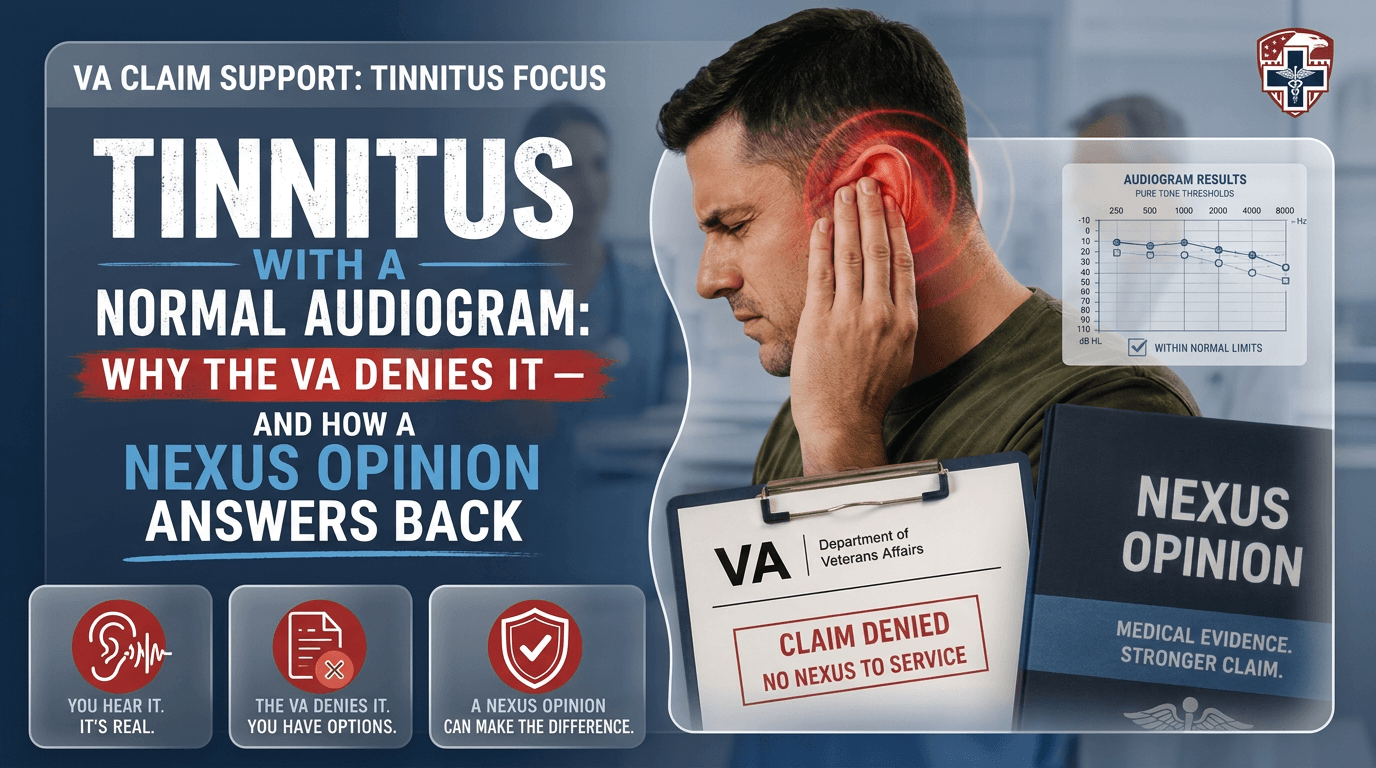
Tinnitus With a Normal Audiogram: Why the VA Denies It — and How a Nexus Opinion Answers Back
- 1.What the VA actually denied
- 2.Why a "normal" hearing test is not proof the noise did nothing
- 3.The objective finding examiners overlook
- 4.Why gradual, late-documented onset supports service connection
- 5.Continuity of symptoms: the lay-evidence bridge
- 6.A DE-IDENTIFIED CASE STUDY:
- 7.Where a clinician-led opinion fits
- 8.Tinnitus rarely stands alone: the conditions that raise your combined rating
- 9.Is the 10% tinnitus rating going away? The proposed DC 6260 change
- 10.Was your tinnitus denied because your hearing test was "normal"?
- 11.If your tinnitus was already denied
- 12.Frequently asked questions
If the VA denied your tinnitus and pointed to a "normal" hearing test, you already know the feeling — dismissed, as if the noise you lived through never counted, worn down from fighting a system alone. One Navy veteran came to us after two denials feeling exactly that. What shifted his footing wasn't a louder argument. It was the right medical evidence — and the science below is what most veterans are never shown.
The Short Answer
The VA frequently denies tinnitus even after conceding both the diagnosis and in-service noise exposure — denying only on the nexus, the medical link. The most common reason given is that the veteran's audiogram is normal, so the noise supposedly caused no injury. That reasoning is contradicted by the science of "hidden hearing loss" (cochlear synaptopathy): loud noise can permanently damage the inner ear's nerve connections while the standard hearing test stays normal. A focused independent medical opinion that explains this mechanism — and addresses what the exam missed — is built to close exactly that gap.
What the VA actually denied
Direct service connection requires three things under 38 CFR §§ 3.303, 3.304: a current diagnosis, an in-service event, and a nexus connecting the two. Tinnitus is evaluated under 38 CFR § 4.87, Diagnostic Code 6260, which provides a single 10% rating for recurrent tinnitus in one or both ears.
In a large share of tinnitus denials, the VA does not dispute the first two elements. It concedes the veteran has a current tinnitus diagnosis, and it concedes hazardous in-service noise based on the veteran's military occupation. It denies anyway — on the nexus. The reasoning, again and again, comes down to one sentence: the audiogram is normal and the service records are silent, so the noise was "less likely than not" the cause.
That is a medical argument. And it can be answered with medical evidence.
Why a "normal" hearing test is not proof the noise did nothing
The core flaw in most negative tinnitus opinions is treating a normal pure-tone audiogram as proof of an uninjured ear. The audiogram measures the function of the outer hair cells. It does not measure the nerve connections behind them.
Loud noise can permanently destroy the synapses between the inner-ear hair cells and the auditory nerve while leaving the audiogram completely normal. Researchers call this cochlear synaptopathy, or "hidden hearing loss" (Kujawa & Liberman, 2009; 2015). Because the standard hearing test cannot see this injury, a normal result is not evidence the noise was harmless — it is exactly what the science predicts.
This is documented specifically in people who have tinnitus with normal hearing. A landmark study provided physiological evidence of hidden hearing loss in patients with tinnitus and a normal audiogram, and modeled how reduced nerve input drives the brain to raise its internal "gain," producing the ringing (Schaette & McAlpine, 2011). In veteran populations with normal audiograms, researchers have found the same pattern of reduced auditory-nerve response linked to the self-report of tinnitus (Bramhall et al., 2017; 2018).
The objective finding examiners overlook
Standard audiology workups often include otoacoustic emissions (OAEs) — an objective measure of inner-ear function that can reveal noise-related change the pure-tone test misses. When those emissions are absent at high frequencies, it is an objective sign of early cochlear change consistent with noise exposure. A negative opinion that rests entirely on "normal hearing" while ignoring an abnormal OAE finding in the same file has skipped evidence material to the very question it claims to resolve.
Why gradual, late-documented onset supports service connection
Examiners often weigh the absence of in-service complaints and the years between service and the first documented mention of tinnitus against the veteran. This misreads the natural history of the condition. Noise injury sustained in young adulthood — from a normal-hearing baseline — can drive delayed, progressive cochlear and neural degeneration over the following decades. The Institute of Medicine, in its report on noise and military service, recognizes that the onset of noise-induced tinnitus can be delayed (IOM, 2006). A symptom that began intermittently in service and became constant over time follows the expected course — it does not contradict it.
Continuity of symptoms: the lay-evidence bridge
Tinnitus is observable through a person's own senses, so a veteran is competent to report it. Service connection for this type of chronic condition can be established through continuity of symptomatology under 38 CFR § 3.303(b) — a route that does not require contemporaneous in-service treatment records (Fountain v. McDonald, 2015). Lay statements of continuous symptoms may not be rejected simply because the service records are silent (Buchanan v. Nicholson, 2006).
In practice, that bridge is built with credible lay evidence: a spouse who attests to ringing observed continuously since discharge, or a fellow service member or coworker who recalls the veteran describing the symptom years before any later, non-military noise. Consistent dating of onset across the record is powerful corroboration.
A DE-IDENTIFIED CASE STUDY:
Consider a representative case from our work — details generalized to protect privacy. A U.S. Navy veteran who served in the mid-1990s as a Boatswain's Mate was exposed daily to engine and generator noise, power tools, metal-on-metal deck work, and live weapons fire during drills, frequently without hearing protection. He developed ringing in both ears during service that became constant over time.
He was denied twice. Both times, the VA conceded the hazardous noise and the current tinnitus diagnosis, and denied solely on the nexus — relying on negative examinations that treated his normal audiogram as proof of no injury, leaned on a pre-service baseline hearing test, and attributed the ringing to a later civilian job.
A clinician-authored independent medical opinion addressed each point directly: the hidden-hearing-loss mechanism showing a normal audiogram does not foreclose a noise cause; an objective high-frequency finding the prior examiners never addressed; the continuity of symptoms corroborated by family and a former colleague; and a point-by-point explanation of why the negative opinions rested on an inaccurate premise. The clinician's conclusion was that the tinnitus was at least as likely as not caused by the conceded in-service noise. (This opinion was submitted as new and relevant evidence; the veteran's claim remained pending at the time of writing.).
Where a clinician-led opinion fits
An attorney can argue the legal standard for service connection — but generating the medical and scientific evidence the nexus actually turns on is clinical work. A defensible tinnitus opinion is not a template letter. It reads the audiology data, explains the mechanism in language a VA rater can act on, cites the peer-reviewed literature, and answers the specific reasoning of the C&P examiner where the exam fell short. That evidence is the product.
Tinnitus rarely stands alone: the conditions that raise your combined rating
Under Diagnostic Code 6260, tinnitus pays a single 10% — there is no 20% or 30% for tinnitus no matter how severe it is, and no bonus for both ears. That is exactly why tinnitus is best understood as the entry point to a larger claim, not the whole claim.
The same in-service noise that caused your tinnitus often connects to other ratable conditions, and the ringing itself can drive or worsen others:
Hearing loss (DC 6100) — commonly claimed alongside tinnitus from the same noise exposure.
Migraines and headaches (DC 8100) — tinnitus and head noise are recognized triggers, rated on their own criteria.
Vertigo and balance problems — peripheral vestibular disorders (DC 6204) and conditions such as Ménière's disease (DC 6205).
Sleep disturbance, anxiety, and depression — constant ringing disrupts sleep and concentration, and these secondary mental-health connections are well recognized.
Tinnitus can also be secondary to another problem rather than directly from noise — for example, traumatic brain injury (TBI), Ménière's disease, or ototoxic medications taken for a service-connected condition. Each is a separate avenue a clinician can evaluate.
Is the 10% tinnitus rating going away? The proposed DC 6260 change
You may have seen alarming posts claiming tinnitus "won't be rated in 2026 unless you have hearing loss." Here is the accurate picture.
As of mid-2026, nothing has changed. Tinnitus is still rated under 38 CFR § 4.87, Diagnostic Code 6260, at a flat 10% — and a normal audiogram does not bar that rating today.
The concern comes from a proposed rule the VA published in February 2022. That proposal would delete DC 6260 and rate tinnitus only as a symptom of an underlying condition — such as hearing loss (DC 6100), a vestibular disorder (DC 6204), Ménière's disease (DC 6205), or TBI (DC 8045). For a veteran with tinnitus and a normal audiogram, that framework could mean no standalone compensation.
But proposed is not final. The VA has not published a final rule and no effective date has been set; the current 10% remains in effect. Schedule changes like this have generally applied to new claims going forward rather than stripping ratings already granted. The practical takeaway: if your tinnitus is service-connectable, there is a real reason to establish it now, under the rule that exists today.
Was your tinnitus denied because your hearing test was "normal"?
A clinician-led review tells you, honestly, whether the medical evidence supports an appeal — and what your file is still missing.
If your tinnitus was already denied
A denial is often the point where the right evidence finally gets added. Common paths:
Supplemental Claim
Submit new and relevant evidence — where an independent medical opinion that addresses the mechanism and rebuts the negative exam belongs.
Higher-Level Review
A senior reviewer re-examines the existing record (no new evidence). Best when the prior decision misapplied the evidence already in the file.
Board Appeal
Review by a Veterans Law Judge. If your denial said there was "no medical link," that sentence is telling you precisely what is missing.
Frequently asked questions
Can tinnitus be service-connected if my hearing test is normal?
Yes. A normal audiogram does not rule out noise injury. Research on cochlear synaptopathy ("hidden hearing loss") shows loud noise can permanently damage the inner-ear nerve connections while the standard hearing test stays normal — and this is documented specifically in people who have tinnitus with normal hearing.
Why would the VA deny tinnitus after admitting I had noise exposure?
A claim needs three things: a current diagnosis, an in-service event, and a nexus linking them. The VA often concedes the first two and denies on the nexus — usually by arguing a normal audiogram or missing service records means the noise didn't cause it. Closing that gap is what a nexus letter is built to do.
What is "hidden hearing loss" or cochlear synaptopathy?
It's permanent, noise-caused damage to the synapses between the inner-ear hair cells and the auditory nerve. Because the standard audiogram measures outer-hair-cell function rather than these nerve connections, the injury can be present even when the hearing test looks normal — and it is associated with tinnitus.
What is continuity of symptomatology?
It's a path to service connection under 38 CFR § 3.303(b). Consistent evidence that a symptom has existed continuously since service — including credible lay statements from you, your spouse, or fellow service members — can help establish the link even without in-service treatment records.
What diagnostic code and rating apply to tinnitus?
Tinnitus is evaluated under 38 CFR § 4.87, Diagnostic Code 6260, which provides a single 10% rating for recurrent tinnitus, whether it affects one ear or both.
Can I appeal a tinnitus denial with a nexus letter?
Yes. A common route is a Supplemental Claim with new and relevant evidence — such as an independent medical opinion that directly addresses the specific reasoning the VA used to deny.
How much does VA tinnitus pay per month?
At the 10% rate under DC 6260, tinnitus pays $180.42 per month in 2026 on its own. Because tinnitus is capped at 10%, its real financial value usually comes from the conditions it connects to — hearing loss, migraines, sleep problems, or mental health — which add to your combined rating.
Can tinnitus be rated higher than 10%?
No. DC 6260 assigns a single 10% for recurrent tinnitus regardless of severity, and whether one or both ears are affected. A higher total comes from separately rating related or secondary conditions, not from the tinnitus code itself.
Is the VA getting rid of the tinnitus rating in 2026?
Not as of mid-2026. A 2022 proposed rule would delete DC 6260 and rate tinnitus only as a symptom of an underlying condition, but it has not been finalized and has no effective date. The 10% rating still applies today, and a normal audiogram does not bar it.
What is the tinnitus C&P exam like?
It's usually a short audiology appointment. You'll be asked when the ringing began, what it sounds like, and how it affects you. Be specific and consistent: tie the onset to service, describe the noise sources, and explain the daily impact on sleep and concentration. A vague or inconsistent onset history is a common reason an examiner writes a negative nexus.
Can I claim tinnitus years after I left service?
Yes. There is no deadline to file, and tinnitus is frequently granted years later. The key is consistent evidence of continuous symptoms since service, since the ringing often began in service but was never formally documented.
Need help with your VA claim?
Get expert guidance and documentation from our licensed clinicians
Get Free ConsultationDr. Kishan Bhalani is a subject matter expert on VA disability claims documentation, with more than five years of focused work at the intersection of clinical m…
Dr. Kishan Bhalani is a subject matter expert on VA disability claims documentation, with more than five years of focused work at the intersection of clinical m…
Originally published June 20, 2026 • Last updated June 20, 2026
Related Insights
What Is a VA Nexus Letter? A Clinician's Anatomy of a Strong Medical Opinion
Who Should Write Your VA Nexus Letter? A Clinician's Specialty-by-Specialty Guide (2026)
Asthma VA Rating Explained: How DC 6602 Actually Works (And Why a Normal Breathing Test Doesn't Cap Your Rating)
About this article. This post is general educational and medical information published by the Military Disability Nexus clinical team. It is not legal advice, not individualized medical advice, and not a substitute for a personal evaluation by a licensed clinician or a consultation with an accredited representative. Reading it does not create a doctor-patient or attorney-client relationship. VA law and rating criteria change; some details may not reflect the most recent updates, and every claim is decided by the VA on its own facts – no outcome is promised or guaranteed. Military Disability Nexus is an independent medical-evidence provider and is not affiliated with, endorsed by, or acting on behalf of the U.S. Department of Veterans Affairs or any government agency. Free claims assistance is available from VA-accredited Veterans Service Organizations and county Veterans Service Officers; you can verify any representative's accreditation through the VA Office of General Counsel.