
Is a Nexus Letter Company a Claim Shark? What the VA Rules Actually Say
- 1.The Short Version
- 2.What a Claim Shark Actually Is
- 3.Why a Nexus Letter Sits on the Other Side of the Line
- 4.Three Tests That Sort Out Who You Are Dealing With
- 5.The Three Roles, Side by Side
- 6.Where Nexus Letter Companies Cross the Line
- 7.Why This Is News Right Now
- 8.What We Do, and What We Will Not Do
- 9.Not sure whether your evidence needs a medical opinion?
A nexus letter company is not a claim shark, as long as it does only what a clinician is allowed to do: review your records and write a medical opinion. The moment it starts filing your claim, or charging a cut of your back pay, the rules change. Two news stories this week told veterans never to pay anyone for help with a VA claim. Neither mentioned nexus letters, but the question lands in our inbox anyway: is paying a doctor for a medical opinion the same thing? It is not. Here is where the line sits, and how to check which side a company is on.
The Short Version
A claim shark is anyone who charges you to prepare, file, or argue a VA claim without VA accreditation. Federal law reserves that work for accredited representatives (38 U.S.C. § 5901).
A nexus letter is medical evidence, not representation. Writing one is practicing medicine, and the fee rules in 38 CFR § 14.636 do not apply to it.
A nexus letter provider does not need VA accreditation, because it is not representing you. It also should not be doing a representative's work. When it does, the accreditation rules kick in.
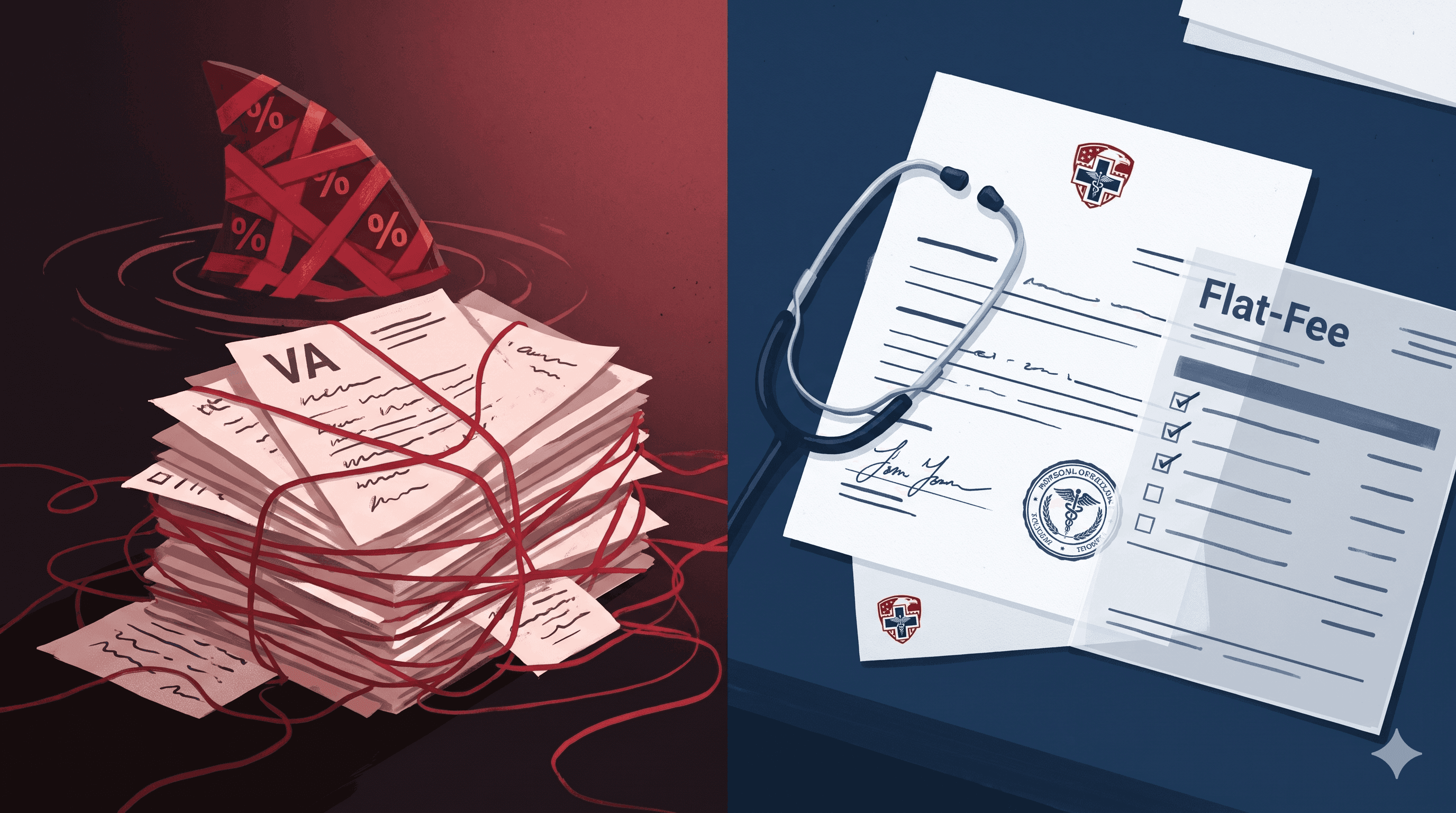
The two reliable tells are who files the claim and how the fee is set. A flat fee for an opinion is a medical charge. A percentage of back pay is a representation fee, and from a medical provider it is a red flag.
The VA weighs a paid private opinion by the same standard as a VA examiner's: accurate facts and a reasoned explanation (Nieves-Rodriguez v. Peake, 22 Vet. App. 295 (2008)).
What a Claim Shark Actually Is
The term is informal. The rule behind it is not. Under 38 U.S.C. § 5901, no one may act as an agent or attorney in the preparation, presentation, or prosecution of a VA claim unless the VA has recognized them. 38 CFR § 14.629recognizes three kinds of representatives: VSO representatives (DAV, VFW, American Legion, and others), accredited claims agents, and accredited attorneys. Nobody else.
VA's General Counsel reads "preparation" broadly. A July 2026 Congressional Research Service legal sidebar (LSB11455) explains that advising a claimant, gathering evidence for the claim, and filling out VA forms all count, so accreditation is required even before anything is filed.
The fee rules are stricter still. 38 CFR § 14.636(b) allows only accredited agents and attorneys to take a fee from a claimant. VSOs may never charge. And even agents and attorneys may not charge for an initial claim: under § 14.636(c), fees are allowed only for work after the VA issues its first decision, such as a supplemental claim, higher-level review, or appeal. A fee of 20% of past-due benefits is presumed reasonable; above 33.3% is presumed unreasonable (§ 14.636(f)).
So the claim shark is easy to define. Not accredited, helps you file, wants money. Any two of those three is a problem. All three is the definition.
THE BOTTOM LINE
Filing a VA claim is free by law. If someone who is not in VA's accreditation database wants to be paid to prepare or file your claim, the law is already against them, whatever they call themselves.
You can check anyone in under a minute at va.gov/ogc/apps/accreditation. A 2023 law (Pub. L. 118-21) also added 38 U.S.C. § 5901(b), which requires VA to show a plain-language warning and a reporting link whenever a veteran logs in to a VA website.
Why a Nexus Letter Sits on the Other Side of the Line
Service connection needs three things: a current diagnosis, an in-service event or injury, and a medical link between them (38 CFR § 3.303). The first two come from records and lay statements. The third is a medical question, and the VA's own rules say who may answer it. 38 CFR § 3.159(a)(1) defines competent medical evidence as evidence from a person qualified by education, training, or experience to give medical diagnoses and opinions. A VA examiner qualifies. So does your treating doctor. So does an independent physician you hire.
That is what a nexus letter is: a qualified clinician's written answer to the third question. The clinician is not your agent. The clinician does not file anything, does not argue your case, and does not take a share of your benefits. 38 U.S.C. § 5904 and § 14.636 regulate what representatives may charge. They say nothing about what a doctor may charge for an opinion, any more than they cap what a hospital charges for an MRI you later submit as evidence.
Nieves-Rodriguez v. Peake, 22 Vet. App. 295 (2008). The Court of Appeals for Veterans Claims held that a medical opinion's weight comes from whether it rests on accurate facts and gives a reasoned explanation, and that a private opinion and a VA opinion are judged by that same standard. A paid opinion is not worth less because it was paid for. A VA exam is not worth more because it was free.
Two things follow. A nexus letter provider does not need VA accreditation, because accreditation is for representatives. And a nexus letter provider should not be doing a representative's work either. If it is, § 5901 applies to that part of the business, and that is where the trouble starts.
Three Tests That Sort Out Who You Are Dealing With
1Who is filing the claim?
If the company fills out your 21-526EZ, picks which conditions to claim, writes your personal statement, or submits anything to the VA for you, it is preparing and presenting a claim. That requires accreditation. A medical practice does none of it. You, or your accredited representative, file the letter as evidence.
2 How is the fee set?
A medical opinion costs the same to produce whether the claim is later rated at 10% or 70%. A flat fee, quoted in writing before work starts, is how clinicians charge. A percentage of back pay, a multiple of your monthly increase, or a "success fee" is how representatives are paid, within VA's limits. From a medical provider, an outcome-based fee is a red flag twice over: it looks like an unlawful representation fee, and it hands the VA rater a reason to question the opinion's objectivity.
3 Who signs, and can you check their license?
Competent medical evidence comes from a named, qualified person. Before you pay, a legitimate provider will tell you that a licensed, board-certified physician will sign your opinion, and the finished letter will carry that physician's name, specialty, and credentials so you can confirm the license with the state medical board before you submit it. A company whose letters have no identifiable, licensed author is not selling medical evidence. It is selling paper.
The Three Roles, Side by Side
Claim shark | Accredited representative | Nexus letter clinician | |
|---|---|---|---|
What they do | Prepare, file, and argue your claim | Prepare, file, and argue your claim | Review records, examine if needed, write a reasoned medical opinion |
VA accreditation | None | Required (38 CFR § 14.629) | Not required; not a representative |
Who oversees them | Effectively no federal enforcement since 2006; some state attorneys general | VA Office of General Counsel | State medical board |
Fee on an initial claim | Charged anyway, unlawfully | Not allowed; fees only after VA's first decision (§ 14.636(c)) | Allowed; it is a medical service, and the claim stage does not matter |
How the fee is set | Percentage of back pay or a multiple of your monthly increase | Up to 20% of past-due benefits, presumed reasonable (§ 14.636(f)) | Flat fee for the opinion, quoted in advance |
How to verify | Not in VA's database | VA accreditation search | State medical board license lookup |
Where Nexus Letter Companies Cross the Line
Most do not set out to be claim sharks. They drift into it, one add-on service at a time. These are the four patterns we see.
The letter comes in a bundle. A "claim package" that includes form completion, condition selection, a personal statement, and submission is preparation and presentation under § 5901. The medical opinion inside the package may be perfectly sound. The rest of the package is the claim-shark problem wearing a lab coat.
The fee moves with your rating. Any pricing that rises with the outcome is representation pricing. It also gives the clinician a financial stake in the conclusion, which a rater can weigh against the opinion. Do not hand the VA a reason to doubt yours.
Nobody will tell you who signs. A template filled in by staff, an AI draft signed without review, or a letter with no named, licensed author is not competent medical evidence under § 3.159(a)(1). VA has announced fraud-detection tools aimed at exactly this. Our post on ChatGPT nexus letters covers what those tools look for.
Someone promises a result. No clinician can promise a rating, and an honest one will decline the case when the records do not support the opinion you were hoping for. A guarantee tells you the conclusion was written before the records were read.
IMPORTANT: THE TRAP THAT CATCHES VETERANS
Veterans who have just read a claim-shark warning sometimes swing the other way and refuse to pay for anything, including the one piece of evidence their claim is missing. The warning is about who files your claim and how they are paid. It is not a rule against medical evidence. Keep the free accredited representative. Add the medical opinion only if the link is the weak spot.
Why This Is News Right Now
On November 11, 2026, Las Vegas station News 3 ran a Veterans Day segment warning Nevada's 220,000-plus veterans about companies that charge thousands of dollars to file claims that VSOs file for free. Two days later the Kansas News Service reported that Kansas lawmakers expect two competing bills in January, one to regulate paid claims consultants and one to ban them, after veterans there paid as much as $20,000 for help.
Both follow the biggest ruling yet. On May 20, 2026, a federal judge in the Middle District of North Carolina found that Veterans Guardian, one of the largest claims consultants in the country, acted as an unaccredited agent in violation of federal law when it prepared and presented VA claims for a fee. An August ruling added unfair trade practices under North Carolina law, and the court found the company collected more than $250 million from class members. Damages are still being decided.
The enforcement gap is why the problem persists. Congress removed the criminal penalty for unauthorized fees in 2006 (Pub. L. 109-461, amending 38 U.S.C. § 5905). A March 2025 GAO report (GAO-25-107211) found VA's only tools are an informal investigation, a cease-and-desist letter, and a referral to law enforcement; it sent 35 such letters in fiscal year 2024. Bills to restore criminal fines, including the GUARD VA Benefits Act (H.R. 1732), have not passed as of this writing.
What We Do, and What We Will Not Do
Hold us to the three tests above.
Licensed, board-certified U.S. physicians review your records, speak with you, and write an independent medical opinion that states a conclusion, explains the reasoning, and cites the literature. When a condition needs it, we complete the medical portion of a DBQ. Our Claim Readiness Review is a clinician's read of your medical evidence that tells you which of the three service-connection elements your records already support and which they do not, so you and your representative know what is missing before you file. One veteran's review turned up five missing elements.
We do not file claims, fill out your 21-526EZ, write your personal statement, or represent you before the VA at any stage. We are not VA-accredited and do not claim to be, because we are not representatives. Every engagement starts with a free consultation and a flat written quote. The physician is matched to your condition after intake, and the signed opinion carries that physician's name, specialty, and credentials so you can check the license yourself before you submit it. We never charge a percentage of your benefits or any fee that depends on your rating, and we do not guarantee results. Fee and refund terms are in the Professional Services Agreement you sign before we start.
An accredited VSO, agent, or attorney is still the right person to file and argue your claim. A nexus letter is one piece of evidence they can submit on your behalf. Our Attorney and Advocate Partnership exists because the two roles work best together.
Not sure whether your evidence needs a medical opinion?
If your records already show a diagnosis, an in-service event, and a medical link, you may not need a nexus letter at all. If the link is the weak spot, a clinician can tell you so in writing before you spend anything on an opinion. Here is what the evidence needs to show, and why.
About this article. This post is general educational and medical information published by the Military Disability Nexus clinical team. It is not legal advice or individualized medical advice, and it does not create a doctor-patient or attorney-client relationship. VA law and policy change, and no outcome is guaranteed. Military Disability Nexus is independent of the Department of Veterans Affairs and is not a VA-accredited representative. Free help filing your claim is available from accredited Veterans Service Organizations and county Veterans Service Officers.
Frequently Asked Questions
Yes. The fee limits in 38 U.S.C. § 5904 and 38 CFR § 14.636 apply to people who represent you before the VA. A nexus letter is a medical opinion from a licensed clinician, and paying for a medical service is lawful. What is not lawful is paying an unaccredited person to prepare or file your claim.
An unaccredited person or company that charges veterans to prepare, file, or argue VA disability claims. Only VA-accredited VSO representatives, claims agents, and attorneys may do that work, and VSOs may never charge. Check anyone's status at va.gov/ogc/apps/accreditation.
No. Accreditation is for representatives, and a clinician writing a medical opinion is not representing you. A company that also fills out your forms, files your claim, or tells you which conditions to claim is doing a representative's work and would need accreditation to charge for it.
No. Under Nieves-Rodriguez v. Peake, 22 Vet. App. 295 (2008), a private opinion is weighed by the same standard as a VA examiner's: whether the clinician knew the facts and explained the reasoning. A fee that rises with your rating, however, can be used to question the opinion's credibility.
It should not. A medical opinion has the same value whether you are rated at 10% or 70%. Percentage fees, multiples of your monthly increase, and "success fees" are how representatives are paid, within VA limits. From a medical provider they are a red flag.
Whether a licensed, board-certified physician will sign the opinion and whether the signed letter will show that physician's name and credentials so you can verify the license; a flat written quote before work starts; confirmation that the company does not file claims or fill out VA forms; the refund terms in writing; and a plain statement that no outcome is guaranteed.
Yes, and it is usually the best setup. The VSO files and argues the claim for free. The nexus letter is evidence you or the VSO submits with it.
Need help with your VA claim?
Get expert guidance and documentation from our licensed clinicians
Get Free ConsultationDr. Kishan Bhalani is a subject matter expert on VA disability claims documentation, with more than five years of focused work at the intersection of clinical m…
Originally published November 17, 2026 • Last updated November 27, 2026
Related Insights
Aid and Attendance Caregiver Statement: What to Write and What to Track
Section 108 Passed the House. The Text Reaches Claims Filed Since October 1, 2026.
Aid and Attendance Caregiver Statement: What to Write and What to Track
About this article. This post is general educational and medical information published by the Military Disability Nexus clinical team. It is not legal advice, not individualized medical advice, and not a substitute for a personal evaluation by a licensed clinician or a consultation with an accredited representative. Reading it does not create a doctor-patient or attorney-client relationship. VA law and rating criteria change; some details may not reflect the most recent updates, and every claim is decided by the VA on its own facts – no outcome is promised or guaranteed. Military Disability Nexus is an independent medical-evidence provider and is not affiliated with, endorsed by, or acting on behalf of the U.S. Department of Veterans Affairs or any government agency. Free claims assistance is available from VA-accredited Veterans Service Organizations and county Veterans Service Officers; you can verify any representative's accreditation through the VA Office of General Counsel.