
Aid and Attendance Caregiver Statement: What to Write and What to Track
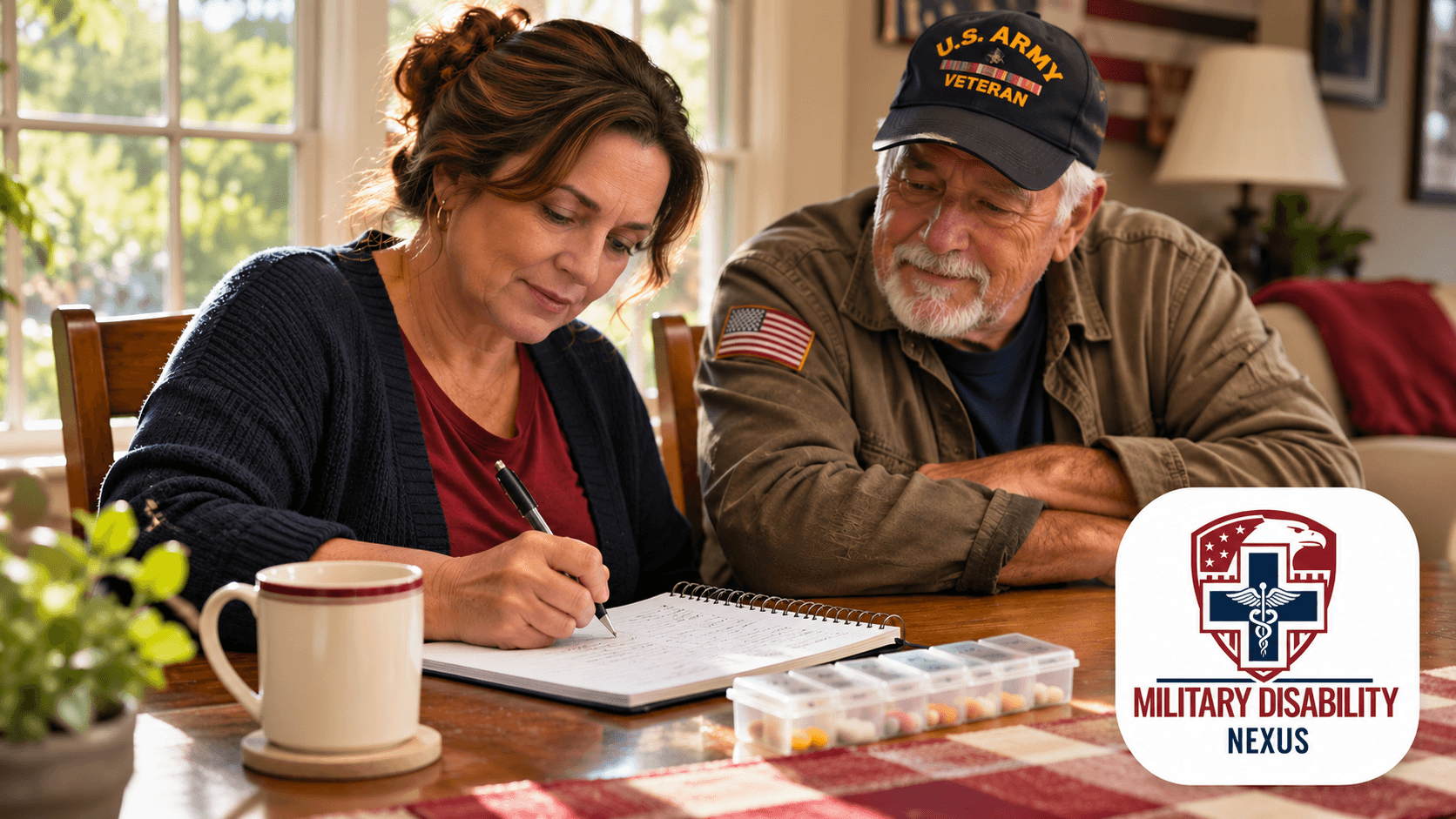
An Aid and Attendance caregiver statement is a written account, usually from a spouse or family member, of the help a veteran or surviving spouse needs each day. By law, the VA must consider all lay and medical evidence in the record (38 U.S.C. 5107(b)), and specific, dated examples make a statement far more useful than general descriptions.
KEY FACTS
Under 38 C.F.R. 3.159(a)(2), lay evidence is competent when the person has knowledge of the facts and describes things a layperson can observe.
Caregivers can submit their account on VA Form 21-10210, Lay/Witness Statement.
Research shows caregivers describe the type of help accurately but tend to overestimate the time it takes, so a written care log improves accuracy.
The strongest statements follow the 38 C.F.R. 3.352(a) areas: dressing, hygiene, eating, toileting, and safety.
The VA must consider lay evidence, such as a caregiver's account, along with the medical evidence. A caregiver can describe what they personally observe, and that account can fill gaps that a short clinic visit leaves behind. This guide explains what to track, what to write, and what to avoid. For the medical side of the claim, see our main guide to Aid and Attendance medical evidence.
What is a caregiver statement, and does the VA have to consider it?
A caregiver statement is lay evidence: a written account from someone who is not a medical professional. Under 38 C.F.R. 3.159(a)(2), competent lay evidence is evidence from a person who has knowledge of facts or circumstances and describes things a layperson can observe. The Court of Appeals for Veterans Claims has long held that lay witnesses are competent to describe what they observe firsthand (Layno v. Brown, 1994).
The VA's form for this is VA Form 21-10210, Lay/Witness Statement. A caregiver can use it to support the claim of a veteran or a surviving spouse.
Leaving it out matters. Our guide to Aid and Attendance vs. Housebound Benefits lists a missing caregiver statement among the five most common documentation failures in Aid and Attendance claims.
What a caregiver should not do is diagnose or explain medical causes. That is the clinician's job. Your job is to describe what happens.
Why should you keep a care log first?
Before you write anything, keep a simple log for about two weeks. Note each time you help, what you did, and anything unsafe that happened.
There is a good reason for this. In a study that videotaped dementia caregivers in the home, caregivers described the type of help they gave accurately, but they consistently overestimated how much time it took. A log keeps your statement accurate, and accuracy is what makes a statement believable.
Track this | Example entry |
|---|---|
Bathing and grooming | Mon: ran shower, cued each step, helped him dry off and shave |
Dressing | Daily: laid out clothes, buttoned shirt, put on shoes |
Toileting and accidents | Tue night: bed wet, changed sheets and clothes at 2 a.m. |
Eating | Cut food at every meal; reminded him to eat |
Medications | Gave all pills; found Sunday's doses untaken |
Safety incidents | Thu: left a burner on; Sat: found him outside at 3 a.m. |
Time alone | Longest he was safely alone this week: 45 minutes |
What should a caregiver statement say?
A strong statement is organized so the rater can match it to the VA's factors. Cover these points:
Who you are: your relationship, whether you live together, and how long you have been giving care.
A typical day, from waking to bedtime, and what happens at night.
Each area of help: dressing, bathing and grooming, eating, toileting, and safety, which are the areas listed in 38 C.F.R. 3.352(a).
The type of help: hands-on, reminders, or watching nearby.
How often: daily, several times a day, or every night.
Specific incidents with dates, taken from your log.
How long the person can safely be left alone, and why.
When the need began and how it has changed.
Weak
"My husband needs a lot of help and can't be left alone."
Strong
"Every morning I lay out his clothes and button his shirt because his hands shake. I stand outside the shower and tell him each step, or he gets confused and stops. On October 12 he left the stove on, and on October 19 I found him in the yard at 3 a.m. I have not left him alone for more than about an hour since August."
Free download: Aid & Attendance Caregiver Checklist. Is your veteran
The checklist gives you the same questions a clinician asks, so your statement and the medical evidence line up.
What mistakes weaken a caregiver statement?
Diagnosing. "He has Stage 6 Alzheimer's" is a medical opinion. "He no longer recognizes our neighbour of 20 years" is an observation.
Describing only the worst day. Describe a typical day. Mention bad days separately and say how often they happen.
Vague words. "A lot," "always," and "can't do anything" are hard to weigh. Use examples and numbers.
Guessing at time. Use your log rather than estimates.
Letting someone else write it. Write it in your own words. Do not have another person or an AI tool write or polish it. A statement that sounds like you is more credible.
Forgetting to sign and date it.
How does the statement work with the medical evidence?
The caregiver statement and the clinician's evaluation should tell the same story from two angles. You describe what happens. The clinician explains why it happens, links it to a diagnosis, and states that the need is expected to continue.
That is why our Aid and Attendance evaluations include a structured caregiver questionnaire, built on the Katz ADL, Lawton IADL, and Pfeffer FAQ scales, filled out by the spouse or caregiver. Learn about our Aid & Attendance service. If your veteran has memory loss, also read our guide to Aid and Attendance for dementia.
Written by and reviewed for clinical accuracy: Dr Kishan Bhalani, MD, MBA. Originally published November 17, 2026 · Last updated November 17, 2026.
About this article. This article is general educational information, not legal advice or individualized medical advice. Reading it does not create a doctor-patient or attorney-client relationship, and no outcome is promised. Military Disability Nexus is not affiliated with the U.S. Department of Veterans Affairs. For help filing a claim, contact a VA-accredited Veterans Service Organization, your county Veterans Service Officer, or a VA-accredited claims agent or attorney.
Frequently Asked Questions
Anyone with firsthand knowledge of the help the person needs, such as a spouse, adult child, neighbor, or paid aide. Under 38 C.F.R. 3.159(a)(2), lay evidence is competent when it comes from someone with knowledge of the facts who describes things a layperson can observe. Each person should write a separate statement about what they personally saw.
The VA’s form for this is VA Form 21-10210, Lay/Witness Statement, available on va.gov. It can support the claim of a veteran or an eligible family member, such as a surviving spouse. Use a separate form for each witness, write in your own words, and sign and date the statement before it is submitted.
No. A caregiver statement supports the medical evidence but does not replace it. The caregiver describes what happens day to day. The VA relies on medical evidence, such as a completed VA Form 21-2680 or a clinician’s opinion, to explain the medical cause of the need and whether it is expected to continue. The two work best together.
Long enough to cover a typical day and each area of help with specific examples; one to two pages is often enough. Clear, dated examples matter more than length. Keeping a care log for about two weeks first helps, because research shows caregivers describe the type of help accurately but tend to overestimate how much time it takes.
Describe your relationship and how long you have given care, a typical day, and the help you give with dressing, bathing, eating, toileting, and safety. Say whether the help is hands-on, reminders, or supervision, and how often. Add dated incidents, how long the person can safely be left alone, and when the need began.
Need help with your VA claim?
Get expert guidance and documentation from our licensed clinicians
Get Free ConsultationDr. Kishan Bhalani is a subject matter expert on VA disability claims documentation, with more than five years of focused work at the intersection of clinical m…
Originally published November 17, 2026 • Last updated November 16, 2026
Related Insights
Aid and Attendance vs. Housebound Benefits: Eligibility, Rates, and Documentation (2026 Guide)
Section 108 Passed the House. The Text Reaches Claims Filed Since October 1, 2026.
VA Denied Your Claim Without Reviewing Your Evidence? How to Spot a Duty-to-Assist Error (2026)
About this article. This post is general educational and medical information published by the Military Disability Nexus clinical team. It is not legal advice, not individualized medical advice, and not a substitute for a personal evaluation by a licensed clinician or a consultation with an accredited representative. Reading it does not create a doctor-patient or attorney-client relationship. VA law and rating criteria change; some details may not reflect the most recent updates, and every claim is decided by the VA on its own facts – no outcome is promised or guaranteed. Military Disability Nexus is an independent medical-evidence provider and is not affiliated with, endorsed by, or acting on behalf of the U.S. Department of Veterans Affairs or any government agency. Free claims assistance is available from VA-accredited Veterans Service Organizations and county Veterans Service Officers; you can verify any representative's accreditation through the VA Office of General Counsel.