
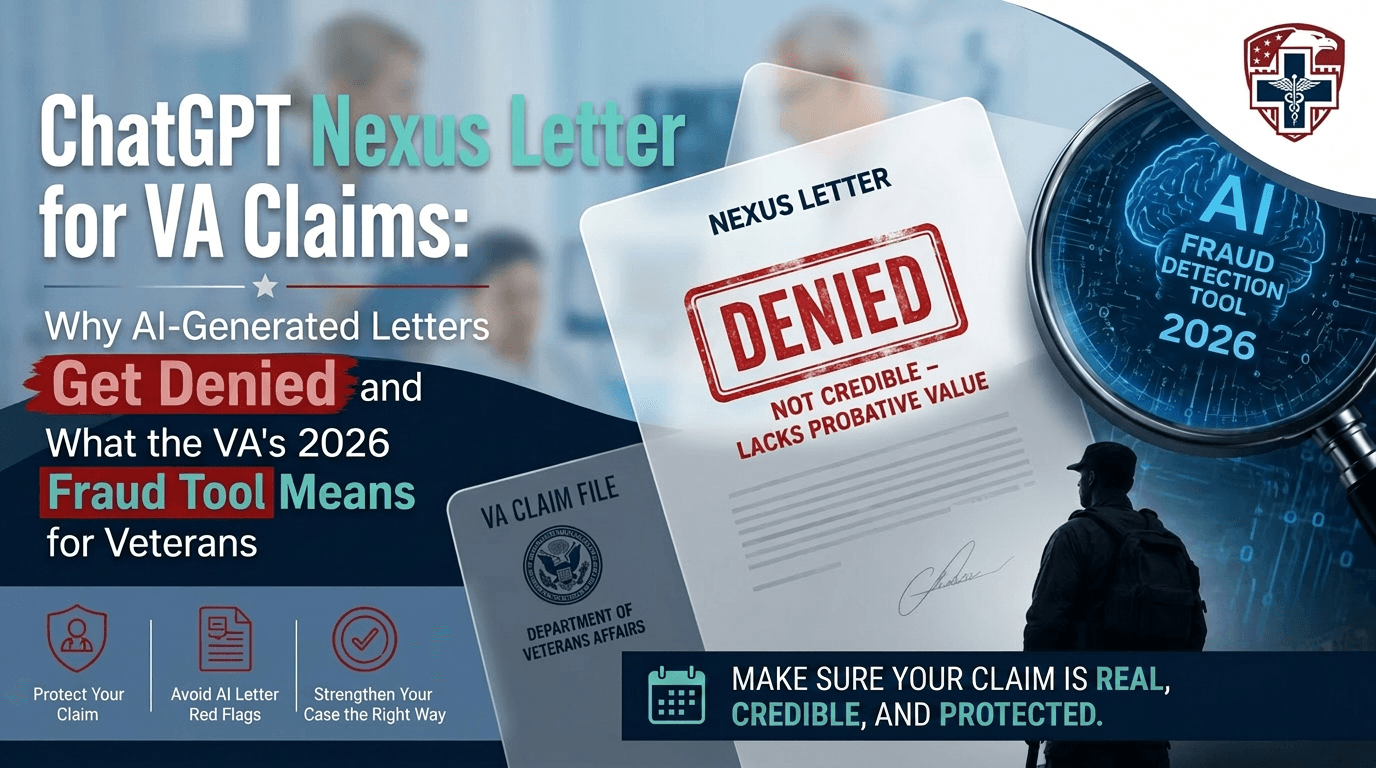
ChatGPT Nexus Letter for VA Claims: Why AI-Generated Letters Get Denied and What the VA's 2026 Fraud Tool Means for Veterans
- 1.Why Is "Use ChatGPT for Your Nexus Letter" Advice Everywhere Right Now?
- 2.What Does the VA Require a Nexus Letter to Contain?
- 3.Why Does a ChatGPT Nexus Letter Fail the VA's Standard?
- 4.AI-Generated vs. Clinician-Written Nexus Letters: How They Compare
- 5.What Is the VA's 2026 Fraud-Detection Tool and What Does It Flag?
- 6.Can My Doctor Sign a Nexus Letter Written by ChatGPT?
- 7.What Can AI Legitimately Help With in a VA Disability Claim?
- 8.What Is the Real Cost of a "Free" AI Nexus Letter?
- 9.What Does a Defensible Nexus Opinion Actually Look Like?
- 10.Frequently Asked Questions
Over 30,000 veterans are using AI tools to generate nexus letters. The VA's new fraud-detection tool was built to catch exactly what those tools produce. Here's what the medical evidence standard actually requires — from clinicians who write nexus opinions every day.
A ChatGPT nexus letter does not meet the VA's standard for competent medical evidence. Under 38 CFR §3.159(a)(1), medical opinions must come from a person qualified through education, training, or experience — not from an algorithm. In January 2024, the VA Office of Inspector General found that 69% of sampled private Disability Benefits Questionnaires (DBQs) contained at least one fraud risk indicator. In March 2026, the VA announced an automated tool to scan over one million DBQs for boilerplate language, template patterns, and exaggerated findings. AI-generated nexus letters match every one of those triggers.
This article explains the regulatory standard AI documents fail to meet, what the VA's new tool actually flags, why the "have your doctor sign it" workaround doesn't work, and what veterans should do instead.
Why Is "Use ChatGPT for Your Nexus Letter" Advice Everywhere Right Now?
Because nexus letters cost $500–$2,000 and veterans are looking for a way around that price tag. The advice to use ChatGPT or AI tools to generate a nexus letter is circulating on Reddit, veteran Facebook groups, YouTube channels, medical forums, and even AI-powered platforms marketing directly to veterans. Understanding where this advice comes from — and why it sounds reasonable — is essential before explaining why it fails.
What Veterans Are Telling Each Other Online
We monitor veteran communities across Reddit, Facebook, Quora, and YouTube not to judge — but because what veterans tell each other matters. The advice below is coming from good intentions. Veterans helping veterans save money. The problem is clinical, not motivational: the advice doesn't account for how the VA evaluates medical evidence, or what the VA's new fraud-detection tool is built to catch.
Doctors are sharing AI-generated nexus letters as templates
On the Student Doctor Network forum, a physician posted enthusiastically about using ChatGPT to write a VA nexus letter for a veteran patient whose prostate cancer claim had been denied. The doctor described the output as thorough and well-written, shared the full AI-generated letter as a template, and encouraged other providers to do the same.
A physician on a medical forum described asking ChatGPT to write a nexus letter connecting a veteran's prostate cancer to military service. He was impressed by the result, called it beautifully written with strong rationale and references, and posted the full text for other doctors to use.
— Student Doctor Network Forum, May 2025.
The doctor's enthusiasm is understandable — the output looks professional. But looking professional and meeting 38 CFR §3.159 are two different things. The letter ChatGPT produced contained generic language about environmental exposure and prostate cancer risk. It didn't reference specific dates from the veteran's service treatment records, specific diagnostic findings, or any clinical evaluation. A VA rater reading that letter would recognize it immediately as a document without record-specific clinical reasoning behind it.
Veterans are telling each other to skip the $1,500 nexus letter
Across Reddit's r/VeteransBenefits and r/Veterans — communities with over 600,000 combined members — a common thread has emerged: veterans advising each other to use ChatGPT to draft a nexus letter and then take it to their doctor for a signature. The reasoning makes sense on the surface: why pay $1,500 for something AI can generate in minutes?
The recurring advice on veteran subreddits follows a pattern: use ChatGPT to generate the nexus letter with medical citations, then bring it to your primary care doctor or VA provider and ask them to review and sign it. Veterans frame it as a smart workaround — saving money on something the VA "should be providing for free anyway."
— Paraphrased from recurring threads on r/VeteransBenefits and r/Veterans, 2025–2026.
We understand the frustration behind this advice. Nexus letters are expensive. VA doctors generally won't write them. The system feels designed to make veterans pay for something they shouldn't need. That's a real problem — and it's the reason companies like ours exist. But the solution isn't a document that fails the evidentiary standard. That just adds a denial to the frustration.
AI platforms are marketing directly to veterans
It's not just forum advice anymore - entire companies have been built around AI-generated nexus letters. Multiple platforms now market themselves as free or low-cost AI tools for generating VA nexus letters, with some claiming tens of thousands of veteran users. These platforms generate nexus letters with medical journal citations and market them as "ready for your doctor to sign." Other sites offer step-by-step ChatGPT prompt guides specifically for creating nexus letters.
One AI platform targeting veterans advertises: "Traditional nexus letters from private doctors cost $500–$1,500+ each. Our AI generates comprehensive, research-backed letters starting with our free plan. Our AI creates the letter; your provider reviews and signs it."
What these platforms don't disclose is that their output does not qualify as competent medical evidence under federal regulation, that most doctors will refuse to sign a document they didn't write, and that the VA's 2026 fraud-detection tool was specifically designed to flag the boilerplate patterns these tools produce.
Clinicians and veteran advocates are pushing back
The pushback is growing as fast as the trend. A disabled veteran and former federal air marshal who hosts a veteran podcast posted in early 2026 that veterans are being advised to use ChatGPT for nexus letters and that the advice is resulting in denials. A clinician-led nexus letter provider reported receiving frequent requests from veterans asking them to simply sign AI-generated letters — and explained publicly why they refuse. Another clinical practice addressed the trend directly, noting that AI-generated documents are precisely what the VA's fraud-detection tool is built to catch.
A disabled veteran and podcast host posted: "Veterans are being told to use ChatGPT to write nexus letters. That advice sounds efficient. It's getting vets denied." He went on to warn that VA law does not recognize AI shortcuts as a substitute for competent medical evidence.
A clinician-led nexus letter service reported: "Lately, we've had a lot of requests that sound like 'I had AI write my nexus letter, I just need you to sign it.' Medical providers cannot ethically sign AI-generated documents. This would go against legal, ethical, and moral standards. They need to review the case and form their own opinion in writing."
The pattern is clear: one side of the veteran community is recommending AI as a cost-saving shortcut, and the clinicians and advocates who understand VA evidentiary standards are warning that it doesn't work. The rest of this article explains the clinical and regulatory reasons why.
What Does the VA Require a Nexus Letter to Contain?
The VA requires nexus letters to qualify as competent medical evidence — meaning they must come from a qualified person, not a software tool. The regulatory definition is specific: under 38 CFR §3.159(a)(1), competent medical evidence is "evidence provided by a person who is qualified through education, training, or experience to offer medical diagnoses, statements, or opinions."
That person must have done three things: reviewed the veteran's specific medical records, applied clinical judgment to those records, and formed an independent medical opinion based on the evidence. The opinion must also include a clearly articulated rationale — the VA denies claims based on conclusions alone without supporting reasoning. According to the M21-1 Adjudication Manual, VA raters assess the probative value of a medical opinion by evaluating whether the clinician reviewed the relevant evidence, whether the rationale is thorough, and whether the conclusion is consistent with the reasoning provided.
KEY STANDARDThe VA does not weigh a nexus opinion by its label, length, or formatting. It weighs the clinical depth behind the opinion: who wrote it, what records they reviewed, what reasoning they applied, and whether the rationale supports the conclusion.
Why Does a ChatGPT Nexus Letter Fail the VA's Standard?
A ChatGPT nexus letter fails because it is not produced by a qualified person, does not involve a record review, does not include a clinical evaluation, and generates conclusions without independent medical judgment. Each of these is a separate disqualifying deficiency.
No Review of the Veteran's Records
A defensible nexus opinion begins with a thorough review of the veteran's service treatment records, post-service treatment records, diagnostic imaging, lab results, and medication history. AI tools do not review your records. They generate generic language about a condition-to-service connection without reference to your specific clinical picture. When a VA rater reads a nexus letter that doesn't reference a single date, diagnosis, provider note, or finding from the actual file, the letter receives little to no probative weight.
No Clinical Evaluation
For many conditions — particularly mental health, musculoskeletal, and neurological claims — a clinical interview or examination is part of forming a medical opinion. The clinician observes, asks follow-up questions, assesses cognitive function or range of motion, and integrates those observations with the written record. AI skips this entirely. The resulting letter reads like a summarized textbook entry, not a patient evaluation.
No Independent Medical Judgment
The "at least as likely as not" standard requires a clinician to weigh evidence for and against a connection, consider alternative explanations, and arrive at an independent conclusion. ChatGPT does not weigh evidence — it generates the most statistically likely next word based on its training data. It can produce a sentence that says "at least as likely as not," but the clinical judgment behind that phrase does not exist.
Detectable Boilerplate Patterns
AI-generated text follows predictable patterns: the same sentence structures, the same transitional phrases, the same way of citing literature. When thousands of veterans submit letters built from the same tool, those patterns become visible — both to experienced VA raters and to automated detection systems. According to one clinician-led practice, "the telltale signs the tool is designed to detect — boilerplate language, cookie-cutter submissions, identical language across multiple veterans — are exactly what template mills produce. They are also what AI-generated medical documents look like."
AI-Generated vs. Clinician-Written Nexus Letters: How They Compare
The difference between an AI-generated nexus letter and a clinician-written nexus opinion is not formatting — it's whether the document meets the federal regulatory standard for competent medical evidence. Here's how they compare on every dimension the VA evaluates.
VA Evidence Requirement | ChatGPT / AI Generator | Licensed Clinician (IMO) |
|---|---|---|
Qualified person under 38 CFR §3.159 | ✗ Not a person | ✓ MD, DO, NP, PA, or PhD |
Review of veteran's specific records | ✗ No record access | ✓ STRs, post-service records, imaging |
Clinical evaluation | ✗ Not possible | ✓ Interview, observation, exam |
Independent medical judgment | ✗ Generates probable text | ✓ Weighs evidence, forms opinion |
Record-specific rationale | ✗ Generic language | ✓ Cites dates, findings, diagnoses |
Peer-reviewed literature citations | ⚠ May cite, but cannot evaluate | ✓ Applies to veteran's specific case |
Passes VA 2026 fraud-detection screening | ✗ Boilerplate triggers flags | ✓ Unique clinical language |
Probative value to VA rater | ✗ None or minimal | ✓ Weighted as competent evidence |
What Is the VA's 2026 Fraud-Detection Tool and What Does It Flag?
The VA's 2026 fraud-detection tool is an automated data collection system built on Microsoft Power BI, designed to screen private Disability Benefits Questionnaires for patterns associated with fraud. It was announced in March 2026 and is expected to launch during fiscal year 2026.
According to Stars and Stripes reporting, James W. Smith, a deputy executive director at the Veterans Benefits Administration, told a House VA subcommittee that the tool will analyze over one million DBQs dating back to 2010 to identify patterns. The VA subsequently clarified through Press Secretary Peter Kasperowicz that "this tool is forward-looking only. VA will not use the tool to revisit previously finalized and processed DBQs." The stated purpose is detecting submissions from claims mills and unaccredited commercial businesses — not investigating individual veterans.
⚠️ What the Tool Flags
According to VA testimony, the OIG report, and Military Times reporting, the fraud-detection tool will flag DBQs that show signs of alteration, contain repeated boilerplate or cut-and-paste language, have incomplete signature blocks, list a medical examiner located more than 100 miles from the veteran's address, describe exaggerated findings inconsistent with the treatment record, or show unusually high volumes of near-identical submissions from a single provider.
The connection to AI-generated documents is direct: the exact patterns the tool is designed to catch — boilerplate language, formulaic structure, identical wording across veterans — are precisely what ChatGPT and AI nexus letter generators produce. Whether the boilerplate originated from a template mill, an AI tool, or a copy-paste operation, the output looks the same to the detection system.
The VA OIG's January 2024 report estimated that 69% of sampled private DBQs contained at least one fraud risk indicator, representing approximately $390 million in potential monetary risk. The Federal Trade Commission separately reported that veterans lost $419 million to predatory claims companies in 2024. These numbers are driving the enforcement push — and AI-generated medical documents land squarely in the crosshairs.
Can My Doctor Sign a Nexus Letter Written by ChatGPT?
In most cases, no — and even when they will, it doesn't solve the underlying evidence problems. This approach fails at three separate points.
Most doctors will refuse. The number one reason veterans seek outside nexus letter services is that their treating physicians already decline to write or sign nexus opinions. VA doctors are often discouraged by facility leadership from providing them. Private PCPs don't understand VA-specific evidentiary standards and don't want the legal exposure. Handing them an AI-generated document doesn't remove the barrier — it adds a new one. Now you're asking them to sign a medical opinion they didn't write, didn't research, and didn't clinically evaluate.
It creates ethical and licensing risk for the provider. A clinician who signs a document they did not author and did not independently verify is representing another entity's output — in this case, a machine's — as their own medical judgment. Multiple clinician-led services have addressed this directly. As one provider stated: "Medical providers cannot sign AI-generated documents. In order to keep their professional integrity, medical providers can't simply sign a document that was generated by AI. This would go against legal, ethical, and moral standards."
The underlying problems remain even with a signature. A signature does not add clinical reasoning, record-specific analysis, or independent medical judgment to a boilerplate document. The VA's fraud-detection tool evaluates the content, not the signature block. A formulaic, AI-generated letter with a real signature is still a formulaic letter.
What Can AI Legitimately Help With in a VA Disability Claim?
AI tools have legitimate uses in the VA claims process — they just can't produce evidence. The distinction is between research and preparation (where AI helps) and medical documentation (where it doesn't).
Understanding a denial letter. Feeding a VA decision letter into ChatGPT and asking it to explain the reasoning in plain English is a reasonable use. The output is general guidance — not legal or medical advice — and the AI may misinterpret VA-specific terminology. But as a starting point for understanding what went wrong, it can be useful.
Researching secondary conditions. Asking AI about the medical literature linking PTSD to hypertension, sleep apnea to GERD, or diabetes to peripheral neuropathy can point you in the right direction. The research then needs to be evaluated and applied by a real clinician to have evidentiary value, but knowing where to look is a legitimate advantage.
Preparing for a C&P exam. Using AI to organize your thoughts about how your symptoms affect daily life, or to understand what a specific diagnostic code measures, is preparation — not evidence. It's the same as reading a VA.gov fact sheet before an exam.
What AI cannot do: produce competent medical evidence under 38 CFR §3.159, write a nexus letter the VA will weigh, complete a DBQ reflecting a genuine clinical evaluation, or substitute for a licensed clinician forming an independent medical opinion.
What Is the Real Cost of a "Free" AI Nexus Letter?
The real cost is measured in denied claims, lost backpay, and months of delay — not in the price of the tool. A ChatGPT nexus letter costs nothing to generate. The downstream cost of a denial it causes can be thousands of dollars.
When an AI-generated nexus letter gets your claim denied, you've used your initial filing. You now have one year to file a Supplemental Claim or Higher-Level Review to preserve your effective date — and that Supplemental Claim will need the competent medical evidence you should have submitted the first time. Every month of delay represents lost compensation. At 2026 rates, a veteran rated at 70% loses approximately $1,808 per month in tax-free benefits for every month the decision is delayed. A six-month delay from a preventable denial costs over $10,800 in lost backpay.
Free evidence that doesn't work is the most expensive evidence you can submit.
What Does a Defensible Nexus Opinion Actually Look Like?
A defensible nexus opinion is the opposite of what AI produces: it is record-specific, clinician-evaluated, and built on transparent medical reasoning that a VA rater can assess for probative value.
It includes a thorough review of the veteran's service treatment records, post-service treatment records, and relevant diagnostic evidence. It includes a clinical evaluation — whether in person or via secure telehealth — where the clinician observes, asks questions, and integrates findings. It includes a clearly articulated rationale that walks through the medical reasoning connecting the condition to service, referencing specific entries in the veteran's records and citing current peer-reviewed medical literature. And it states the opinion using the VA's probability standard: "at least as likely as not."
That's what the VA weighs. Not the label on the document. Not the length. Not the formatting. The clinical depth behind the opinion.
The Bottom Line
The VA's fraud-detection tool is designed to catch documents that lack genuine clinical work behind them. The best defense against that tool isn't avoiding it — it's submitting evidence that reflects a real clinical evaluation. A legitimate, record-specific, clinician-written nexus opinion has nothing to fear from increased scrutiny. It's the kind of evidence the tool is designed to protect.
Not sure what evidence your claim actually needs?
A Claim Readiness Review identifies gaps in your medical evidence before you file — so you know whether your records already support the claim or whether a nexus opinion, DBQ, or rebuttal letter is what's missing.
Frequently Asked Questions
Can ChatGPT write a nexus letter for a VA disability claim?
No. Under 38 CFR §3.159(a)(1), competent medical evidence must come from a person qualified through education, training, or experience to offer medical diagnoses, statements, or opinions. ChatGPT is not a person, has no clinical license, cannot review a veteran's medical records, cannot conduct a clinical evaluation, and cannot form an independent medical judgment. The VA's 2026 fraud-detection tool is also specifically designed to flag the kind of boilerplate, formulaic language that AI tools produce.
What happens if I submit an AI-generated nexus letter to the VA?
An AI-generated nexus letter will likely result in a denied claim because it lacks the elements VA raters weigh most: a review of the veteran's specific records, a clinical evaluation by a qualified provider, and independent medical judgment with clearly articulated rationale. The VA's 2026 fraud-detection tool, built on Microsoft Power BI, is designed to flag DBQs and medical opinions with repeated boilerplate language, near-identical wording across multiple veterans, and findings inconsistent with the treatment record.
Can my doctor sign a nexus letter written by ChatGPT?
Most doctors will refuse. The most common reason veterans seek outside nexus letter services is that their doctors already decline to write or sign nexus opinions. A physician who signs a document they did not write and did not independently evaluate faces ethical and licensing risks. Even when signed, the boilerplate language can still be flagged by the VA's fraud-detection tool, which evaluates content, not just the signature block.
What is the VA's 2026 fraud-detection tool for DBQs?
In March 2026, the VA announced an automated data collection tool to screen private DBQs for signs of fraud. According to congressional testimony from James W. Smith at the Veterans Benefits Administration, the tool will analyze over one million DBQs dating back to 2010 to identify patterns. The VA clarified the tool is forward-looking only and will not revisit previously finalized claims. It flags repeated boilerplate language, near-identical submissions, providers more than 100 miles from the veteran, and exaggerated findings. The stated target is claims mills, not individual veterans.
What does a nexus letter need to qualify as competent medical evidence?
Under 38 CFR §3.159(a)(1), competent medical evidence must come from a qualified person. A defensible nexus letter includes five elements: a thorough review of the veteran's service treatment records and post-service records, a clinical evaluation by the signing provider, an independent medical judgment applying the "at least as likely as not" standard, citations to peer-reviewed medical literature, and a clearly articulated rationale explaining the reasoning — not just the conclusion.
Are AI nexus letter generators legitimate for VA claims?
AI nexus letter generators — platforms that use artificial intelligence to produce nexus letters for veterans — do not meet the VA's competent medical evidence standard under 38 CFR §3.159. The output still requires a licensed provider to review and sign, and the same problems apply: most providers will not sign a document they did not write, the boilerplate language is detectable by the VA's fraud tool, and the letter lacks record-specific clinical reasoning. AI tools can help veterans research conditions and understand the claims process, but they cannot replace a qualified clinician's independent medical opinion.
What can ChatGPT legitimately help with for a VA claim?
ChatGPT can help veterans understand VA decision letters in plain English, research medical literature linking conditions to service, organize thoughts before a C&P exam, and identify potential secondary conditions. These are research and preparation uses — not evidence. AI output does not qualify as competent medical evidence, cannot be submitted as a nexus letter, and should not replace a clinical evaluation by a licensed provider.
Need help with your VA claim?
Get expert guidance and documentation from our licensed clinicians
Get Free ConsultationDr. Kishan Bhalani is a subject matter expert on VA disability claims documentation, with more than five years of focused work at the intersection of clinical m…
Dr. Kishan Bhalani is a subject matter expert on VA disability claims documentation, with more than five years of focused work at the intersection of clinical m…
Originally published May 14, 2026 • Last updated May 14, 2026
Related Insights
What Is a 38 U.S.C. § 1151 Claim? When VA Healthcare Causes Additional Disability
What Is a VA Nexus Letter? A Clinician's Anatomy of a Strong Medical Opinion
Who Should Write Your VA Nexus Letter? A Clinician's Specialty-by-Specialty Guide (2026)
About this article. This post is general educational and medical information published by the Military Disability Nexus clinical team. It is not legal advice, not individualized medical advice, and not a substitute for a personal evaluation by a licensed clinician or a consultation with an accredited representative. Reading it does not create a doctor-patient or attorney-client relationship. VA law and rating criteria change; some details may not reflect the most recent updates, and every claim is decided by the VA on its own facts – no outcome is promised or guaranteed. Military Disability Nexus is an independent medical-evidence provider and is not affiliated with, endorsed by, or acting on behalf of the U.S. Department of Veterans Affairs or any government agency. Free claims assistance is available from VA-accredited Veterans Service Organizations and county Veterans Service Officers; you can verify any representative's accreditation through the VA Office of General Counsel.