
Unemployed vs. Unemployable: What the VA Actually Requires to Prove TDIU
- 1.The distinction that decides the claim
- 2.What "capable of performing the physical and mental acts required by employment" means
- 3."Substantially gainful" employment — and the twist that surprises people
- 4.Why this is exactly where claims fail
- 5.Where a clinician-led provider has the edge
- 6.What your medical evidence has to show to satisfy Van Hoose
- 7.Find out if your file actually proves unemployability
- 8.If you were denied because "you can work"
- 9.Frequently asked questions
- 10.References
The Short Version
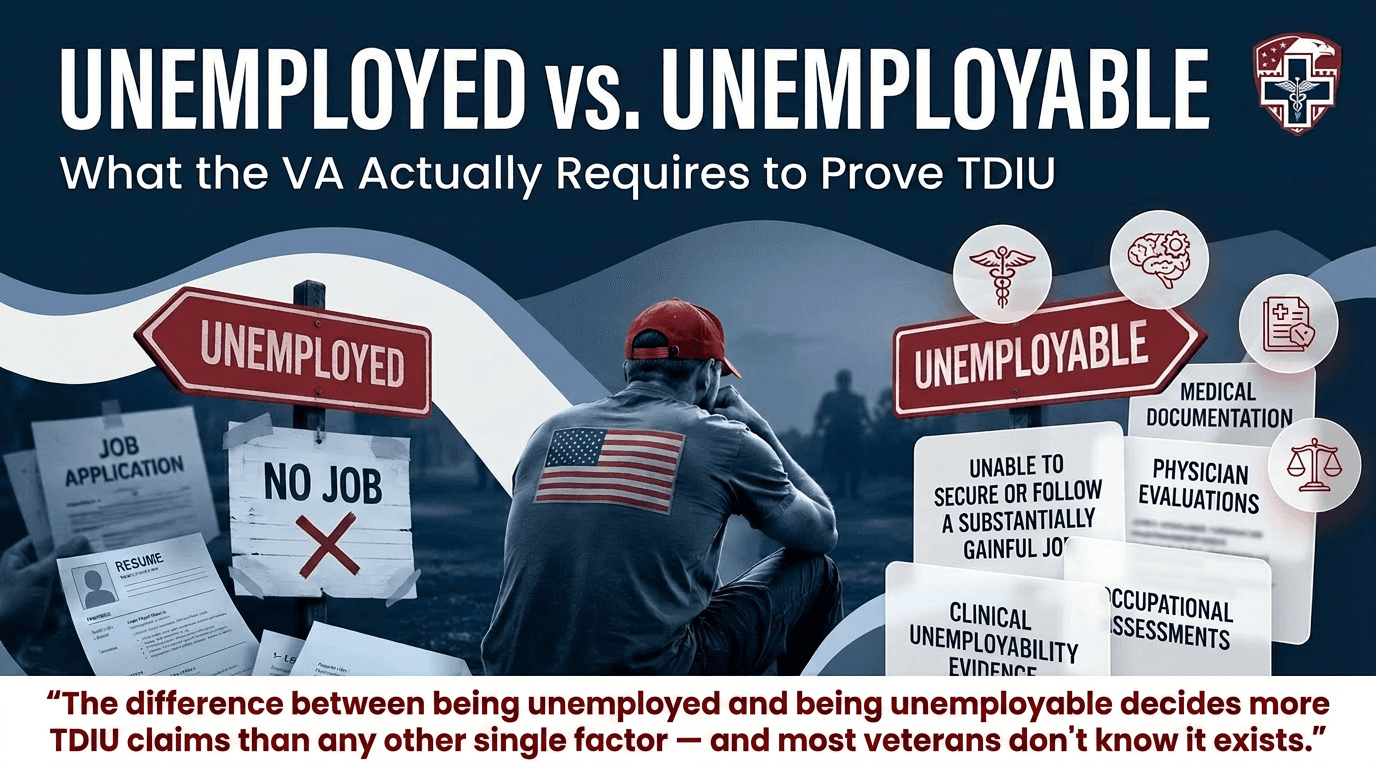
The VA does not grant TDIU just because you are unemployed or cannot find work. Under the standard set in Van Hoose v. Brown, the question is whether your service-connected conditions make you incapable of performing the physical and mental acts required by employment — not whether you currently hold a job, and not whether you can find one. Winning TDIU (unemployed vs. unemployable is the whole game) means documenting that you cannot do the work itself.
The distinction that decides the claim
Two words sound almost identical and mean completely different things to the VA:
Unemployed = you do not have a job.
Unemployable = you are not capable of holding a job.
TDIU pays for the second, not the first. This is the exact principle the Court set in Van Hoose v. Brown, 4 Vet. App. 361, 363 (1993): the sole fact that a veteran is unemployed or has difficulty obtaining employment is not enough. A high disability rating, the Court explained, is already a recognition that your impairment makes it hard to obtain and keep work. To win TDIU, the record has to reflect some factor that takes your case outside the norm of other veterans rated at the same level — and that factor is your inability to perform the acts of employment.
What "capable of performing the physical and mental acts required by employment" means
This is the heart of the standard, so let’s make it concrete. The VA is asking whether you can reliably do the physical and mental tasks that competitive work demands — day after day, not on your best day. That breaks down into two buckets:
Physical acts of employment
Sitting, standing, and walking for sustained periods; lifting and carrying; using your hands for fine and gross tasks; stamina across a full shift; and simply showing up reliably without excessive absences.
Mental acts of employment
Sustained concentration and memory; keeping pace and persisting through a workday; interacting appropriately with supervisors, coworkers, and the public; handling ordinary workplace stress; and adapting to changes — again, on a consistent, sustained basis.
The standard is about sustained capability, not a single snapshot. Many veterans can do almost any task for ten minutes. The question is whether they can do it for forty hours a week, every week, in a competitive setting where unscheduled breaks, frequent absences, or unpredictable flare-ups would get them fired.
"Substantially gainful" employment — and the twist that surprises people
TDIU is about the inability to secure or follow substantially gainful employment under 38 CFR § 4.16. The Court defined that in Moore v. Derwinski, 1 Vet. App. 356, 358 (1991) as work ordinarily followed by the nondisabled to earn a livelihood — in other words, a living wage. Two consequences follow:
Marginal employment does not count against you. Earnings at or below the federal poverty threshold for one person are not "substantially gainful" (38 CFR § 4.16(a)).
You can sometimes qualify even while working. Here is the twist: if you only keep a job because of a protected environment — a family business or an employer making accommodations far beyond the norm — that employment may not defeat your claim. The question is still whether you are capable of performing the required acts, not whether some sheltered job technically exists.
Why this is exactly where claims fail
Most denied TDIU claims fail for the same quiet reason: the record proves the veteran is not working — which Van Hoose says is not enough — but never proves the veteran cannot perform the acts of work. Treatment notes describe symptoms and diagnoses. A C&P examiner checks a box that says you "can perform sedentary work" without grappling with whether you could actually obtain and sustain such a job. Nothing in the file connects your conditions to a functional inability to do the physical and mental tasks employment requires. That missing connection is the difference between a denial and a grant.
Where a clinician-led provider has the edge
A law firm can cite Van Hoose and argue the standard — but attorneys are not clinicians and cannot produce the functional medical evidence the standard demands. And remember: the VA, not the examiner, makes the final TDIU decision (Geib v. Shinseki, 733 F.3d 1350 (Fed. Cir. 2013)). That means the evidence’s job is to hand the adjudicator a complete, clinical picture of what you can and cannot do — so the Van Hoose standard gets applied in your favor. Documenting functional capacity is medical work. It is the work we do.
What your medical evidence has to show to satisfy Van Hoose
To meet this standard, the evidence cannot stop at "the veteran is disabled." It has to translate your service-connected conditions into specific, sustained functional limitations — which physical and mental acts of employment you cannot reliably perform, and why. This matters because functional impairment is measurable and distinct from diagnosis or symptom severity: validated instruments such as the Inventory of Psychosocial Functioning were developed precisely to capture impairment in work and role functioning separately from a symptom count.1 A strong functional evaluation does the same thing for your claim — it documents capability, not just condition.
In practice, that means a clinician-led evaluation that addresses pace, attendance, stamina, the effect of flare-ups, and the cognitive and physical demands you cannot meet on a sustained competitive basis — the precise building blocks the VA needs to find you unemployable rather than merely unemployed.
Find out if your file actually proves unemployability
Start with a clinician-led review. We examine your record against the § 4.16 standard and tell you, honestly, whether your evidence shows you cannot work — and what is missing.
If you were denied because "you can work"
If your denial said your evidence did not show you are unable to work, or that an examiner found you "capable of sedentary work," that is the Van Hoose gap in action — the file showed you were not working, but never proved you cannot perform the acts of work. That gap is fixable with the right functional evidence.
Frequently asked questions
Is being unemployed enough to get TDIU?
No. Under Van Hoose v. Brown, the sole fact that you are unemployed or have difficulty finding work is not enough. The VA asks whether your service-connected conditions make you incapable of performing the physical and mental acts required by employment.
What does "unemployable" mean to the VA?
It means you are not capable of performing the tasks competitive employment requires, on a sustained basis, because of your service-connected disabilities — not simply that you do not currently have a job.
Can I get TDIU if I am still working?
Possibly. If your work is "marginal" (earnings at or below the federal poverty threshold for one person) or exists only in a "protected environment" with accommodations far beyond the norm, that employment may not defeat a TDIU claim under 38 CFR § 4.16(a).
Does my doctor decide whether I am unemployable?
No. The VA — not a medical examiner — makes the final TDIU determination. Your medical evidence’s job is to document the functional capacity the VA uses to apply the legal standard, which is why thorough functional documentation matters.
References
Bovin MJ, Black SK, Rodriguez P, et al. Development and validation of a measure of PTSD-related psychosocial functional impairment: The Inventory of Psychosocial Functioning. Psychological Services. 2018;15(2):216–229.
Legal standards referenced: Van Hoose v. Brown, 4 Vet. App. 361 (1993); Moore v. Derwinski, 1 Vet. App. 356 (1991); Geib v. Shinseki, 733 F.3d 1350 (Fed. Cir. 2013); 38 CFR §§ 4.15, 4.16, 4.19.
Military Disability Nexus is not affiliated with the Department of Veterans Affairs and does not provide legal advice, legal representation, or claim-filing services. We provide independent clinical medical evidence. This article is educational and is not medical or legal advice; outcomes depend on the specific facts of each claim.
Need help with your VA claim?
Get expert guidance and documentation from our licensed clinicians
Get Free ConsultationDr. Kishan Bhalani is a subject matter expert on VA disability claims documentation, with more than five years of focused work at the intersection of clinical m…
Dr. Kishan Bhalani is a subject matter expert on VA disability claims documentation, with more than five years of focused work at the intersection of clinical m…
Originally published June 3, 2026 • Last updated June 3, 2026
Related Insights
TDIU Medical Opinion: The Evidence That Wins Individual Unemployability
Spicer v. McDonough and the "But-For" Standard: What the May 2026 M21-1 Update Means for Your Secondary VA Claim
TDIU Medical Opinion: The Evidence That Wins Individual Unemployability
About this article. This post is general educational and medical information published by the Military Disability Nexus clinical team. It is not legal advice, not individualized medical advice, and not a substitute for a personal evaluation by a licensed clinician or a consultation with an accredited representative. Reading it does not create a doctor-patient or attorney-client relationship. VA law and rating criteria change; some details may not reflect the most recent updates, and every claim is decided by the VA on its own facts – no outcome is promised or guaranteed. Military Disability Nexus is an independent medical-evidence provider and is not affiliated with, endorsed by, or acting on behalf of the U.S. Department of Veterans Affairs or any government agency. Free claims assistance is available from VA-accredited Veterans Service Organizations and county Veterans Service Officers; you can verify any representative's accreditation through the VA Office of General Counsel.