
TDIU Medical Opinion: The Evidence That Wins Individual Unemployability
- 1.What TDIU is
- 2.The two ways to qualify
- 3.Why TDIU claims get denied (the honest answer)
- 4.What "substantially gainful employment" actually means
- 5.The evidence that wins: medical + occupational
- 6.Find out if your file actually proves unemployability
- 7.If your TDIU claim was already denied
- 8.Frequently asked questions
The Shorter Version
TDIU pays at the 100% rate when your service-connected conditions stop you from holding substantially gainful employment under 38 CFR § 4.16 — even if your combined rating is lower. Meeting the threshold only opens the door. To win, the record has to prove you cannot sustain competitive work — which usually takes a strong medical opinion and a vocational assessment, not your treatment notes alone.
What TDIU is
Total Disability based on Individual Unemployability (TDIU, or "IU") pays you at the 100% disability rate even if your combined rating is below 100%, as long as your service-connected disabilities prevent you from keeping substantially gainful employment. It exists because the rating schedule does not always capture how a disability plays out in a working life. Two veterans can both be rated 70% and have very different abilities to hold a job. This benefit is governed by 38 CFR § 4.16 (unemployability) and 38 CFR § 4.15 (total disability ratings).
The two ways to qualify
Schedular TDIU — 38 CFR § 4.16(a)
One disability rated 60% or higher, or
Two or more disabilities with a combined 70% or higher, with at least one rated 40% or higher.
Extraschedular TDIU — 38 CFR § 4.16(b)
You do not meet those numbers, but your service-connected conditions still uniquely keep you from working. These claims go to the Director of Compensation Service and depend even more heavily on strong evidence. Meeting the threshold is not the same as winning. Eligibility is the door; entitlement is the room. The gap between them is where most denials live.
Why TDIU claims get denied (the honest answer)
TDIU is decided on an occupational question — can you keep a job — but most claims are built like a medical question. Here is why claims fall short:
The record proves severity, not unemployability. Treatment notes describe symptoms; they rarely explain why those symptoms make a 40-hour competitive workweek impossible.
The C&P exam checked a box. An opinion may say you can do "sedentary work" without addressing whether you could actually get and keep such a job.
The employment evidence is missing. Claims are routinely denied because VA Form 21-8940 (work history) or VA Form 21-4192 (former employer) was incomplete. If you do not supply it, the VA decides without it.
Nobody built the bridge from medical limitations to the functional inability to work in your specific situation.
What "substantially gainful employment" actually means
It is not "can you work at all." It is whether you can hold steady, competitive work that supports you financially.
Marginal employment (below the federal poverty threshold) or work in a protected environment generally does not count against you.
The VA cannot consider your age and cannot ask why you left a previous job.
The evidence that wins: medical + occupational
1. A TDIU-grade medical opinion
Not "the veteran is disabled," but a focused opinion that translates your diagnoses into functional limitations on a sustained and reliable basis — pace, attendance, unscheduled breaks, the effect of flare-ups — and explains, with medical rationale, why those limitations are inconsistent with substantially gainful work. The link between serious conditions and unemployment is well established: in the National Health and Resilience in Veterans Study, veterans with a history of PTSD were more than twice as likely to be unemployed and nearly four times as likely to be classified as disabled. Validated tools like the Inventory of Psychosocial Functioning exist precisely to measure functional impairment rather than symptom counts.
2. A vocational / functional-capacity assessment
This is the piece most providers skip, and it is frequently decisive. It takes your medical limitations and analyzes them against your actual education, training, and work history to show why no realistic competitive job remains. Standard vocational services often fall short for veterans with serious occupational dysfunction, which is why specialized, evidence-based approaches were developed and tested in VA randomized trials.
Where a clinician-led provider has the edge
A law firm can argue the legal standard under § 4.16 — but attorneys are not clinicians and cannot generate the medical and functional evidence the claim turns on. That evidence is the product, and it is the work we do.
Why our evidence is built differently
What goes into a Military Disability Nexus evaluation
Why our evidence is built differently
What goes into a Military Disability Nexus evaluation
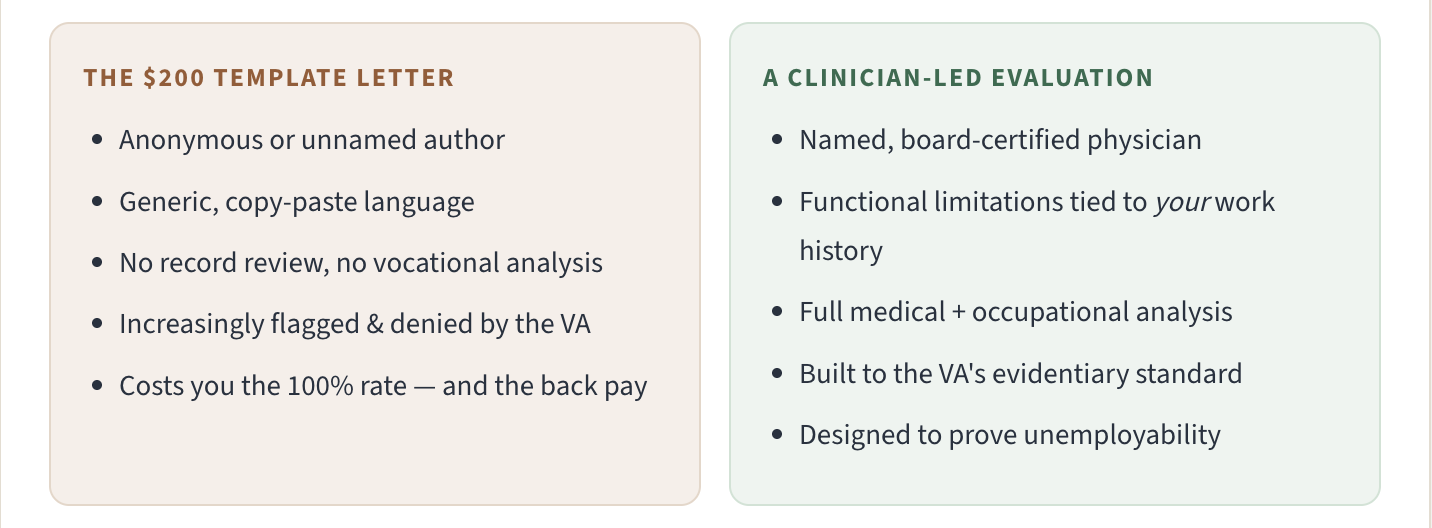
TDIU can mean the difference between a partial rating and the 100% rate — for the rest of your life — plus back pay to the date your unemployability began. The evidence that secures it is a clinical work product, not a form-fill. Every evaluation includes:
A board-certified physician (MD) — not an anonymous template service
A forensic review of your complete record against the unemployability standard in 38 CFR § 4.16
Functional-capacity documentation — pace, attendance, sustainability — in the language the VA requires
A vocational analysis connecting your limitations to your real education and work history
Evidence-based clinical rationale, with medical literature cited where it strengthens the opinion
A direct response to the C&P examiner where the exam fell short.
Put the cost in perspective. The jump to the 100% rate is worth a substantial, tax-free amount every month for life, plus retroactive back pay. Measured against that — and against what a denial costs you in lost years — getting the evidence done right is a fraction of what is at stake.
Find out if your file actually proves unemployability
Start with a clinician-led review. We examine your record against the § 4.16 standard and tell you, honestly, whether your evidence shows you cannot work — and what is missing.
If your TDIU claim was already denied
A denial is often exactly where the right evidence finally gets added:
Supplemental Claim — submit new and relevant evidence (where a medical opinion and vocational assessment belong).
Higher-Level Review — a senior reviewer re-examines the existing record (no new evidence).
Board Appeal — review by a Veterans Law Judge.
If your denial said the evidence "does not show you are unable to work," that sentence is telling you what is missing.
Frequently asked questions
Does TDIU require a medical opinion?
It is not technically mandatory, but TDIU claims rarely succeed without strong medical evidence connecting your conditions to the inability to sustain gainful work. An independent opinion carries weight a routine treatment note does not.
My treating doctor will not say I cannot work. What now?
Very common — treating physicians focus on care, not claims, and many decline to opine on employability. An independent clinician can perform a focused evaluation and provide the opinion your treating doctor will not.
Can I work part-time and still get TDIU?
Possibly, if the work is marginal (below the federal poverty threshold) or in a protected environment. The situation must be documented correctly under 38 CFR § 4.16.
Will the VA take TDIU away if my condition is stable?
TDIU can be reviewed, but there are safeguards, and static conditions and long-held ratings carry protections. The risk is usually overstated when the file is documented properly.
What is the difference between TDIU and a 100% schedular rating?
A 100% schedular rating comes from the rating math. TDIU pays at the 100% rate when your combined rating is lower but your conditions still prevent you from working.
Military Disability Nexus is not affiliated with the Department of Veterans Affairs and does not provide legal advice, legal representation, or claim-filing services. We provide independent clinical medical evidence. This article is educational and is not medical or legal advice; outcomes depend on the specific facts of each claim.
Need help with your VA claim?
Get expert guidance and documentation from our licensed clinicians
Get Free ConsultationDr. Kishan Bhalani is a subject matter expert on VA disability claims documentation, with more than five years of focused work at the intersection of clinical m…
Dr. Kishan Bhalani is a subject matter expert on VA disability claims documentation, with more than five years of focused work at the intersection of clinical m…
Originally published June 2, 2026 • Last updated June 3, 2026
Related Insights
Spicer v. McDonough and the "But-For" Standard: What the May 2026 M21-1 Update Means for Your Secondary VA Claim
Unemployed vs. Unemployable: What the VA Actually Requires to Prove TDIU
VA Form 21-526EZ Is Shrinking to 5 Pages: What Changes, and What Doesn't
About this article. This post is general educational and medical information published by the Military Disability Nexus clinical team. It is not legal advice, not individualized medical advice, and not a substitute for a personal evaluation by a licensed clinician or a consultation with an accredited representative. Reading it does not create a doctor-patient or attorney-client relationship. VA law and rating criteria change; some details may not reflect the most recent updates, and every claim is decided by the VA on its own facts – no outcome is promised or guaranteed. Military Disability Nexus is an independent medical-evidence provider and is not affiliated with, endorsed by, or acting on behalf of the U.S. Department of Veterans Affairs or any government agency. Free claims assistance is available from VA-accredited Veterans Service Organizations and county Veterans Service Officers; you can verify any representative's accreditation through the VA Office of General Counsel.