
PTSD VA Disability Claim: Nexus Letters, Denial Reasons & Your Complete Filing Guide
- 1.What a PTSD VA Disability Claim Actually Requires
- 2.Claim Readiness Review: Are You Ready to File?
- 3.7 Common Reasons PTSD VA Disability Claims Are Denied
- 4.When Should You Get a Nexus Letter for a PTSD VA Claim?
- 5.Who Should Write Your PTSD Nexus Letter?
- 6.The Court of Appeals for Veterans' Claims (CAVC) has established in Nieves-Rodriguez v. Peake that the probative value of a medical opinion depends on the quality of its reasoning not simply the conclusion. A psychiatrist providing a detailed, evidence-based rationale for a PTSD nexus will outweigh a vague opinion from a more credentialed but less specific provider.
- 7.What Makes a Strong PTSD Nexus Letter?
- 8.Red Flags: What Weak Nexus Letters Look Like
- 9.Secondary Conditions Veterans Can Claim Alongside PTSD
- 10.Frequently Asked Questions About PTSD VA Disability Claims
- 11.Your Next Steps
Section 01
What a PTSD VA Disability Claim Actually Requires
Definition
What Is a PTSD VA Disability Claim?
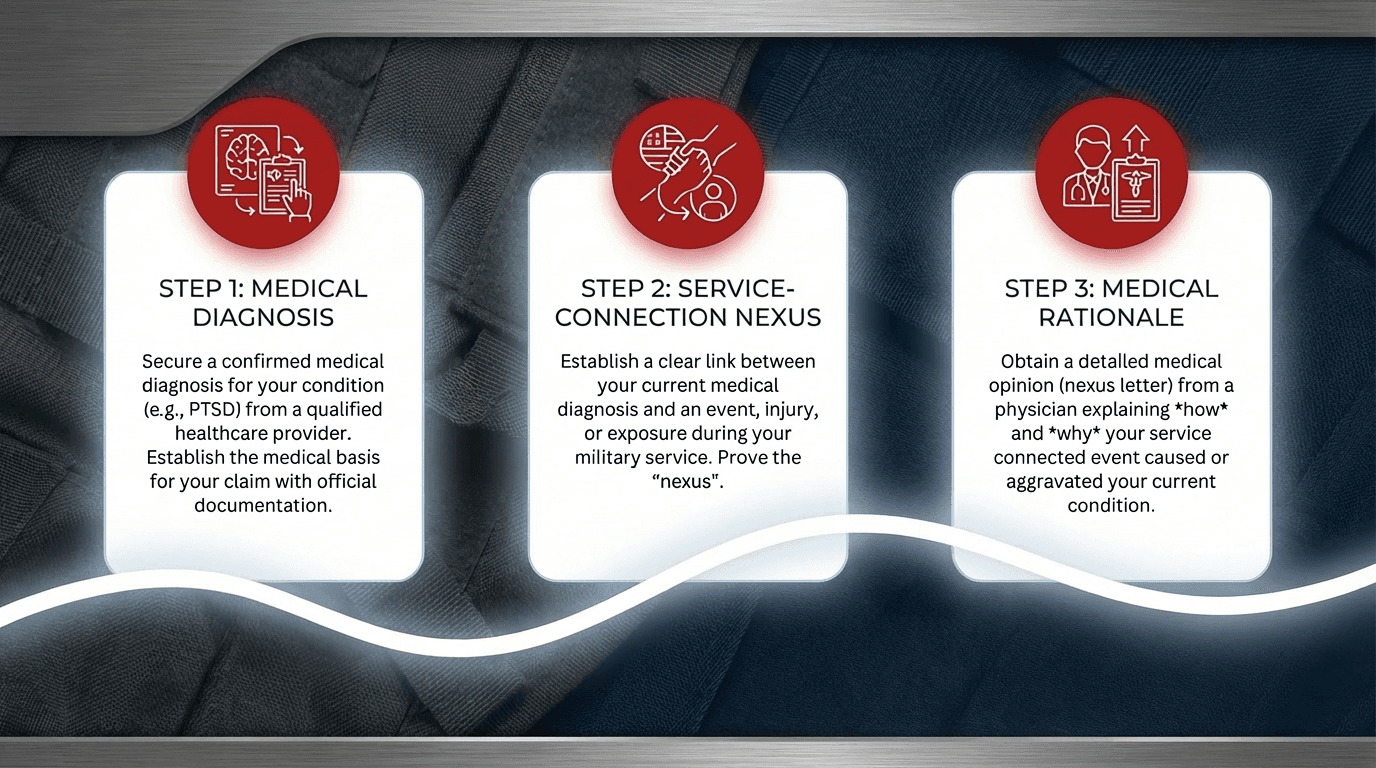
A PTSD VA disability claim is a formal request to the Department of Veterans Affairs for monthly compensation based on a post-traumatic stress disorder diagnosis that is connected to an in-service traumatic event. To be approved, the VA requires three elements: a current formal PTSD diagnosis, a documented in-service stressor, and a medical nexus establishing that the diagnosis is at least as likely as not connected to military service.
A PTSD VA disability claim cannot be won on diagnosis alone. The VA requires documented proof that the condition is medically connected to a specific event during military service — and that proof must meet a defined legal standard of probability.
Element 1: A Current, Formal PTSD Diagnosis
You must have a formal PTSD diagnosis from a licensed mental health professional — a psychiatrist, psychologist, or licensed clinical social worker (LCSW). The diagnosis must be clearly documented using DSM-5 criteria, with specific symptom clusters identified. A mention of "PTSD symptoms" in treatment notes or a self-reported diagnosis does not meet this standard.
Element 2: A Documented In-Service Stressor
You must identify the traumatic event during military service that caused your PTSD. This could be combat exposure, Military Sexual Trauma (MST), witnessing the death or serious injury of others, or being personally threatened with death or grave harm. For combat veterans and MST survivors, the VA applies stronger evidentiary protections under 38 CFR §3.304(f) — meaning your credible personal statement carries greater weight and corroborating service records are not always required. If your stressor involves military sexual trauma, you do not need an official report to file, and a different evidence framework applies. Our MST-related PTSD nexus letter page explains how it works.
Element 3: A Medical Nexus Connecting Diagnosis to Service
This is where the majority of PTSD claims break down. The VA must see a competent, documented medical opinion linking your current PTSD diagnosis to your in-service stressor. Without that medical bridge, even a confirmed diagnosis and a credible stressor will not produce an approved claim.
Legal StandardThe VA requires the nexus to meet the "at least as likely as not" threshold — a ≥50% probability that the condition is connected to service. This exact phrase, or legally equivalent language, must appear in any medical opinion submitted in support of a PTSD claim.
Section 02
Claim Readiness Review: Are You Ready to File?
Filing a PTSD VA disability claim too early — without the documentation to support it — is one of the most common and most costly mistakes a veteran can make. A premature filing doesn't just risk denial; it can set a damaging precedent that complicates future appeals.
Before you submit, conduct a Claim Readiness Review — a structured pre-filing self-assessment that ensures your evidence, documentation, and claim strategy are strong enough to withstand VA scrutiny. Think of it as your preflight checklist before a critical mission.
Your Pre-Filing Claim Readiness Checklist
I have a current, formal PTSD diagnosis from a licensed psychiatrist, psychologist, or LCSW — documented with DSM-5 criteria.
I can clearly identify and describe my in-service stressor — what happened, when, where, and how it affected me.
I have gathered my service treatment records (STRs), including any mental health visits, sick call records, or incident documentation from the period of service.
I have current private or VA medical records documenting PTSD symptoms, treatment history, and functional impairment in work and daily life.
I understand whether my stressor qualifies for presumptive service connection (combat, MST) or requires an independent nexus opinion.
I have buddy letters, personal statements, or other lay evidence that corroborate my account of service events.
I have considered whether secondary conditions (sleep apnea, hypertension, IBS, migraines) should be filed at the same time.
I have consulted a VSO, VA-accredited claims agent, or veterans' disability attorney before submitting.
If you cannot check most of these boxes, do not file yet. Use a Claim Readiness Review to identify the gaps, before the VA does.
Section 03
7 Common Reasons PTSD VA Disability Claims Are Denied
A denial from the VA is not a verdict on whether your PTSD is real. It is, in most cases, a finding that the evidence submitted did not meet the legal and evidentiary threshold the VA requires. Understanding why claims fail is the first step toward winning.
Reason 01
No Confirmed PTSD Diagnosis on File
The VA requires a current, formal PTSD diagnosis from a licensed mental health professional. Symptoms referenced in treatment notes, informal provider observations, or self-reported PTSD without a documented clinical diagnosis will not satisfy this requirement.
Reason 02
In-Service Stressor Not Adequately Established
For non-combat PTSD claims that don't fall under the combat or MST presumption, the VA may deny if the stressor isn't corroborated by service records, unit records, or credible buddy statements. The stressor must be specific, verifiable, and tied to military service. MST claims are the exception: the stressor can be supported by marker evidence rather than a report, and a clinician's interpretation of those markers can itself help corroborate the event. Our guide to MST markers explains what counts:
Reason 03
Missing or Insufficient Medical Nexus
This is the leading cause of PTSD denials. Without a documented medical opinion linking the current diagnosis to the in-service stressor — using the correct legal language — the VA has no legal basis to grant service connection regardless of how severe the condition is.
Reason 04
Unfavorable or Inadequate C&P Exam
VA Compensation & Pension (C&P) exams are often brief and may not reflect the full scope of your condition or records. A negative or insufficient C&P exam opinion can sink an otherwise viable claim — unless countered by a strong independent medical opinion (IMO).
Reason 05
Hedging Language in the Medical Opinion
Phrases like "could be related," "may have contributed," or "cannot rule out" do not meet the VA's legal threshold. The required standard is "at least as likely as not" — reflecting ≥50% probability. Anything weaker is legally insufficient and will typically result in denial.
Reason 06
Gap Between Service Events and Treatment Records
A significant delay between the in-service stressor and the first documented mental health treatment raises questions for VA adjudicators. Personal statements, buddy letters, and a well-reasoned IMO explaining delayed-onset PTSD can help bridge these evidentiary gaps.
Reason 07
Incomplete or Incorrectly Filed Claim Forms
Technical errors — missing fields, wrong forms, or vague descriptions — can result in outright denial or significant processing delays. VA forms use complex language, and small omissions carry real consequences. Every section matters.
Key InsightVeterans who appeal denied PTSD claims with the help of a VA-accredited attorney or claims agent are nearly twice as likely to be approved compared to those who navigate the appeals process alone. A denial is not the end of the fight — it is the beginning of a better-prepared one.
Definition
What Is a Nexus Letter (IMO) for a VA Claim?
A nexus letter — formally called an Independent Medical Opinion (IMO) — is a written statement from a licensed medical professional that establishes a documented connection between a veteran's current disability and their military service. For PTSD claims, it must conclude that the diagnosis is "at least as likely as not" (50% or greater probability) caused or aggravated by an in-service stressor, and must include a clinical rationale supported by the veteran's service and medical records.
A nexus letter is not required for every PTSD claim — but when a C&P exam is unfavorable, a claim has been denied, or the stressor is non-presumptive, it is often the single most decisive piece of evidence a veteran can submit.
You should strongly consider obtaining a nexus letter in any of the following situations:
Your initial PTSD claim was denied — especially if the denial cited insufficient nexus or an unfavorable C&P exam. This is the most critical moment to seek an independent medical opinion.
Your C&P exam was inadequate, rushed, or dismissive — if the examiner did not review your full records, spent minimal time with you, or produced a brief and conclusory negative opinion.
You are filing a non-presumptive PTSD claim — if your stressor does not automatically qualify under combat or MST presumption provisions, a well-reasoned IMO provides the medical logic the VA requires.
You are filing years after separation — a significant time gap between service and your PTSD diagnosis raises evidentiary questions. A strong IMO explains delayed onset in clinical terms the VA can legally accept.
You are claiming PTSD secondary to another condition — such as PTSD secondary to TBI, MST-related injury, or other service-connected medical events.
You are seeking a rating increase for worsening PTSD — an IMO documenting the progression and current functional severity can support a higher disability rating.
You are appealing to the Board of Veterans' Appeals (BVA) — at this level, a well-reasoned specialist IMO carries significant evidentiary weight against a prior unfavorable VA opinion.
Section 05
Who Should Write Your PTSD Nexus Letter?
The VA evaluates nexus letters not just on what they say — but on who wrote them and why that person is qualified to render an opinion on your specific condition. For PTSD, specialty relevance is critical.
The credibility of a nexus letter is directly tied to the writer's credentials and clinical relevance to the claimed condition. For PTSD specifically, these providers carry the most weight:
Highest Evidentiary Weight
Psychiatrist (MD / DO)
A licensed psychiatrist specializing in trauma-related disorders carries the strongest evidentiary weight for PTSD claims. They can diagnose, prescribe, and provide a comprehensive medical opinion grounded in psychiatric and pharmacological expertise.
Highly Qualified
Psychologist (PhD / PsyD)
A licensed psychologist who specializes in trauma assessment or forensic psychology is well-positioned to produce a strong PTSD nexus letter. Their DSM-5 diagnostic expertise is directly applicable to VA evidentiary standards.
Qualified
Licensed Clinical Social Worker (LCSW)
LCSWs with documented experience in trauma-focused therapy and VA claims documentation can provide nexus opinions that the VA accepts, though these may carry less probative weight in contested cases.
Use with Caution
Primary Care Physician
General practitioners can technically write nexus letters, but for a complex psychiatric condition like PTSD, the VA may assign less evidentiary weight to a non-specialist opinion. A specialist referral is strongly advisable.
For Secondary Conditions
Relevant Specialist
Secondary conditions require specialty-matched writers — a sleep physician for sleep apnea, a cardiologist for hypertension secondary to PTSD, a gastroenterologist for IBS. Specialty match amplifies probative value.
Independence Matters
Private vs. VA Provider
An independent private provider experienced in VA claims IMOs is generally preferred. They are free from institutional pressures and are familiar with the exact VA evidentiary language requirements that VA providers may not prioritize.
SPECIALITY MATCH PRINCIPAL
The Court of Appeals for Veterans' Claims (CAVC) has established in Nieves-Rodriguez v. Peake that the probative value of a medical opinion depends on the quality of its reasoning not simply the conclusion. A psychiatrist providing a detailed, evidence-based rationale for a PTSD nexus will outweigh a vague opinion from a more credentialed but less specific provider.
Section 06
What Makes a Strong PTSD Nexus Letter?
A nexus letter that states a conclusion without explaining its reasoning carries almost no evidentiary weight. The VA and the courts have made clear: the reasoning is the opinion.
A strong PTSD nexus letter meets every one of these standards:
Provider credentials clearly stated upfront— Full name, licensure type, specialty, and clinical experience must appear at the opening of the letter to establish the authority behind the opinion.
Explicit confirmation that records were reviewed— The provider must state they reviewed the veteran's service treatment records (STRs), private medical history, and any prior VA decisions. Without this, the opinion lacks a documented evidentiary foundation.
Formal DSM-5 PTSD diagnosis included: The diagnosis must be stated explicitly, with symptom clusters documented. It should not rely on a reference to someone else's prior diagnosis.
The exact nexus phrase "at least as likely as not". This language, or a clearly equivalent statement reflecting ≥50% probability, must appear in the opinion. Anything weaker is legally insufficient.
A detailed clinical rationale: The letter must explainhowandwhythe in-service stressor caused or contributed to the PTSD — including the mechanism of psychological injury, symptom onset, and development over time.
References to supporting medical literature: Strong IMOs cite peer-reviewed research connecting the claimed mechanism to the diagnosis, particularly important for secondary conditions or delayed-onset PTSD claims.
Consistency with all existing records: Dates, stressor descriptions, and symptom timelines must align perfectly with your service records and prior VA submissions. Any discrepancy gives adjudicators grounds to discount the entire letter.
Provider signature on official letterhead: The letter should be signed and presented on the provider's official practice letterhead to establish professional authenticity.
Section 07
Red Flags: What Weak Nexus Letters Look Like
Even well-intentioned nexus letters can fail under VA scrutiny. Knowing what not to accept from a provider before submission can protect your claim from a preventable denial.
Hedging language:"Could be related," "possibly connected," "may have contributed," or "cannot rule out" fall below the VA's legal threshold and will typically result in denial or reduced evidentiary weight.
Conclusion with no clinical rationale:A letter that simply states "this veteran's PTSD is service-connected" without explaining the medical reasoning behind that conclusion will be assigned little or no probative value by VA adjudicators.
No confirmation that records were reviewed:If the letter does not explicitly state that the provider reviewed the service treatment records and relevant medical history, the VA may question the entire basis of the opinion.
Non-specialist writing outside their expertise:A general practitioner writing a nexus opinion on PTSD without psychiatric credentials or training may be successfully challenged by the VA as lacking sufficient specialty relevance.
Broad, generic statements not tied to your case:Statements like "military service is inherently traumatic" without connecting specific events to this veteran's individual diagnosis are too vague to meet VA evidentiary standards.
Inconsistencies with service records or prior submissions:Any date discrepancies, contradictory symptom timelines, or factual conflicts between the nexus letter and your official records give adjudicators grounds to challenge the credibility of the entire document.
No medical literature cited for contested claims:For secondary conditions or unusual causal theories, a nexus letter without peer-reviewed research citations is significantly weaker than one that grounds its conclusions in published medical evidence.
Section 08
Secondary Conditions Veterans Can Claim Alongside PTSD
PTSD rarely travels alone. The physiological and psychological impact of chronic PTSD can cause or aggravate a wide range of medical conditions, each of which may qualify for its own separate disability rating and monthly compensation.
Filing secondary conditions simultaneously with your PTSD claim or immediately after receiving a PTSD rating can significantly increase your combined disability rating. Each secondary condition requires a separate nexus letter from an appropriate specialist.
Most Searched: Sleep Apnea Secondary to PTSDVeterans are up to four times more likely than the general civilian population to develop obstructive sleep apnea. PTSD-related hyperarousal, nocturnal disturbances, and disrupted sleep architecture are well-documented contributors. Sleep apnea secondary to PTSD is the most searched secondary claim combination and remains one of the most winnable with a properly written IMO from a sleep medicine physician or psychiatrist. If you have PTSD and have not been evaluated for sleep apnea, a sleep study is strongly advisable.
Section 09
Frequently Asked Questions About PTSD VA Disability Claims
These are the most commonly searched questions veterans ask about PTSD claims, nexus letters, and the VA disability process answered directly.
What does a PTSD VA disability claim require to be approved?
A PTSD VA disability claim requires three things: a current formal PTSD diagnosis from a licensed mental health professional, a documented in-service stressor that caused the condition, and a medical nexus opinion stating the condition is "at least as likely as not" connected to military service. All three must be present — a diagnosis and stressor alone are not sufficient without the medical link.
Why do most PTSD VA disability claims get denied?
Most PTSD VA disability claims are denied due to a missing or insufficient medical nexus — the documented connection between a veteran's diagnosis and their in-service stressor. Other common reasons include the absence of a formal diagnosis, an unfavorable C&P exam opinion, hedging language in a submitted medical opinion, gaps in treatment records, or incomplete claim forms. A denial does not mean the claim lacks merit; it typically means the evidence submitted did not meet the VA's legal threshold.
What is a nexus letter for a VA PTSD claim?
A nexus letter — also known as an Independent Medical Opinion (IMO) — is a written statement from a licensed medical professional that establishes the connection between a veteran's PTSD diagnosis and their military service. It must use the phrase "at least as likely as not" (or equivalent language reflecting ≥50% probability), include a detailed clinical rationale, confirm that records were reviewed, and be authored by a provider with relevant specialty credentials.
Do I need a nexus letter for a PTSD VA claim?
Not always. Combat veterans and MST survivors may qualify under presumptive service connection provisions, which give added weight to credible personal statements. However, if your claim is non-presumptive, was previously denied, received an unfavorable C&P exam opinion, or involves a secondary condition, a nexus letter from a qualified mental health specialist is often the most important piece of evidence you can submit.
Who should write a nexus letter for a PTSD VA claim?
For PTSD claims, the most credible nexus letters are written by psychiatrists (MD/DO) or licensed psychologists (PhD/PsyD) who specialize in trauma. Licensed Clinical Social Workers (LCSW) with VA claims experience are also qualified. An independent private provider experienced with VA evidentiary standards is generally preferred over a VA-employed provider, as they carry no institutional bias and are typically more familiar with the precise language VA adjudicators require.
What does "at least as likely as not" mean in a VA claim?
"At least as likely as not" is the legal standard of proof required by the VA to establish service connection. It means there is a 50% or greater probability that the veteran's disability is connected to their military service. This exact phrase — or clearly equivalent language — must appear in any nexus letter or medical opinion submitted to the VA. Language that implies less certainty — such as "possibly" or "could be" — does not meet this standard and will result in an insufficient medical opinion.
Can I claim sleep apnea secondary to PTSD?
Yes. Sleep apnea secondary to PTSD is one of the most widely filed and successfully won secondary VA disability claims. Veterans with PTSD are significantly more likely to develop obstructive sleep apnea due to PTSD-related hyperarousal, fragmented sleep, and nocturnal disturbances. A nexus letter from a sleep medicine physician or psychiatrist — citing published research linking PTSD and OSA — is typically required to establish this secondary connection.
What is a Claim Readiness Review for VA disability?
A Claim Readiness Review is a structured pre-filing assessment that evaluates whether a veteran has sufficient evidence to support a VA disability claim before submission. It examines the strength of the diagnosis, the quality of in-service stressor documentation, the completeness of medical records, the need for a nexus letter, and whether secondary conditions should be filed simultaneously. A Claim Readiness Review helps veterans avoid preventable denials by identifying evidentiary gaps before the VA does.
Section 10
Your Next Steps
Filing a PTSD VA disability claim requires preparation, documentation, and strategy. Here is how to move from where you are now to a claim that is built to withstand VA scrutiny.
01 Get a Formal PTSD Diagnosis
If you don't have one on file, schedule an evaluation with a licensed psychiatrist or psychologist. A formal, DSM-5-documented diagnosis is the non-negotiable foundation of your entire claim.02 Conduct a Claim Readiness Review Before Filing
Use the checklist in Section 02 to assess your evidence. Identify gaps in your diagnosis, stressor documentation, medical records, and nexus evidence before the VA does.
03 Gather Your Complete Records
Request your DD-214, service treatment records (STRs), and all VA and private mental health records. These are the source material every nexus letter writer will need to produce a credible opinion.
04 Determine Whether You Need a Nexus Letter
If your claim is non-presumptive, has been previously denied, involves a secondary condition, or received an unfavorable C&P exam — an IMO from a qualified specialist is likely your most important next move.
05 Identify and File Secondary Conditions Simultaneously
Review Section 08 and assess whether conditions like sleep apnea, hypertension, or migraines should be filed alongside your PTSD claim to maximize your combined disability rating from day one.
06 Consult a VA-Accredited Professional Before Submitting
Work with a VSO, VA-accredited claims agent, or veterans' disability attorney before filing. Veterans who file with professional guidance are significantly more likely to be approved on the first submission.
Need help with your VA claim?
Get expert guidance and documentation from our licensed clinicians
Get Free ConsultationDr. Kishan Bhalani is a subject matter expert on VA disability claims documentation, with more than five years of focused work at the intersection of clinical m…
Dr. Kishan Bhalani is a subject matter expert on VA disability claims documentation, with more than five years of focused work at the intersection of clinical m…
Originally published April 21, 2026 • Last updated July 14, 2026
Related Insights
MST Markers: What They Are and How a Psychologist Reads Them
VA Disability Claims: Obesity as an Intermediate Cause for Secondary Conditions
Crohn's Secondary to PTSD VA Claim: Why It Gets Denied
About this article. This post is general educational and medical information published by the Military Disability Nexus clinical team. It is not legal advice, not individualized medical advice, and not a substitute for a personal evaluation by a licensed clinician or a consultation with an accredited representative. Reading it does not create a doctor-patient or attorney-client relationship. VA law and rating criteria change; some details may not reflect the most recent updates, and every claim is decided by the VA on its own facts – no outcome is promised or guaranteed. Military Disability Nexus is an independent medical-evidence provider and is not affiliated with, endorsed by, or acting on behalf of the U.S. Department of Veterans Affairs or any government agency. Free claims assistance is available from VA-accredited Veterans Service Organizations and county Veterans Service Officers; you can verify any representative's accreditation through the VA Office of General Counsel.