
Why So Many Claims Get Denied or Underrated ?
The VA's claims process isn't designed to help you build your case: it's designed to evaluate the evidence you present. If you don't know what evidence is required, what's missing, or how to frame your condition, the VA will rate (or deny) your VA disability claim based solely on what's in front of them.
Most of these denials are preventable. A veteran with a clear, well-documented claim rarely gets denied. The issue isn't their service history: it's how their file is presented to the VA.
📊 Where These Numbers Come From
We believe in transparency. Here's exactly where each statistic originates — so you can verify them yourself.
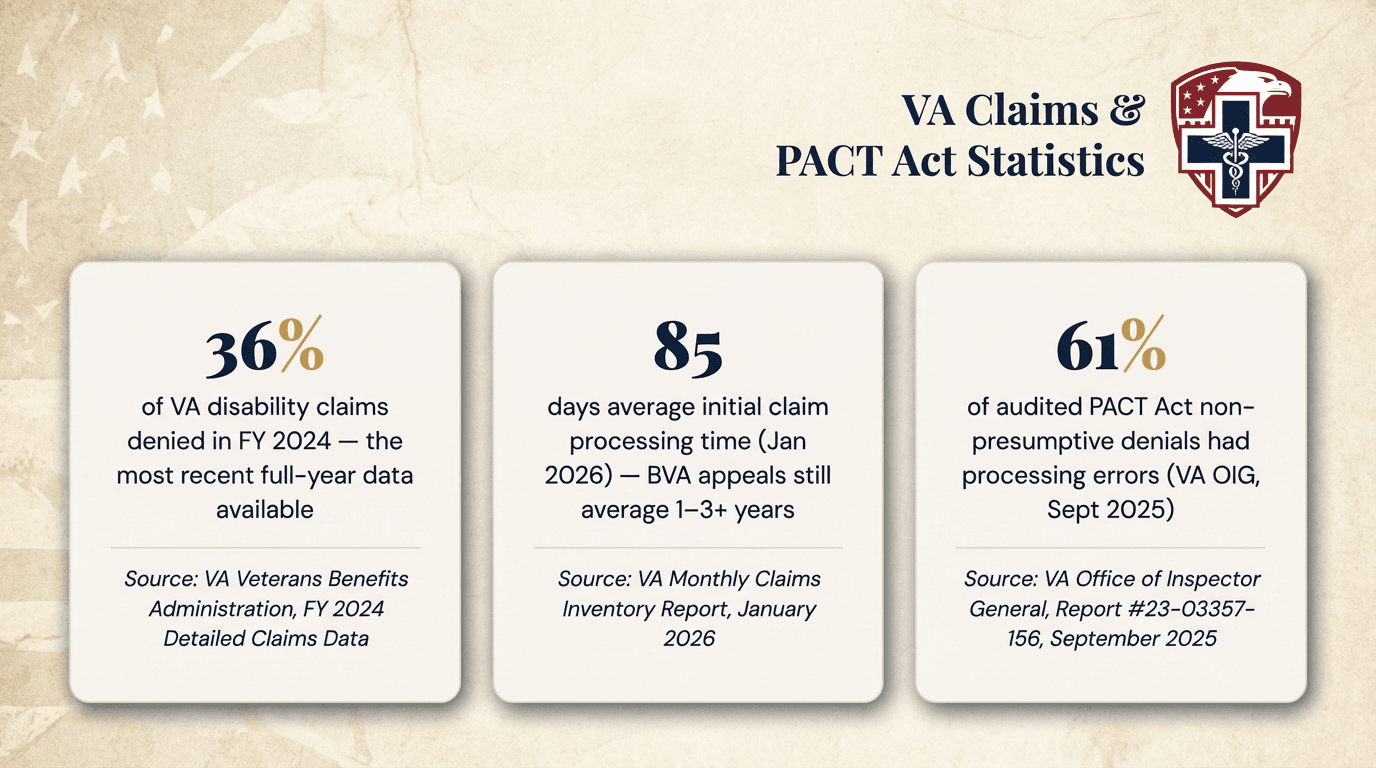
- ~36% denial rate (FY 2024): The VA's own fiscal year 2024 reporting confirmed it processed over 2.4 million disability claims, with only 64.2% approved — meaning nearly 36% were denied. This figure is cited by multiple legal and veteran advocacy organizations including Veterans Guide and corroborated by the VA's own VBA Detailed Claims Data. Full-year FY 2025 figures have not yet been published.
- 85-day average initial claim processing time (January 2026): As of January 2026, the VA's national average for processing initial disability claims is approximately 85 days, per the VA's monthly claims inventory reporting. This applies to initial decisions only. If your claim is denied and you appeal to the Board of Veterans and Appeals (BVA), timelines range from 365 days (Direct Review) to 730+ days (Hearing track) — with real-world waits often reaching 3–5 years for complex cases.
- 61% of audited PACT Act non-presumptive denials had processing errors (VA OIG, September 2025): The VA's own Office of Inspector General audit (Report #23-03357-156, published September 30, 2025) found a 61% error rate in its statistical sample of denied non-presumptive conditions associated with toxic exposure under the PACT Act. The OIG testified to Congress in October 2025 that processors failed to accurately identify toxic exposure claims, skipped legally required steps, and issued denials they were not legally permitted to make. The most common errors: failure to properly establish service connection and missing or insufficient documentation - not veteran ineligibility.
⚠ Common Filing Mistake
Many veterans assume that having a diagnosis is enough for VA approval. But the VA also requires a documented service connection — a clear medical or factual link between your condition and your military service. Without it, even a well-diagnosed condition can be denied. Learn more about Nexus Letters and service connection evidence.
What Is a Claim Readiness Review?
A Claim Readiness Review is a one-on-one expert checkup of your VA claim file — conducted before you file. Think of it as having a seasoned navigator review your map before you start a critical journey.
At Military Disability Nexus, our reviews are led by Subject Matter Experts (SMEs) with deep expertise in VA claim documentation. They've seen what works, what fails, and exactly why: and they'll give you a straight, honest assessment of where your file stands.
Our Honest Promise
Not every claim needs a Nexus Letter or additional medical opinion. Many claims already stand on their own merits. We'll tell you that upfront — because our goal is your win, not our revenue. Every recommendation we make is based on evidence, not upselling.
During your review, an SME evaluates your file from the perspective of a VA rater identifying the specific strengths to lean into, the weaknesses to address, and the documentation gaps that could derail your claim before you ever submit it.
What Gets Reviewed — and Why It Matters
1. Your Service Treatment Records (STRs):
Your STRs are the backbone of your claim. We examine them to confirm your condition appears on record and that the documentation is clear enough to support a service connection argument. Incomplete or vague STRs are one of the leading causes of denial — catching that early gives you time to address it.
2. Your Current Medical Evidence:
A current diagnosis from your private doctor or the VA is important, but it's often not sufficient on its own. We assess whether the language used in your medical records supports your claim — and whether additional documentation is needed to fill any gaps.
3. Claim Type Classification:
Not all VA claims are alike. Understanding which pathway applies to your situation is essential to both your strategy and your outcome.
- Primary Claim: a condition directly caused by your military service (e.g., a back injury from training).
- Secondary Claim: a condition caused or worsened by an already service-connected disability (e.g., sleep apnea secondary to PTSD).
- Aggravation / TERA: a pre-existing condition made significantly worse beyond its natural progression during service.
Misclassifying your claim type or not knowing which one applies - is a common and costly mistake. We identify the right pathway for you so you're not leaving benefits on the table.
4. Evidence Gaps and Missing Documentation:
We identify what's missing and give you clear, actionable guidance on how to obtain it. This might include buddy statements, personal statements, civilian medical records, or specific diagnostic results that will meaningfully strengthen your case.
What You Walk Away With
A Claim Readiness Review isn't just a conversation — it's a structured process with a concrete deliverable at the end.
1. File Submission and Intake
You submit your VA claim file, service treatment records, and any medical evidence you have. Your SME reviews everything before your session.
2. One-on-One SME Consultation:
A 60-minute session with your Subject Matter Expert — scheduled within 3–5 days. You discuss findings, ask questions, and get clarity on every aspect of your file.
3. Written Claim Readiness Report
Delivered within 5–7 days. A comprehensive written summary of your claim's strengths, weaknesses, missing documentation, and a clear step-by-step action plan.
4. You File Confidently
Armed with your report, you submit your claim knowing exactly what's in it, why it's strong, and what the VA will see when they open your file.
5. Who Should Get a Claim Readiness Review?
This service is built for veterans in one of three situations:
- First-time filers who want to file independently but want professional confirmation that their evidence is solid before submitting.
- Veterans with complex claims involving secondary conditions, TERA/aggravation pathways, or multiple service-connected disabilities.
- Veterans who've been denied before and want to understand exactly why — and what needs to be fixed — before refiling.
Not Sure Where You Stand?
Take the free 5-question Claim Readiness Diagnostic. It takes two minutes, and gives you instant personalized feedback on where your claim stands before you invest in anything?
Need help with your VA claim?
Get expert guidance and documentation from our licensed clinicians
Get Free ConsultationEducational Guidance and Evidence Research
View editorial standardsClinical Integrity and Accuracy Review
View medical review policyOriginally published March 11, 2026 • Last updated May 3, 2026
Related Insights
The VA Claim Pre-Filing Checklist: What Your Claim Actually Needs Before You Submit
Who Should Write Your VA Nexus Letter? A Clinician's Specialty-by-Specialty Guide (2026)
The C&P Examiner Said “Less Likely Than Not”: How a Rebuttal Opinion Answers Back
About this article. This post is general educational and medical information published by the Military Disability Nexus clinical team. It is not legal advice, not individualized medical advice, and not a substitute for a personal evaluation by a licensed clinician or a consultation with an accredited representative. Reading it does not create a doctor-patient or attorney-client relationship. VA law and rating criteria change; some details may not reflect the most recent updates, and every claim is decided by the VA on its own facts – no outcome is promised or guaranteed. Military Disability Nexus is an independent medical-evidence provider and is not affiliated with, endorsed by, or acting on behalf of the U.S. Department of Veterans Affairs or any government agency. Free claims assistance is available from VA-accredited Veterans Service Organizations and county Veterans Service Officers; you can verify any representative's accreditation through the VA Office of General Counsel.