
VA Disability Claims: Obesity as an Intermediate Cause for Secondary Conditions
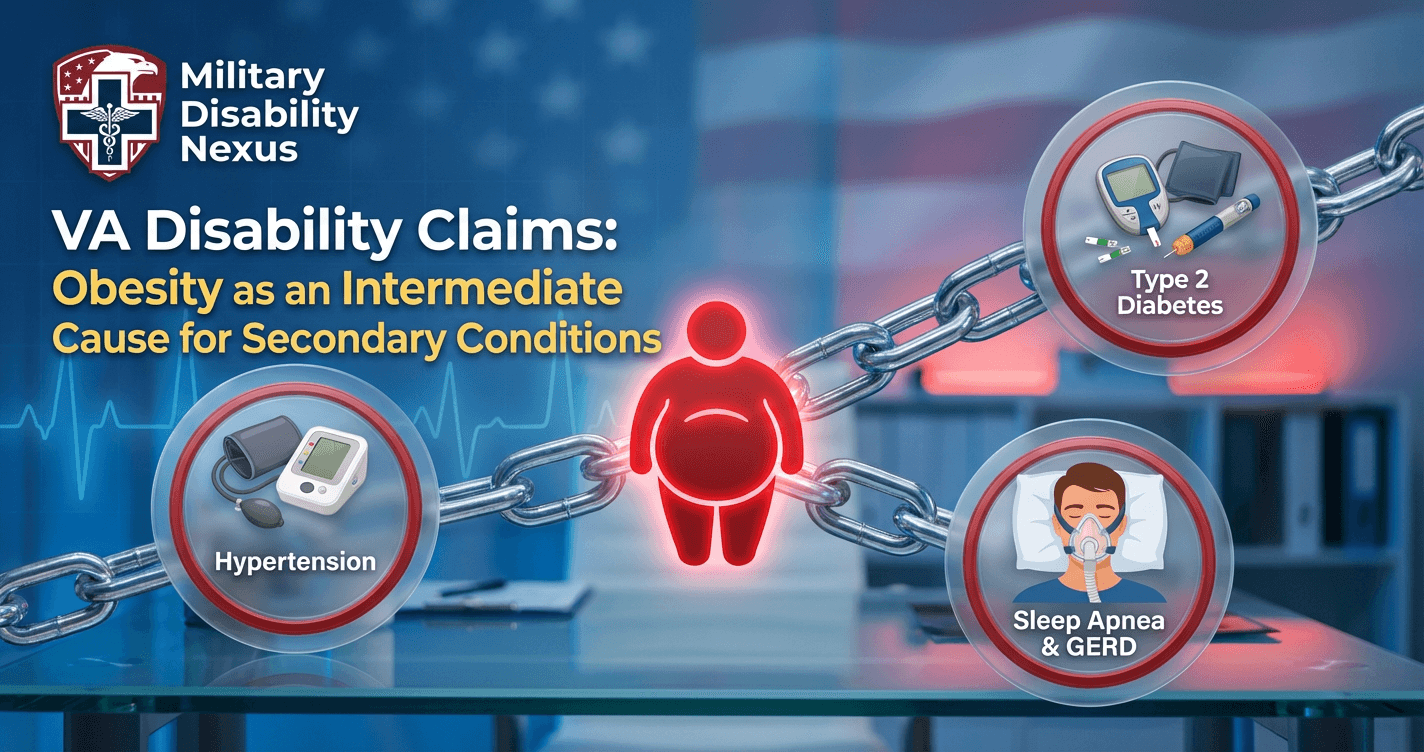
VA disability claims are rarely about a single diagnosis. For many veterans, service-connected conditions trigger a chain reaction of medical problems that unfold over years. Understanding this progression is critical when filing secondary service-connection claims.
One of the most important and misunderstood links in this chain is obesity as an intermediate medical cause. While obesity itself is not compensable, it can legally and medically connect a service-connected condition to serious secondary disabilities such as Hypertension, Type 2 Diabetes, Obstructive Sleep Apnea (OSA), and gastroesophageal reflux disease (GERD).
How Service-Connected Conditions Can Lead to Obesity
Many veterans live with service-connected conditions including:
Chronic knee, hip, or back injuries
Musculoskeletal conditions limiting movement
Mental health conditions such as PTSD, depression, or anxiety.
These conditions often lead to:
Reduced physical activity and mobility
Chronic pain and fatigue
Weight-promoting medication side effects
Poor sleep and metabolic disruption
Over time, these factors can directly contribute to weight gain and obesity, which then increases the risk of multiple chronic diseases.
Is Obesity a VA-Ratable Disability?
No. Obesity by itself is not considered a compensable disability under VA regulations. However, obesity can still be legally significant when it acts as an intermediate step between a service-connected condition and another diagnosable disability. The Department of Veterans Affairs recognizes secondary service connection when medical evidence clearly explains how one condition caused or aggravated another—even when obesity is part of that chain.
What Does “Obesity as an Intermediate Cause” Mean in VA Claims?
For VA secondary service-connection claims involving obesity, medical evidence must establish two clear links:
A service-connected condition caused or aggravated obesity, and
Obesity caused or aggravated another diagnosable condition
This sequential explanation is known as the medical nexus.
The VA does not infer these relationships automatically. Each step must be supported by medical reasoning, not simply by listing diagnoses in medical records.
Secondary Conditions Commonly Linked to Obesity in VA Disability Claims.
From a medical perspective, obesity is not merely a risk factor - it is a pathophysiological driver that can cause or permanently aggravate multiple chronic diseases. These conditions frequently appear in VA disability claims and are commonly recognized when obesity serves as an intermediate cause.
Hypertension (High Blood Pressure)
Obesity directly contributes to the development and worsening of hypertension through several well-established mechanisms, including:
Increased circulating blood volume, which raises arterial pressure
Elevated peripheral vascular resistance due to endothelial dysfunction
Chronic activation of the sympathetic nervous system
Increased cardiac workload and left ventricular strain
Over time, these changes place sustained stress on the cardiovascular system, making obesity a medically recognized cause or aggravating factor for chronic hypertension.
Type 2 Diabetes Mellitus
Obesity plays a central role in the development of Type 2 diabetes by disrupting normal metabolic function. Excess adipose tissue leads to:
Insulin resistance at the cellular level
Impaired glucose uptake and utilization
Chronic low-grade systemic inflammation
Dysregulation of lipid and carbohydrate metabolism
These metabolic abnormalities are foundational to Type 2 diabetes and explain why obesity is frequently identified as a causal or aggravating condition in diabetic disease progression.
Obstructive Sleep Apnea (OSA)
Obesity is one of the strongest and most consistently documented causes of obstructive sleep apnea. Excess body fat affects airway anatomy and respiratory mechanics through:
Fat deposition around the neck and upper airway, narrowing the airway lumen
Reduced pharyngeal muscle tone during sleep
Increased collapsibility of the upper airway
Impaired respiratory mechanics related to central obesity
These changes result in repeated airway obstruction during sleep, oxygen desaturation, fragmented sleep architecture, and long-term cardiovascular strain—hallmarks of clinically significant OSA.
Gastroesophageal Reflux Disease (GERD)
GERD is particularly important in VA claims because it is not simply a symptom-based condition, but a structural and pressure-related disorder that obesity can directly cause or aggravate.
Obesity contributes to GERD through multiple mechanical mechanisms, including:
Increased intra-abdominal pressure, which forces gastric contents upward into the esophagus
Mechanical weakening of the lower esophageal sphincter (LES), reducing its ability to prevent reflux
Increased risk or worsening of hiatal hernia, which disrupts normal esophageal anatomy
Delayed gastric emptying, prolonging acid exposure in the upper gastrointestinal tract
These structural and pressure-related changes allow stomach acid to reflux into the esophagus repeatedly, leading to chronic GERD and esophageal injury. Because these mechanisms involve physical alterations to anatomy and function, obesity can clearly be identified as a causative or permanently aggravating factor.
How the VA Evaluates Obesity-Related Secondary Claims
The VA looks for medical evidence that clearly explains:
How a service-connected condition led to obesity, and
How obesity then caused or aggravated hypertension, diabetes, OSA, or GERD
Strong claims often include:
A detailed medical nexus opinion
Clear cause-and-effect explanations
Consistent treatment records supporting progression over time.
Real-World Example: Obesity as an Intermediate Cause — A VA Success Story
The concept of obesity as an intermediate cause is not just theoretical — it has been successfully applied in real VA disability claims.
In one documented case study, a veteran was granted secondary service connection for obstructive sleep apnea (OSA) where:
PTSD was already service-connected,
PTSD contributed to chronic sleep disturbance, medication effects, and long-term weight gain,
Obesity acted as the intermediate medical step, and
Obesity then caused obstructive sleep apnea through well-established physiological mechanisms.
This case demonstrates how clearly explaining the step-by-step medical nexus — rather than simply listing diagnoses — can lead to a successful outcome.
👉 You can read the full case study here: Obesity as an Intermediate Cause — A VA Disability Claim Success Story
This case highlights an important lesson: VA claims involving obesity are often won or lost based on how well the medical reasoning is documented—not whether obesity is mentioned at all.
Need help with your VA claim?
Get expert guidance and documentation from our licensed clinicians
Get Free ConsultationDr. Kishan Bhalani is a subject matter expert on VA disability claims documentation, with more than five years of focused work at the intersection of clinical m…
Originally published January 14, 2026 • Last updated May 3, 2026
Related Insights
PTSD VA Disability Claim: Nexus Letters, Denial Reasons & Your Complete Filing Guide
Who Should Write Your VA Nexus Letter? A Clinician's Specialty-by-Specialty Guide (2026)
VA Form 21-526EZ Is Shrinking to 5 Pages: What Changes, and What Doesn't
About this article. This post is general educational and medical information published by the Military Disability Nexus clinical team. It is not legal advice, not individualized medical advice, and not a substitute for a personal evaluation by a licensed clinician or a consultation with an accredited representative. Reading it does not create a doctor-patient or attorney-client relationship. VA law and rating criteria change; some details may not reflect the most recent updates, and every claim is decided by the VA on its own facts – no outcome is promised or guaranteed. Military Disability Nexus is an independent medical-evidence provider and is not affiliated with, endorsed by, or acting on behalf of the U.S. Department of Veterans Affairs or any government agency. Free claims assistance is available from VA-accredited Veterans Service Organizations and county Veterans Service Officers; you can verify any representative's accreditation through the VA Office of General Counsel.