
The "Permanent and Total" (P&T) Pathway and Its Connection to Aid and Attendance and SMC
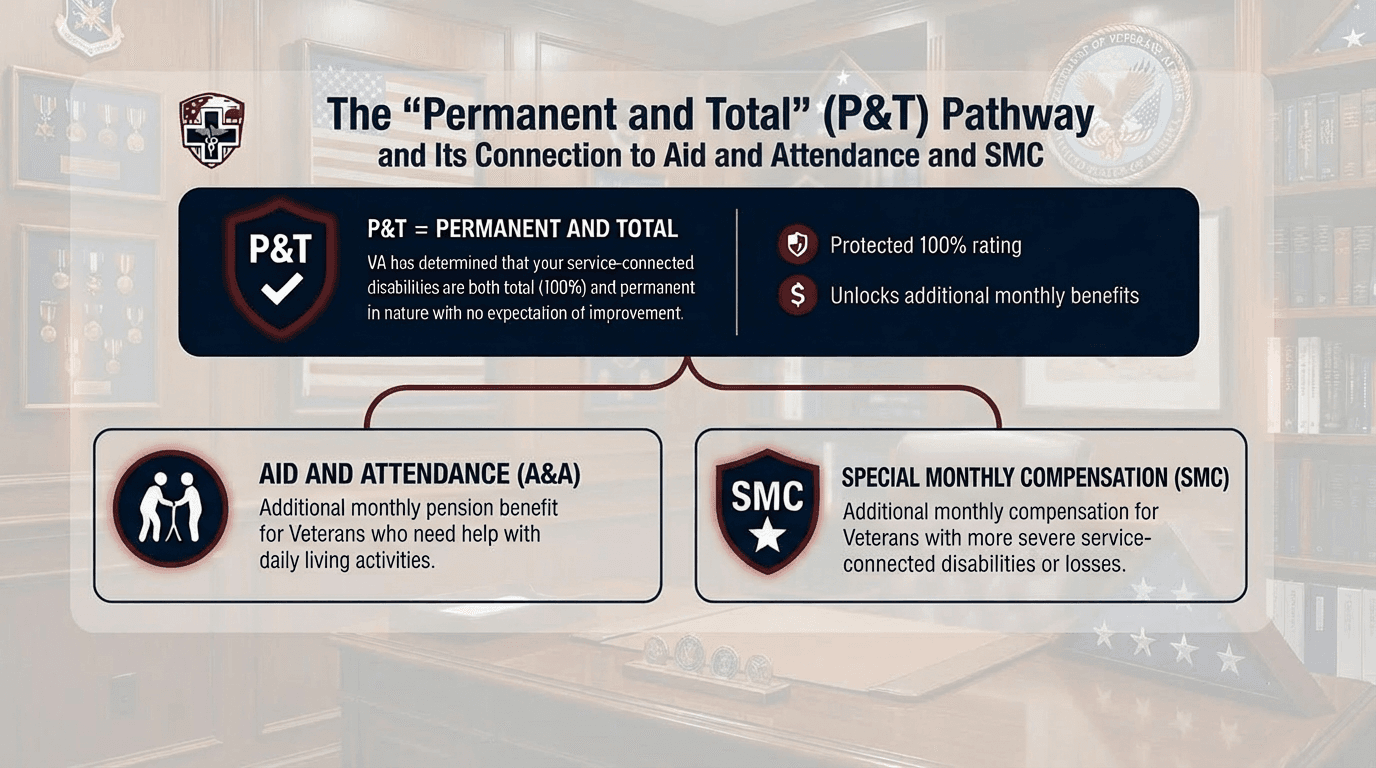
- 1.What "Permanent and Total" Actually Means
- 2.How to Verify Your P&T Status
- 3.Benefits P&T Unlocks Beyond Compensation
- 4.The P&T → A&A → SMC Progression
- 5.Going From P&T to Aid and Attendance (SMC-L)
- 6.P&T and Housebound (SMC-S): The Overlooked Benefit
- 7.The SMC Ladder: L Through R and Beyond
- 8.TDIU and P&T: How They Interact
- 9.Documenting the Progression: What the VA Needs
- 10.How Military Disability Nexus Supports the P&T → A&A Pathway
QUICK ANSWERPermanent and Total (P&T) means the VA has determined your service-connected disabilities are rated at 100% and are not expected to improve. P&T is not just a rating — it's a gateway to additional benefits including CHAMPVA for dependents, Chapter 35 education benefits, property tax exemptions, and eligibility for Aid and Attendance (SMC-L) and higher levels of Special Monthly Compensation. Many P&T veterans are undercompensated because they don't know about the benefits P&T unlocks or don't realize their conditions have progressed to the point of qualifying for SMC.
What "Permanent and Total" Actually Means
"Permanent and Total" is two separate determinations combined:
Total means the VA has rated the veteran's service-connected disabilities at 100% on the combined rating schedule (or has granted TDIU, which pays at the 100% rate).
Permanent means the VA has determined that the veteran's disabilities are static — they are not expected to improve. The VA will not schedule future re-examinations.
A veteran can be rated at 100% without being "permanent" for example, if the VA expects improvement and schedules a future re-examination. And a veteran can have a permanent disability rated at less than 100%. P&T requires both elements.
The significance of the "permanent" designation is that it eliminates the risk of a future rating reduction and unlocks a tier of benefits that are not available to veterans who are 100% but not yet permanent.
How the VA signals P&T: The rating decision letter will typically contain the language "no future examinations are scheduled" or "your disability is considered permanent and total." If neither phrase appears in your rating decision, you may be 100% without the permanent designation — which means you are still subject to future re-examinations and do not yet qualify for P&T-linked benefits.
How to Verify Your P&T Status
There are several ways to confirm whether you have P&T status:
VA rating decision letter — look for "no future examinations are scheduled" or "service-connected disabilities are permanent and total"
VA.gov benefits summary letter — log in to VA.gov, navigate to "Download your benefit letters," and check the Benefits Summary Letter. It will indicate if you are "totally and permanently disabled"
eBenefits — the legacy portal shows P&T status under disability compensation details
Call the VA — 1-800-827-1000. A representative can confirm P&T status verbally
Your VA-accredited representative can pull your rating code sheet, which explicitly shows permanence designations for each rated condition
Benefits P&T Unlocks Beyond Compensation
Many veterans focus solely on the monthly compensation at 100%, not realizing that the "permanent" designation unlocks a separate tier of benefits that can be worth tens of thousands of dollars annually.
CHAMPVA for Dependents
Dependents of P&T veterans who are not eligible for TRICARE qualify for CHAMPVA healthcare coverage. This covers medical, pharmacy, and mental health care for spouses and children — a benefit worth thousands per year in healthcare costs..
CHAPTER 35 DEA
Chapter 35 Dependents' Educational Assistance (DEA) provides up to 36 months of education and training benefits to eligible dependents of P&T veterans. Spouses and children can use DEA for undergraduate and graduate degree programs, certificate courses, apprenticeships, and on-the-job training. The current monthly benefit rate for full-time institutional training is approximately $1,298 per month (2026 rate). Spouses generally have 10 years from the date the VA finds the veteran P&T to use the benefit. Children are typically eligible between ages 18 and 26. This benefit alone can be worth $46,000+ in education funding per eligible dependent.
PROPERTY TAX EXEMPTIONS
Many states offer partial or full property tax exemptions for P&T veterans. In some states (Texas, Florida, others), this exemption alone can be worth $5,000–$15,000+ per year, depending on home value.
NO FUTURE NO EXAMINATIONS
The "permanent" designation means the VA will not schedule routine future C&P exams to reduce your rating. This provides stability and eliminates the anxiety of potential rating reductions.
COMMISSARY AND EXCHANGE ACCESS
Dependents of P&T veterans receive commissary and exchange privileges.
GATEWAY TO A&A AND SMC
P&T status is often the starting point for Aid and Attendance and Special Monthly Compensation claims when conditions progress. This is the focus of this article.
The cumulative value: For a P&T veteran with a spouse and two children in a state with full property tax exemption, the combination of CHAMPVA, DEA, property tax savings, and stability from no re-exams can add $20,000–$40,000+ per year in effective value beyond the monthly compensation check. Many veterans don't claim all of these benefits.
The P&T → A&A → SMC Progression
The pathway from initial service connection to the highest levels of VA compensation follows a logical progression. Each step builds on the previous one.
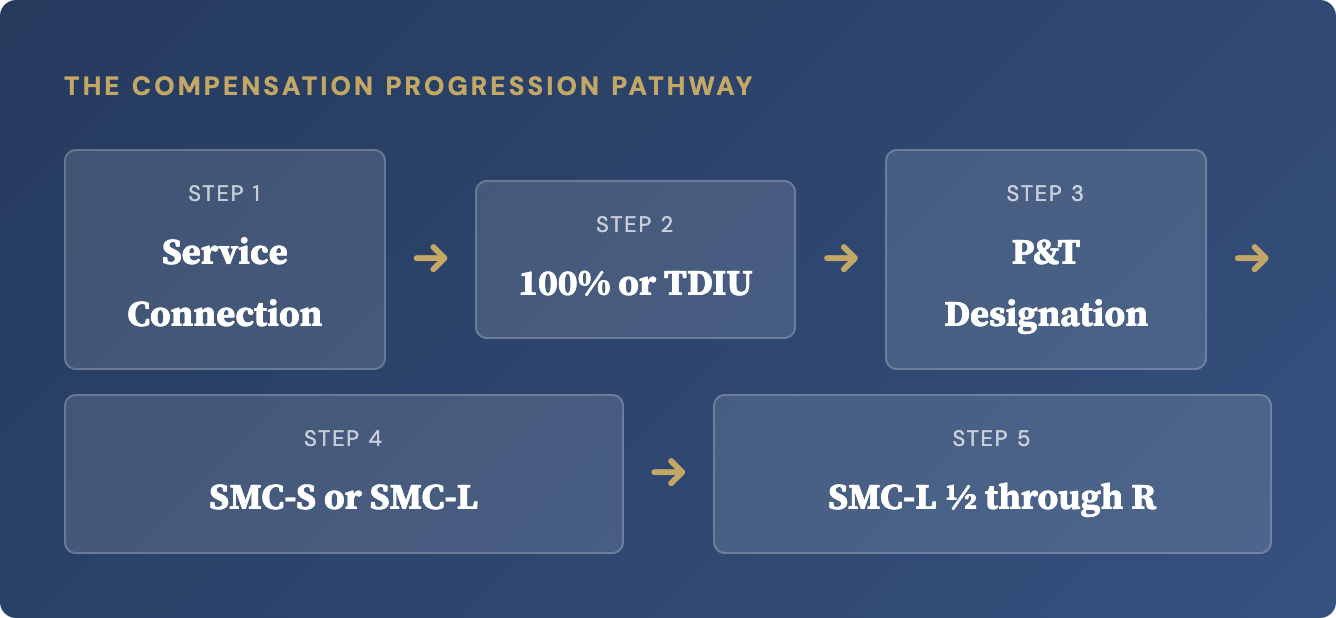
Not every veteran will progress through all five steps, and not every veteran should. But understanding the pathway helps veterans and their representatives recognize when it's time to file for the next level of benefits.
Going From P&T to Aid and Attendance (SMC-L)
The most common transition from P&T to a higher benefit level is the move from 100% P&T to SMC-L (Aid and Attendance). This happens when a veteran's service-connected conditions have progressed to the point where they need another person's regular assistance with activities of daily living.
When does this transition typically occur?
In our clinical experience, the P&T-to-A&A transition most commonly occurs when:
Cognitive decline accelerates — veterans with PTSD, TBI, or other service-connected conditions who develop dementia or significant cognitive impairment requiring supervision
Mobility deteriorates — veterans with service-connected musculoskeletal conditions who become wheelchair-dependent or fall-prone
Multiple conditions compound — a veteran with diabetes, neuropathy, cardiovascular disease, and visual impairment who can no longer manage medications, meal preparation, or hygiene independently
Cancer treatment residuals — veterans undergoing chemotherapy or with advanced cancer who need daily assistance
Neurological progression — Parkinson's, MS, or ALS progression reaching the point of ADL dependence
What the VA needs to grant SMC-L:
VA Form 21-2680 completed by a physician documenting the specific ADL limitations
Medical evidence connecting the ADL limitations to service-connected disabilities (not merely age-related decline)
Evidence that the need is regular — not occasional. "Regular" means the veteran needs assistance on a daily or near-daily basis
Caregiver lay statements describing the daily care provided.
Common error: Veterans and their representatives sometimes fail to establish the link between the service-connected disabilities and the ADL limitations. If the VA determines that the need for assistance is due to non-service-connected conditions (such as age-related arthritis that was never claimed), the SMC-L claim may be denied even though the veteran clearly needs help. An independent medical opinion that explicitly connects the current ADL limitations to the service-connected conditions and explains why they — rather than non-service-connected factors — are the primary cause can be critical.
P&T and Housebound (SMC-S): The Overlooked Benefit
SMC-S (Housebound) is one of the most underutilized VA benefits because many veterans qualify for it without realizing it.
The two-part statutory test for SMC-S:
The veteran has a single service-connected disability rated at 100% (or TDIU based on a single condition), AND
The veteran has additional service-connected disabilities independently rated at 60% or more (combined under VA math)
If both conditions are met, the veteran qualifies for SMC-S regardless of whether they are actually confined to the home. This is the "statutory" housebound test — it's purely mathematical.
For 2026, SMC-S pays approximately $4,409/month for a single veteran with no dependents — roughly $470 more per month than the standard 100% rate of $3,939.
Example: A veteran with PTSD rated at 70% plus TDIU (paying at the 100% rate) based on PTSD alone, who also has lumbar spine at 40%, tinnitus at 10%, and migraine at 30% (combining to approximately 62% under VA math for the non-PTSD conditions) — this veteran likely qualifies for SMC-S. That's an additional $470/month ($5,640/year) that many veterans don't know they're entitled to.
The VA is supposed to proactively consider SMC-S whenever the evidence in the file supports it. In practice, this doesn't always happen. Veterans and their representatives should review the rating structure and check whether SMC-S has been addressed.
The SMC Ladder: L Through R and Beyond
For veterans whose conditions are severe enough to warrant A&A, the SMC system has multiple levels reflecting increasing severity of disability and care needs.
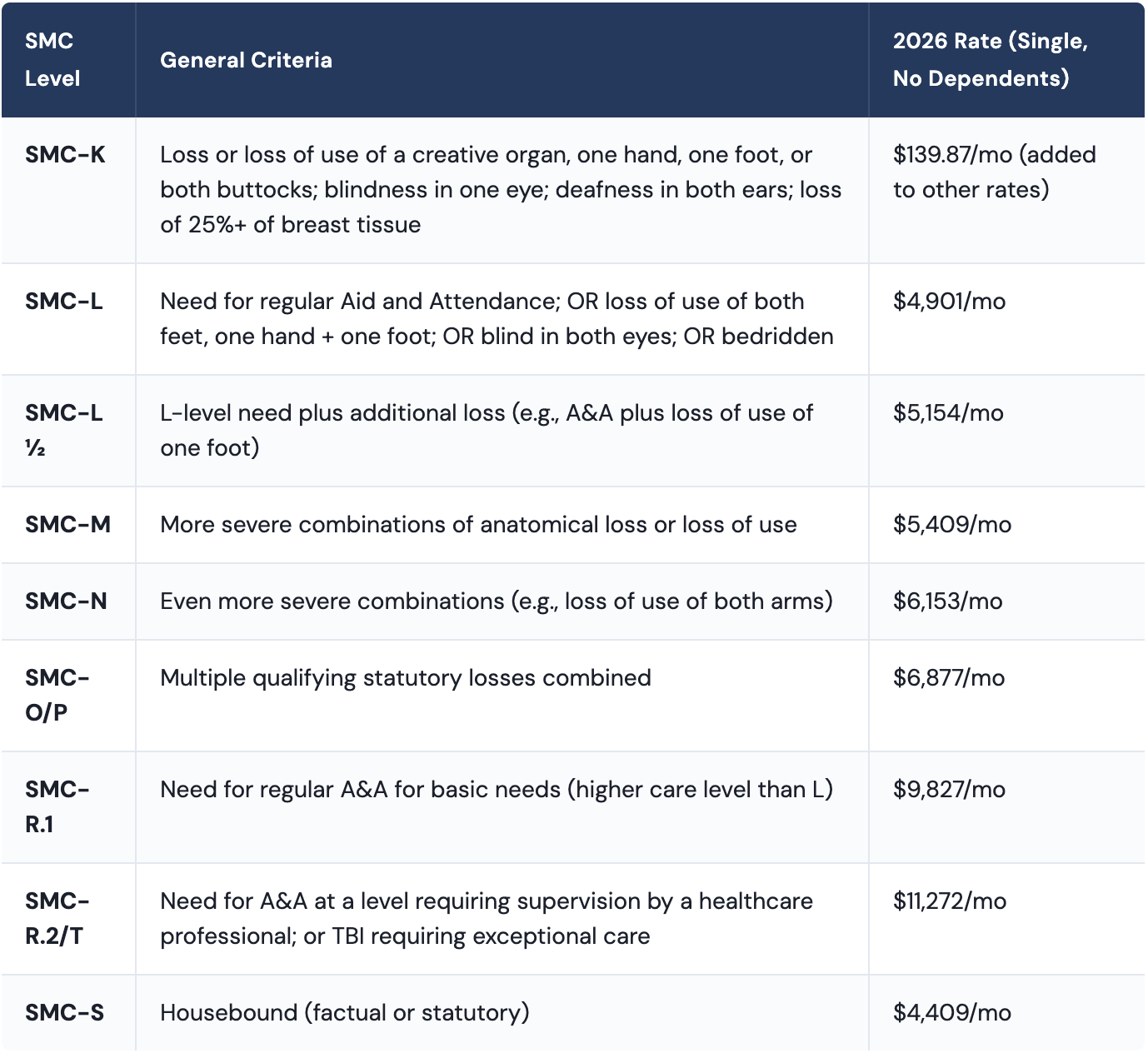
SMC-K is unique because it adds to other rates rather than replacing them. A veteran receiving SMC-L who also qualifies for SMC-K would receive $4,901 + $139.87 = approximately $5,041/month. Up to three SMC-K awards can stack if separate qualifying losses exist.
TDIU and P&T: How They Interact
TDIU (Total Disability Based on Individual Unemployability) pays at the 100% rate when a veteran's service-connected disabilities prevent substantially gainful employment, even if their combined schedular rating is less than 100%.
Can TDIU be permanent?
Yes. If the VA determines the veteran's unemployability is not expected to improve, TDIU is designated as permanent. TDIU with permanence unlocks the same P&T-linked benefits as a 100% schedular rating with permanence — CHAMPVA, Chapter 35 DEA, property tax exemptions, and no future re-examinations.
TDIU and SMC-S: The critical distinction
TDIU can qualify for SMC-S (statutory housebound), but only if the TDIU is based on a single disability. If TDIU was granted because multiple conditions together prevent employment, that TDIU generally does not satisfy the "single disability at 100%" prong of the SMC-S test.
This distinction matters significantly for veterans with multiple service-connected conditions. A veteran whose TDIU was granted based on PTSD alone, with other conditions rated separately at 60%+, may qualify for SMC-S. A veteran whose TDIU was granted based on "combined effect of PTSD, lumbar spine, and bilateral knee" typically would not.
Strategy consideration: For veterans with multiple conditions who are approaching TDIU, how the TDIU grant is structured — single-condition basis vs. combined-conditions basis — can have significant downstream implications for SMC-S eligibility. This is a topic veterans should discuss with a VA-accredited representative before filing.
Documenting the Progression: What the VA Needs
Moving along the P&T → A&A → SMC pathway requires documentation at each transition point.
For P&T designation:
Medical evidence showing the disability is static and not expected to improve
Treatment records showing stability or progressive worsening over time
An IMO stating that the condition is permanent, based on the medical literature, the veteran's specific pathology, and the treatment history
For the transition from P&T to SMC-L (A&A):
VA Form 21-2680 with detailed ADL documentation
Medical records showing functional decline attributable to service-connected conditions
Caregiver lay statements
An IMO connecting the current ADL limitations specifically to service-connected disabilities and explaining why non-service-connected factors are not the primary cause
For higher SMC levels (M, N, O, R):
Medical evidence documenting the specific anatomical losses or combinations of losses that qualify for the higher level
Functional assessments demonstrating the level of care required
For SMC-R, evidence of the need for care by or under the supervision of a licensed healthcare professional
FAQ
What does Permanent and Total (P&T) mean for VA disability?
P&T means the VA has determined that your service-connected disabilities are rated at 100% (total) and are not expected to improve (permanent). P&T unlocks additional benefits including CHAMPVA, Chapter 35 DEA, property tax exemptions, and serves as a gateway to A&A and SMC.
How do I know if I have P&T status?
Check your VA rating decision letter for "no future examinations are scheduled" or check your Benefits Summary Letter on VA.gov. You can also call 1-800-827-1000 to confirm.
Do I need P&T to get Aid and Attendance?
P&T is not strictly required for A&A, but the two are closely related. For SMC-L (service-connected A&A), you need a 100% rating or TDIU. Veterans needing A&A-level care typically have permanent disabilities.
What benefits does P&T unlock beyond compensation?
CHAMPVA healthcare for dependents, Chapter 35 Dependents' Educational Assistance (DEA), property tax exemptions in many states, no future C&P re-examinations, and eligibility for A&A (SMC-L) and higher SMC levels.
Can TDIU qualify as P&T?
Yes. If the VA determines unemployability is permanent, TDIU receives the P&T designation and unlocks the same benefits. However, TDIU only qualifies for SMC-S if it was granted based on a single disability.
What is the connection between P&T and SMC?
P&T and SMC are related but distinct. P&T means total and permanent. SMC is additional compensation for specific types of severe disability. A veteran can be P&T without SMC. The most common connection is that P&T veterans whose conditions worsen to ADL dependence become eligible for SMC-L or higher.
How do I go from 100% P&T to Aid and Attendance (SMC-L)?
File a claim for SMC with VA Form 21-2680 completed by a physician, supported by medical records documenting functional decline, caregiver statements, and potentially an IMO connecting the ADL limitations to service-connected conditions.
How Military Disability Nexus Supports the P&T → A&A Pathway
When we work with veterans navigating the transition from P&T to Aid and Attendance, we provide independent medical opinions that explicitly connect the veteran's current ADL limitations to their service-connected disabilities. This is the critical evidentiary link that the VA requires but that is often missing from the claim.
Our clinicians review the medical record, the Form 21-2680, the rating history, and the caregiver evidence to produce an opinion that addresses the specific question: "Is the veteran's need for aid and attendance at least as likely as not caused by or related to their service-connected conditions?"
We provide medical opinions only - not claims-preparation or legal representation. Veterans should work with a VA-accredited representative for the claims-preparation side.
⚠️ Disclaimer
Educational purpose only.This article reflects general information about VA P&T status, Aid and Attendance, and Special Monthly Compensation. It is not legal, financial, or medical advice.
Rates may change. All rates cited are effective December 1, 2025 through November 30, 2026. Veterans should verify current figures on va.gov.
Not claims preparation. Military Disability Nexus provides independent medical opinions only. Under 38 CFR § 14.629, claims-preparation services require VA accreditation.
State benefits vary. Property tax exemptions and other state-level P&T benefits vary by state and are subject to change. Contact your state's Department of Veterans Affairs..
Need help with your VA claim?
Get expert guidance and documentation from our licensed clinicians
Get Free ConsultationDr. Kishan Bhalani is a subject matter expert on VA disability claims documentation, with more than five years of focused work at the intersection of clinical m…
Dr. Kishan Bhalani is a subject matter expert on VA disability claims documentation, with more than five years of focused work at the intersection of clinical m…
Originally published April 28, 2026 • Last updated July 15, 2026
Related Insights
PTSD VA Disability Claim: Nexus Letters, Denial Reasons & Your Complete Filing Guide
Who Should Write Your VA Nexus Letter? A Clinician's Specialty-by-Specialty Guide (2026)
Will Filing for Aid & Attendance Put My Current VA Disability Ratings at Risk?
About this article. This post is general educational and medical information published by the Military Disability Nexus clinical team. It is not legal advice, not individualized medical advice, and not a substitute for a personal evaluation by a licensed clinician or a consultation with an accredited representative. Reading it does not create a doctor-patient or attorney-client relationship. VA law and rating criteria change; some details may not reflect the most recent updates, and every claim is decided by the VA on its own facts – no outcome is promised or guaranteed. Military Disability Nexus is an independent medical-evidence provider and is not affiliated with, endorsed by, or acting on behalf of the U.S. Department of Veterans Affairs or any government agency. Free claims assistance is available from VA-accredited Veterans Service Organizations and county Veterans Service Officers; you can verify any representative's accreditation through the VA Office of General Counsel.