
Aid and Attendance vs. Housebound Benefits: Eligibility, Rates, and Documentation (2026 Guide)
- 1.Side-by-Side Comparison: Aid and Attendance vs. Housebound
- 2.Two Pathways to Aid and Attendance: Pension vs. Disability Compensation
- 3.2026 Rates: What Aid and Attendance and Housebound Pay
- 4.Aid and Attendance Eligibility: The ADL Standard
- 5.Housebound Eligibility: The Confinement Standard
- 6.Documentation: VA Form 21-2680 and Supporting Evidence
- 7.Why A&A Claims Get Denied: Five Common Documentation Failures
- 8.Aid and Attendance for Surviving Spouses
- 9.Medicaid and Aid and Attendance: The Interaction
- 10.Frequently Asked Questions
- 11.How Military Disability Nexus Can Help With A&A Documentation
QUICK ANSWERAid and Attendance (A&A) is for veterans who need help from another person to perform activities of daily living. Housebound is for veterans substantially confined to their home. Both are enhancements to existing VA pension or disability compensation — not standalone benefits. You cannot receive both simultaneously. A&A generally pays more. For 2026, the maximum A&A pension rate is $2,424/month for a single veteran; service-connected A&A (SMC-L) pays approximately $4,901/month..
Side-by-Side Comparison: Aid and Attendance vs. Housebound
Veterans often confuse these two benefits or aren't aware they are separate. The following table summarizes the key differences.
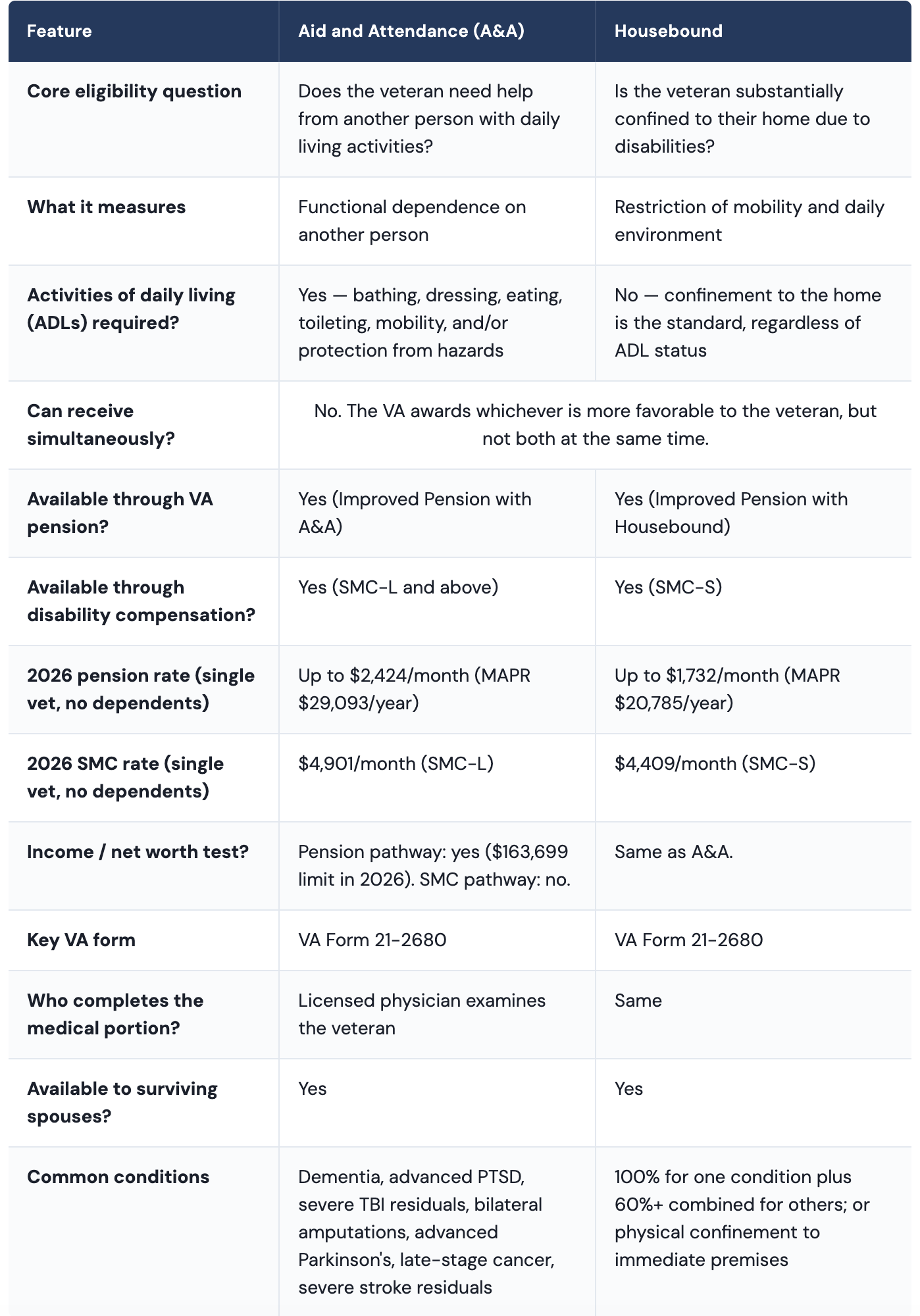
Key distinction: A&A asks "does this veteran need another person's help?" Housebound asks "is this veteran stuck at home?" A veteran in a wheelchair who can perform ADLs independently but cannot leave the house may qualify for Housebound but not A&A. A veteran with dementia who can physically walk but cannot safely bathe, dress, or eat without supervision may qualify for A&A but not necessarily Housebound.
Common conditionsDementia, advanced PTSD, severe TBI residuals, bilateral amputations, advanced Parkinson's, late-stage cancer, severe stroke residuals100% for one condition plus 60%+ combined for others; or physical confinement to immediate premises
Key distinction: A&A asks "does this veteran need another person's help?" Housebound asks "is this veteran stuck at home?" A veteran in a wheelchair who can perform ADLs independently but cannot leave the house may qualify for Housebound but not A&A. A veteran with dementia who can physically walk but cannot safely bathe, dress, or eat without supervision may qualify for A&A but not necessarily Housebound.
Two Pathways to Aid and Attendance: Pension vs. Disability Compensation
One of the most common sources of confusion is that "Aid and Attendance" exists through two entirely separate VA benefit systems. Understanding which pathway applies to a veteran's situation determines the eligibility criteria, the payment amount, and the documentation required.
Pathway 1: VA Improved Pension with Aid and Attendance
This is the needs-based pathway. It applies to wartime veterans (or their surviving spouses) who:
Served at least 90 days of active duty with at least one day during a recognized wartime period (WWII, Korea, Vietnam, Gulf War era, or post-9/11)
Have a permanent and total non-service-connected disability, are 65 or older, or are in a nursing home
Meet the income and net worth limits ($163,699 combined net worth limit for 2026)
Need the regular aid and attendance of another person for ADLs
This pathway is income-dependent. The VA calculates payment by subtracting the veteran's countable income from the applicable Maximum Annual Pension Rate (MAPR). Unreimbursed medical expenses (UMEs) can reduce countable income, which is important for veterans whose income might otherwise exceed the threshold.
Pathway 2: Special Monthly Compensation (SMC) at Level L or Above
This is the service-connected pathway. It applies to veterans who:
Have service-connected disabilities rated at 100% schedular or TDIU
Need the regular aid and attendance of another person due to their service-connected conditions
OR meet specific anatomical or functional loss criteria (loss of use of both feet, one hand and one foot, blindness in both eyes, or being bedridden)
This pathway is not income-dependent. SMC pays a fixed monthly amount based on the level of disability and dependency, regardless of the veteran's income or assets. SMC rates are substantially higher than pension A&A rates.
Important: A veteran may qualify for both pension-based A&A and SMC-based A&A, but the VA generally pays the higher of the two — not both. Veterans should evaluate both pathways with a VA-accredited representative to determine which produces the better outcome.
2026 Rates: What Aid and Attendance and Housebound Pay
The following rates are effective December 1, 2025 through November 30, 2026, reflecting the 2.8% COLA increase.
Pension Pathway: Maximum Annual Pension Rates (MAPR)
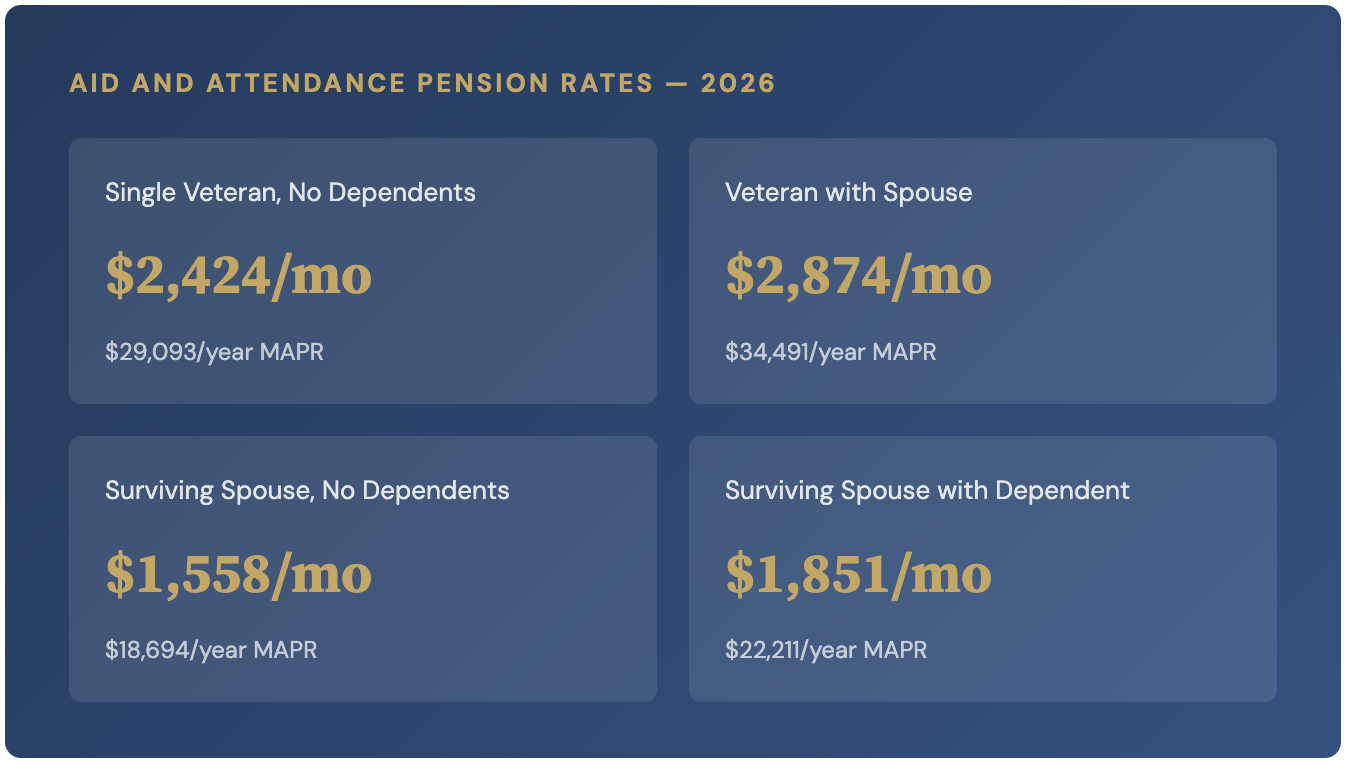
⚠️ Note: These are maximum rates. Actual payment equals MAPR minus countable income, divided by 12. Unreimbursed medical expenses reduce countable income. Rates are updated annually based on COLA. The 2026 net worth limit is $163,699.
Disability Compensation Pathway: SMC Rates
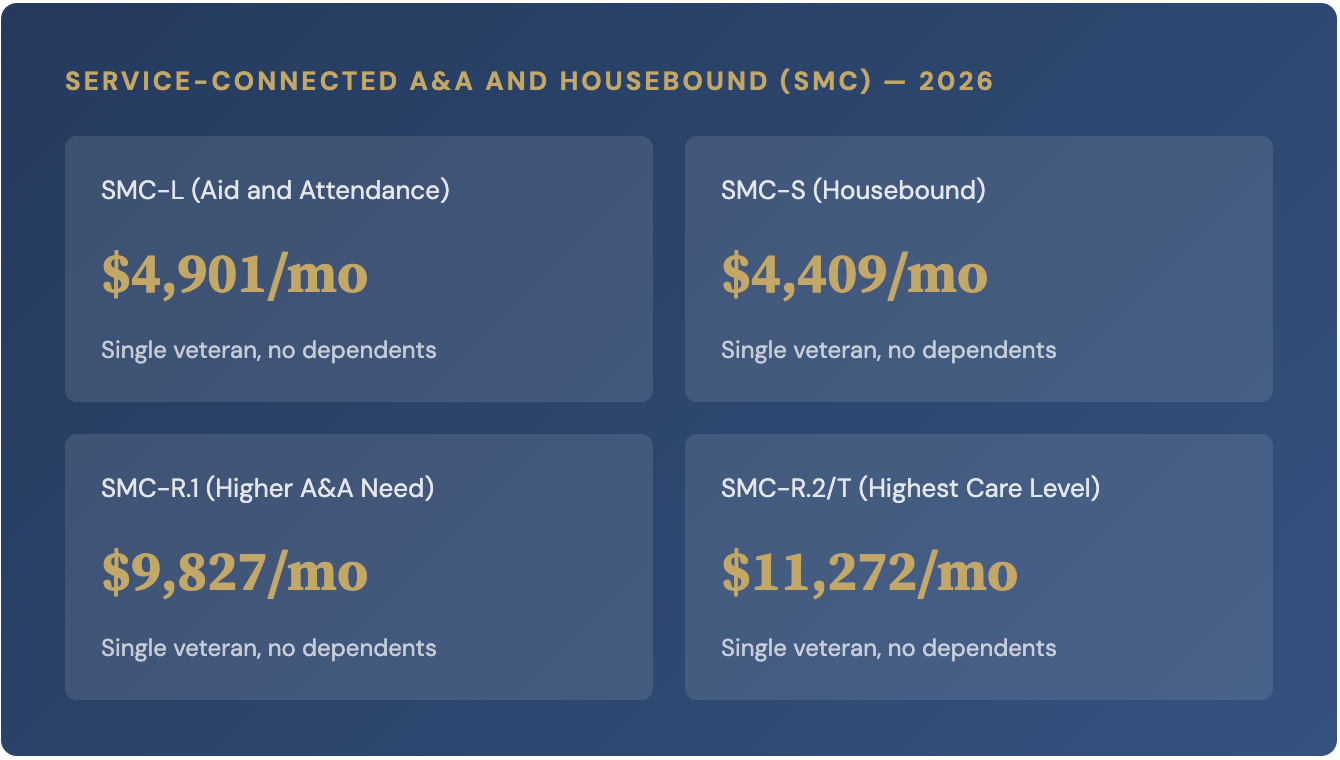
SMC rates increase with dependents. A veteran with a spouse receiving SMC-L would receive approximately $5,120/month. SMC-K ($139.87/month) may be added on top of SMC-L for qualifying anatomical losses.
Aid and Attendance Eligibility: The ADL Standard
Aid and Attendance eligibility turns on the veteran's functional dependence on another person. The VA evaluates this through activities of daily living (ADLs) — the basic self-care tasks that most adults perform independently.
The Five Core ADL Categories
1. Bathing and Personal Hygiene
Can the veteran safely bathe, shower, or maintain personal hygiene without assistance? This includes getting in and out of the tub or shower, washing hair and body, oral care, and grooming. If the veteran requires hands-on help or standby supervision due to fall risk, cognitive impairment, or physical limitation, this ADL is impaired.
2. Dressing and Undressing
Can the veteran select appropriate clothing, put it on, fasten buttons and zippers, and remove it without help? Veterans with severe arthritis, bilateral upper extremity limitations, stroke residuals, or cognitive decline often require assistance with dressing.
3. Eating and Meal Preparation
Can the veteran feed themselves once food is prepared? Can they prepare simple meals? This includes the physical ability to use utensils, bring food to the mouth, and chew and swallow safely. Veterans with advanced Parkinson's tremor, severe TBI, or dysphagia often qualify on this ADL.
4. Toileting
Can the veteran use the bathroom independently, including transfers to and from the toilet, managing clothing, and maintaining hygiene afterward? Incontinence management (catheter care, ostomy care, or use of absorbent products) also falls under this ADL.
5. Mobility and Transfers
Can the veteran move from bed to chair, stand from a seated position, walk within the home, and navigate stairs? This includes the ability to ambulate with or without assistive devices. Veterans who are wheelchair-dependent, use walkers, or have frequent falls often qualify on this ADL.
Additional Criterion: Protection from Hazards
Even if a veteran can physically perform some ADLs, if they require protection from the hazards or dangers of their daily environment due to cognitive decline — such as leaving the stove on, wandering, inability to manage medications, or impaired judgment about safety — this alone may qualify them for A&A. This criterion is particularly relevant for veterans with dementia, Alzheimer's disease, advanced TBI, or severe PTSD with dissociative features.
The documentation standard: The veteran does not need to be unable to perform all ADLs. Needing regular assistance with any one or more ADLs may establish eligibility, depending on the severity and the totality of the evidence. The key is that the need for assistance must be documented as being due to disabilities, not merely personal preference.
Housebound Eligibility: The Confinement Standard
Housebound benefits apply when a veteran is substantially confined to their immediate premises due to service-connected disabilities. "Substantially confined" does not mean the veteran can never leave the home — it means leaving the home is impractical or requires considerable effort due to the disability.
Two Ways to Qualify for Housebound (SMC-S)
Factual Housebound
The veteran is physically confined to the home and immediate premises. Examples include severe agoraphobia, oxygen dependence that prevents leaving the home, wheelchair dependence without accessible transportation, or post-surgical confinement with ongoing disability.
Statutory Housebound
The veteran has a single service-connected disability rated at 100% (or TDIU based on a single condition) plus additional service-connected disabilities independently rated at 60% or more. This is a mathematical test, not a confinement test — the veteran does not need to be physically housebound.
Commonly overlooked: Many veterans who qualify for statutory housebound (SMC-S) don't realize it. If you have PTSD rated at 100% (or TDIU based on PTSD alone) and your other service-connected conditions (back, knees, tinnitus, migraines, etc.) combine to 60% or more, you may qualify for SMC-S even if you leave the house regularly. This is one of the most underutilized VA benefits.
Documentation: VA Form 21-2680 and Supporting Evidence
The cornerstone document for both A&A and Housebound claims is VA Form 21-2680 (Examination for Housebound Status or Permanent Need for Regular Aid and Attendance). This form must be completed by a licensed physician who conducts an in-person examination of the veteran.
What the physician must document on Form 21-2680:
Diagnoses causing the functional limitations
Specific ADL impairments — the form asks about each ADL category individually. Vague answers ("patient has difficulty") carry less weight than specific descriptions ("patient requires hands-on assistance from caregiver to transfer from wheelchair to toilet; cannot stand independently")
Mobility assessment — ability to walk, balance, and navigate the environment
Cognitive assessment — ability to manage finances, medications, and make safety-related decisions
Whether the veteran is bedridden — confined to bed for the majority of the day
Whether the veteran requires nursing home care
Best corrected vision — relevant to the profound visual impairment criterion
Supporting documentation that strengthens the claim:
Caregiver lay statements — spouse, family member, or professional caregiver describing the daily assistance they provide, in specific terms ("I help my husband get out of bed every morning, assist him to the bathroom, help him dress, and cut his food at meals")
Treatment notes from the veteran's treating physicians documenting functional decline over time
Home health agency records if professional caregiving services are already being used
Pharmacy records showing medication complexity (relevant to cognitive management ability)
Fall risk assessments from physical therapy or occupational therapy evaluations
An Independent Medical Opinion (IMO) connecting the veteran's service-connected disabilities to the functional limitations documented on Form 21-2680
Common documentation failure: The physician completing Form 21-2680 checks the box for "needs assistance" but provides no narrative explanation of what kind of assistance, how often, and why the veteran cannot perform the task independently. In our experience reviewing denied claims, this vagueness is one of the most frequent reasons A&A claims fail. The VA needs specificity.
Why A&A Claims Get Denied: Five Common Documentation Failures
In our clinical experience reviewing A&A denial files, we observe these patterns regularly:
1. Incomplete or vague VA Form 21-2680
The most common failure. The physician checks boxes but provides no narrative detail. The VA rater sees "needs help with bathing" but has no context about why — fall risk? Upper extremity weakness? Cognitive inability to sequence the task? Without the "why," the rater may assign lower probative weight to the form.
2. Failure to document the need as disability-related
The VA must establish that the need for assistance is due to a diagnosed disability, not merely a preference for help or age-related deconditioning that is not connected to any specific medical condition. The form and supporting evidence should clearly link each ADL limitation to a specific diagnosis.
3. Exceeding the net worth limit (pension pathway)
Veterans (or their representatives) sometimes fail to calculate net worth correctly. Remember: the $163,699 limit in 2026 combines assets and income. However, unreimbursed medical expenses (UMEs) can reduce countable income, and the primary residence and one vehicle are excluded. Many veterans who appear over the limit actually qualify once UMEs are properly calculated.
4. Missing the "protection from hazards" argument for cognitive conditions
Veterans with dementia, Alzheimer's, or advanced TBI may be physically capable of walking and eating but cognitively unable to live safely without supervision. If the Form 21-2680 focuses only on physical ADLs and doesn't address the cognitive "protection from hazards" criterion, the claim may be denied even though the veteran clearly needs A&A-level care.
5. Not submitting a caregiver statement
The physician's medical assessment on Form 21-2680 is the primary evidence, but a detailed lay statement from the veteran's primary caregiver provides the daily-reality context that the VA rater uses to evaluate the claim. The caregiver sees what happens at 3 AM, what happens during meals, what happens when the veteran tries to dress independently. Omitting this evidence leaves a gap in the record.
Aid and Attendance for Surviving Spouses
Surviving spouses of wartime veterans may qualify for Survivors Pension with Aid and Attendance if they:
Were married to the veteran at the time of death (or meet the remarriage exception rules)
The veteran served at least 90 days of active duty with one day during a wartime period
The surviving spouse meets the functional criteria for A&A (needs assistance with ADLs)
The surviving spouse meets the income and net worth limits
For 2026, the maximum A&A survivors pension rate is approximately $1,558/month ($18,694/year) for a surviving spouse with no dependents. Surviving spouses receiving Dependency and Indemnity Compensation (DIC) may also qualify for A&A as an added amount.
Medicaid and Aid and Attendance: The Interaction
Veterans eligible for both VA pension with A&A and Medicaid face a complex interaction between the two programs.
Most states count the Basic Pension portion of the VA benefit as income for Medicaid eligibility purposes. The A&A and Housebound enhancement portions are generally excluded from Medicaid income calculations, but this varies by state. This means that in some cases, receiving VA pension could push a veteran's income above Medicaid's threshold, potentially making them ineligible for Medicaid.
Veterans who are in nursing homes receiving Medicaid benefits may have their VA pension reduced to $90/month. Veterans and their families should evaluate both programs with a VA-accredited representative and, if applicable, an elder law attorney before making decisions.
Planning consideration: The VA has a three-year look-back period on asset transfers for pension purposes (effective October 18, 2018). Transferring assets solely to qualify for VA pension may result in a penalty period. Veterans considering Medicaid planning alongside VA pension should consult qualified professionals in both areas.
Frequently Asked Questions
What is the difference between Aid and Attendance and Housebound benefits?
Aid and Attendance (A&A) is for veterans who need help from another person to perform activities of daily living such as bathing, dressing, eating, toileting, or mobility. Housebound benefits are for veterans substantially confined to their home because of service-connected disabilities. A veteran cannot receive both simultaneously. A&A generally pays a higher rate than Housebound. Both are enhancements added on top of existing VA pension or disability compensation — they are not standalone benefits.
How much does Aid and Attendance pay in 2026?
For the pension pathway, the maximum A&A rate is $2,424/month for a single veteran with no dependents, and $2,874/month for a veteran with one dependent. For the service-connected disability compensation pathway (SMC-L), a single veteran receives approximately $4,901/month. Actual payment amounts depend on income, net worth, and specific circumstances.
What are the five activities of daily living (ADLs) for Aid and Attendance?
The VA evaluates A&A eligibility based on the veteran's ability to perform: bathing and hygiene, dressing and undressing, eating and meal preparation, toileting, and mobility and transfers. The VA also considers whether the veteran needs protection from hazards of the daily environment due to cognitive decline. These limitations must be documented by a physician on VA Form 21-2680.
Can I receive Aid and Attendance through disability compensation, not just pension?
Yes. The disability compensation pathway awards Special Monthly Compensation (SMC) at the L level or higher for service-connected disabilities requiring aid and attendance. SMC is not income-dependent and pays substantially higher monthly amounts than the pension pathway.
What form do I need for Aid and Attendance?
VA Form 21-2680 (Examination for Housebound Status or Permanent Need for Regular Aid and Attendance) is the primary form. It must be completed by a licensed physician who examines the veteran.
Do I need to be rated 100% or P&T to get Aid and Attendance?
For the SMC pathway, you generally need a 100% schedular rating or TDIU. P&T status is not strictly required for A&A eligibility but is often present because veterans needing A&A-level care typically have severe, permanent disabilities. For the pension pathway, P&T is not required, but the veteran must meet other eligibility criteria (age 65+, permanent and total non-service-connected disability, or nursing home residence).
What is the net worth limit for VA A&A pension in 2026?
The 2026 net worth limit is $163,699. This combines assets and annual income. The VA excludes the primary residence and one vehicle. There is a three-year look-back period on asset transfers (effective October 18, 2018).
Can a surviving spouse receive Aid and Attendance?
Yes. The maximum 2026 A&A survivors pension rate is approximately $1,558/month for a surviving spouse with no dependents. Surviving spouses receiving DIC may also qualify for A&A as an added benefit.
Why do Aid and Attendance claims get denied?
Common reasons include: incomplete or vague VA Form 21-2680; exceeding the net worth limit; failure to document that the need for assistance is disability-related; missing the "protection from hazards" cognitive criterion; and not submitting caregiver lay statements.
How Military Disability Nexus Can Help With A&A Documentation
When we work on Aid and Attendance cases, we provide independent medical opinions that connect the veteran's service-connected disabilities to the functional limitations documented on VA Form 21-2680. Our clinicians review the medical record, the ADL assessment, and the caregiver evidence to produce an opinion that addresses the specific probative-weight factors the VA considers under M21-1.
We provide independent medical opinions only - we do not represent veterans in claims preparation or adjudication. Veterans seeking representation should work with a VA-accredited attorney, claims agent, or VSO representative.
Disclaimer
Educational purpose only. This article reflects general information about VA Aid and Attendance and Housebound benefits as of the date published. It is not legal, financial, or medical advice for any specific veteran or claim.
Rates and limits may change. VA pension rates, SMC rates, net worth limits, and COLA adjustments are updated annually. Veterans should verify current figures on the official VA website (va.gov) or consult a VA-accredited representative.
Not claims preparation. Military Disability Nexus provides independent medical opinions. We do not represent veterans in claims preparation or adjudication. Under 38 CFR § 14.629, only VA-accredited attorneys, claims agents, or VSO representatives may provide claims-preparation services.
Medicaid interaction varies by state. The Medicaid-VA pension interaction described in this article is general and varies significantly by state. Veterans considering both programs should consult qualified professionals in both areas.
Need help with your VA claim?
Get expert guidance and documentation from our licensed clinicians
Get Free ConsultationDr. Kishan Bhalani is a subject matter expert on VA disability claims documentation, with more than five years of focused work at the intersection of clinical m…
Dr. Kishan Bhalani is a subject matter expert on VA disability claims documentation, with more than five years of focused work at the intersection of clinical m…
Originally published April 29, 2026 • Last updated May 3, 2026
Related Insights
Who Should Write Your VA Nexus Letter? A Clinician's Specialty-by-Specialty Guide (2026)
The "Permanent and Total" (P&T) Pathway and Its Connection to Aid and Attendance and SMC
Will Filing for Aid & Attendance Put My Current VA Disability Ratings at Risk?
About this article. This post is general educational and medical information published by the Military Disability Nexus clinical team. It is not legal advice, not individualized medical advice, and not a substitute for a personal evaluation by a licensed clinician or a consultation with an accredited representative. Reading it does not create a doctor-patient or attorney-client relationship. VA law and rating criteria change; some details may not reflect the most recent updates, and every claim is decided by the VA on its own facts – no outcome is promised or guaranteed. Military Disability Nexus is an independent medical-evidence provider and is not affiliated with, endorsed by, or acting on behalf of the U.S. Department of Veterans Affairs or any government agency. Free claims assistance is available from VA-accredited Veterans Service Organizations and county Veterans Service Officers; you can verify any representative's accreditation through the VA Office of General Counsel.